[C1] Define molecular biology according to the lecture notes.
A.The study of only whole-organism anatomy.
B.The study of chemical reactions without reference to genes.
C.The study of only ecological interactions among species.
D.The study of gene structure and function at the molecular level.
[C1] Identify the scientist associated with the laws of inheritance using pea plants.
A.Erwin Chargaff.
B.Thomas Hunt Morgan.
C.Gregor Mendel.
D.Friedrich Miescher.
[C1] Identify the substance Friedrich Miescher isolated from cell nuclei in 1869.
A.Lipid membrane.
B.Messenger RNA.
C.Protein enzyme.
D.Nuclein.
[C1] Identify the organism Thomas Hunt Morgan used to provide evidence for the chromosome theory of inheritance.
A.Pisum sativum.
B.Drosophila melanogaster.
C.Escherichia coli.
D.Neurospora crassa.
[C1] Recall the base relationship described by Chargaff.
A.A = G and T = C.
B.A = T and G = C.
C.All four bases occur in exactly equal amounts.
D.A = C and G = T.
[C2] Explain why Mendel's work is described as transmission genetics in the notes.
A.It established the sequence of the human genome.
B.It demonstrated semiconservative DNA replication.
C.It described how traits are inherited before the molecular nature of genes was known.
D.It identified the chemical structure of DNA directly.
[C2] Interpret the significance of Morgan's experiments with fruit flies.
A.They proved that all mutations are caused by X-rays.
B.They showed that DNA is made only of proteins.
C.They demonstrated that RNA is the hereditary material.
D.They provided evidence that genes are located on chromosomes.
[C2] Explain the importance of McClintock and Creighton's 1931 work.
A.They discovered the double helix of DNA.
B.They discovered messenger RNA.
C.They linked physical chromosome recombination with genetic recombination.
D.They demonstrated semiconservative replication.
[C2] Explain why Beadle and Tatum's work connected genetics with biochemistry.
A.They proved that every gene produces a lipid molecule.
B.Mutations in genes were linked to loss of specific enzyme functions in amino-acid synthesis.
C.They discovered the DNA double helix using X-ray diffraction.
D.They showed chromosomes are made entirely of enzymes.
[C2] Interpret the importance of Levene's nucleotide concept.
A.It established that nucleic acids are built from nucleotides containing a base, sugar, and phosphate.
B.It proved the exact double-helical structure of DNA.
C.It showed that DNA replication is semiconservative.
D.It demonstrated that genes are on chromosomes using fruit flies.
[C3] Apply Chargaff's rule to a DNA sample containing 28 percent adenine and select the expected percentage of thymine.
A.56 percent.
B.28 percent.
C.22 percent.
D.44 percent.
[C3] Apply the chromosome theory to a trait that repeatedly cosegregates with a visible chromosome marker.
A.Conclude that all chromosomes carry the same genes.
B.Infer that the gene is associated with that chromosome region.
C.Infer that proteins alone determine inheritance.
D.Conclude that the trait cannot be genetic.
[C3] Apply the Avery-MacLeod-McCarty finding to bacteria that acquire a heritable virulence trait after exposure to material from dead virulent cells.
A.The recipient cells have undergone genetic transformation.
B.The recipient cells have undergone protein translation only.
C.The recipient cells have completed meiosis.
D.The recipient cells have only experienced temporary physiological adaptation.
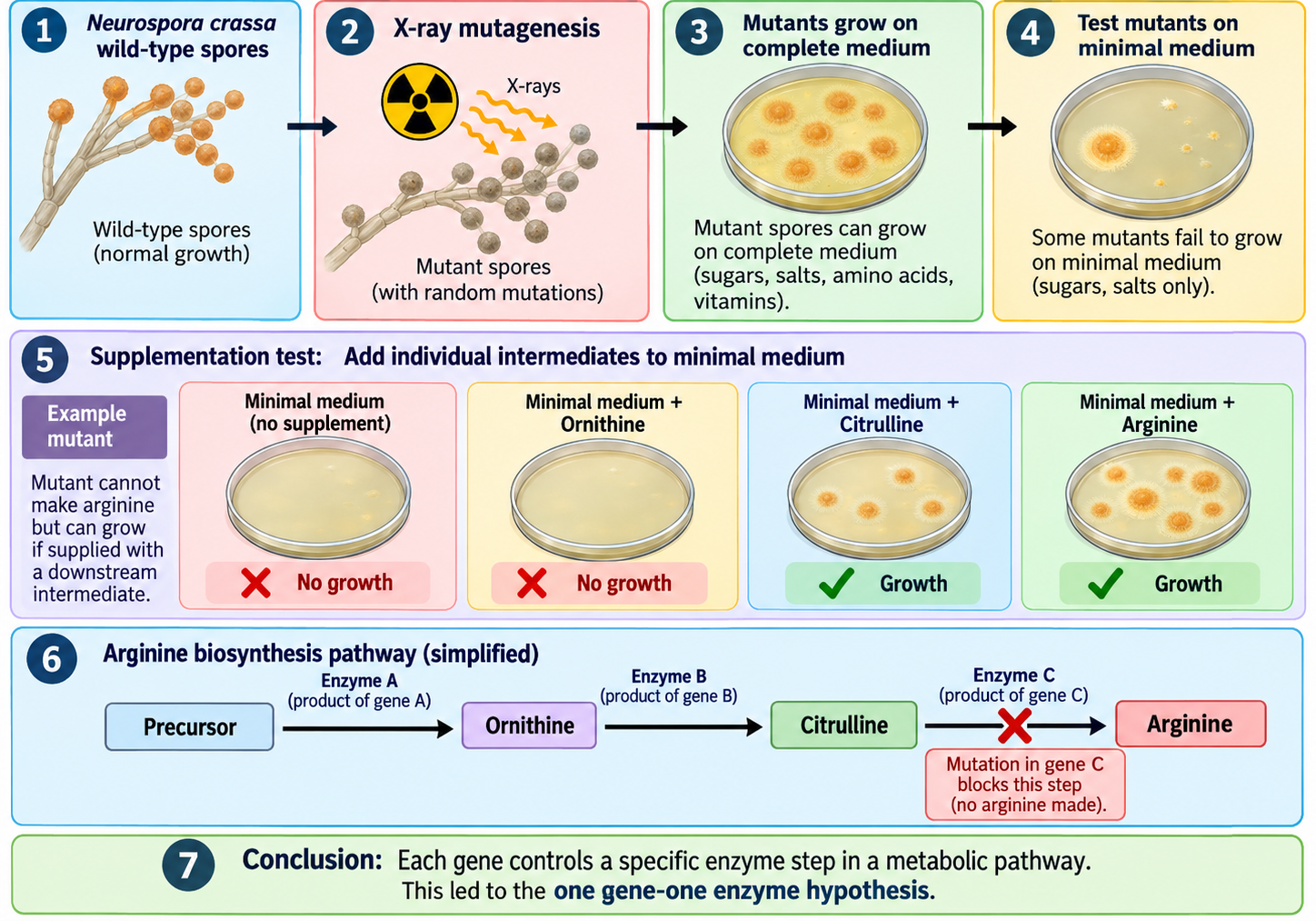
[C3] Apply Beadle and Tatum's approach to a mutant that grows on complete medium but not minimal medium.
A.Assume the mutant has no genetic defect.
B.Measure only chromosome number without testing nutrients.
C.Sequence the entire human genome first.
D.Test supplements individually to identify the missing biosynthetic requirement.
[C4] Analyse the sequence Mendel to Morgan to McClintock and Creighton and determine the major conceptual progression.
A.From DNA sequencing to genome editing and cloning.
B.From inheritance patterns to chromosome location of genes and physical evidence of recombination.
C.From protein structure to membrane transport.
D.From ecology to population dynamics.
[C4] Analyse the evidence from Chargaff and X-ray crystallography and determine why both were important for the DNA model.
A.Both directly measured gene expression in bacteria.
B.Both independently proved DNA was a protein.
C.Both demonstrated semiconservative replication.
D.Base-pair relationships constrained pairing, while X-ray data constrained overall molecular geometry.
[C4] Differentiate the main focus of the 1865-1920s era from the 1928-1950s era in the additional note.
A.Both eras focused mainly on genome editing.
B.The earlier era focused on PCR while the later era focused on cloning.
C.The earlier era focused on RNA interference while the later era focused on CRISPR.
D.The earlier era focused on transmission and chromosome location of heredity, while the later era focused on the molecular identity and structure of genetic material.
[C5] Evaluate which finding most strongly supports the conclusion that DNA, rather than a temporary cellular response, carries hereditary information in the Avery-MacLeod-McCarty experiment.
A.The cells were exposed to heat-killed bacteria.
B.The bacteria changed colour during culture.
C.The transformed virulence trait was passed to progeny.
D.The experiment used more than one bacterial strain.
[C5] Evaluate Levene's tetranucleotide hypothesis in light of later discoveries.
A.It correctly identified nucleotide components but incorrectly proposed a simple repeating sequence.
B.It correctly established semiconservative replication.
C.It was completely correct and directly predicted the double helix.
D.It showed that RNA was the only genetic material.
[C6] Select the best study design to test whether a newly observed heritable bacterial trait is carried by DNA.
A.Compare two unrelated species without transferring cellular material.
B.Treat the transforming material with DNA-degrading enzyme and compare transformation with untreated controls.
C.Observe bacterial shape only and avoid molecular treatment.
D.Measure growth temperature without testing heredity.
[C4] Analyse Diagram 2 and determine the conclusion supported when live avirulent bacteria become virulent after receiving material from heat-killed virulent cells.
A.Heat alone permanently created virulence in all bacteria.
B.The donor cells reproduced after being heat-killed.
C.The avirulent cells became virulent only because of nutrient depletion.
D.A heritable transforming factor was transferred from donor to recipient cells.
[C4] Analyse Diagram 3 and determine why a mutant rescued by one specific amino acid supports the one gene-one enzyme hypothesis.
A.The mutation proves every gene produces several unrelated enzymes.
B.The mutation likely disrupted an enzyme needed in the biosynthetic pathway for that amino acid.
C.The mutation must have increased chromosome number.
D.The amino acid directly repaired the DNA sequence.
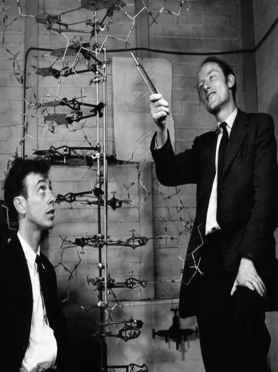
[C5] Evaluate Diagram 5 and select the combination of earlier evidence that most directly supported the proposed DNA double-helix model.
A.Mendel's pea ratios together with Hardy-Weinberg equilibrium.
B.Chargaff's base ratios together with X-ray crystallography data from Franklin and Wilkins.
C.Dolly cloning together with PCR amplification.
D.Beadle and Tatum's amino-acid mutants together with gene therapy.
[C3] A researcher observes that a fruit-fly trait is inherited together with a particular chromosome abnormality. Apply the historical evidence and identify the most relevant experimental tradition.
A.Levene's nucleotide chemistry.
B.Miescher's isolation of nuclein.
C.Morgan's chromosome theory work with Drosophila.
D.Sanger's genome sequencing.
[C4] A bacterial culture acquires a new trait after exposure to material from dead cells, and the trait is transmitted to daughter cells. Analyse the scenario and identify the most appropriate interpretation.
A.The cells completed translation without genetic change.
B.The cells only experienced reversible acclimatisation.
C.The cells have undergone heritable transformation.
D.The cells underwent crossing over during meiosis.
[C5] A scientist proposes that DNA contains the repeating sequence G-C-T-A throughout the molecule. Evaluate this proposal using the historical development in the notes.
A.It reflects Levene's tetranucleotide idea but is inconsistent with later evidence for variable DNA sequence and base pairing.
B.It exactly matches the Watson-Crick model.
C.It is equivalent to the one gene-one enzyme hypothesis.
D.It is the same as Chargaff's rule.
[C5] A student claims that Watson and Crick could have derived the DNA double helix without any prior experimental evidence. Evaluate this claim.
A.The claim is correct because no earlier evidence contributed to the model.
B.The claim is correct because Beadle and Tatum determined DNA bond angles.
C.The claim is weak because their model depended on earlier base-composition and X-ray diffraction evidence.
D.The claim is correct because Mendel directly photographed DNA.
[C6] Select the best sequence for designing a short teaching activity that demonstrates the historical development from inheritance to DNA structure.
A.Begin with Mendelian inheritance, connect genes to chromosomes, introduce DNA as hereditary material, then integrate Chargaff and X-ray evidence into the double-helix model.
B.Begin with the Human Genome Project and treat earlier findings as unrelated.
C.Begin with CRISPR, then omit genetics and end with Mendel.
D.Teach only DNA sequencing and exclude all inheritance studies.