[C1] Define hazard communication.
A.A systematic process for providing information and communicating hazards of chemicals and other hazardous substances in the workplace.
B.A process used only to purchase chemicals from approved suppliers.
C.A method used only to calculate chemical exposure limits.
D.A programme used only after a chemical accident has occurred.
[C1] Identify the primary purpose of hazard communication.
A.To restrict chemical information to managers only.
B.To replace all engineering controls with personal protective equipment.
C.To eliminate the need for chemical risk assessment.
D.To prevent or minimise workplace accidents, injuries, and illnesses related to hazardous substances.
[C1] Identify the organisation that developed the Globally Harmonized System of Classification and Labelling of Chemicals.
A.The International Monetary Fund.
B.The World Bank.
C.The World Trade Organization.
D.The United Nations.
[C1] State the number of standard sections contained in a Safety Data Sheet under the CLASS Regulations.
A.Eight sections.
B.Twenty sections.
C.Ten sections.
D.Sixteen sections.
[C1] Identify the Malaysian regulation that prescribes classification, packaging, labelling, Safety Data Sheets, and inventory requirements for hazardous chemicals supplied to workplaces.
A.Environmental Quality (Scheduled Wastes) Regulations 2005.
B.Factories and Machinery (Safety, Health and Welfare) Regulations 1970.
C.Occupational Safety and Health (Classification, Labelling and Safety Data Sheet of Hazardous Chemicals) Regulations 2013.
D.Occupational Safety and Health (Noise Exposure) Regulations 2019.
[C2] Explain why a chemical label and a Safety Data Sheet should be used together.
A.The label is used only by suppliers while the SDS is used only by government agencies.
B.The label provides immediate hazard warnings while the SDS provides more detailed hazard, control, emergency, and handling information.
C.The SDS is required only when a container has no product identifier.
D.The label replaces the need for an SDS when a chemical is hazardous.
[C2] Explain the role of the GHS in hazard communication.
A.It replaces the need for national chemical legislation.
B.It requires all hazardous chemicals to be eliminated from workplaces.
C.It sets one universal workplace exposure limit for every chemical.
D.It standardises chemical hazard classification and communication through common classes, categories, pictograms, signal words, hazard statements, and SDS requirements.
[C2] Distinguish a health hazard from a physical hazard.
A.A health hazard is always visible, while a physical hazard is always invisible.
B.A health hazard exists only during emergencies, while a physical hazard exists only during normal operations.
C.A health hazard can cause effects such as irritation or carcinogenicity, while a physical hazard includes properties such as flammability, corrosion, or reactivity.
D.A health hazard affects equipment, while a physical hazard affects workers only.
[C2] Explain why a written hazard communication programme is important in a workplace using hazardous chemicals.
A.It provides a structured system for labels, SDS access, training, and communication to potentially exposed employees.
B.It removes the need to classify chemicals before use.
C.It allows workers to handle chemicals without referring to labels or SDSs.
D.It transfers all responsibility for chemical safety to the chemical supplier.
[C2] Explain why the CLASS Regulations require Safety Data Sheets to be supplied in both the national language and English.
A.To replace the requirement for worker training.
B.To ensure that only managers can interpret the SDS.
C.To improve accessibility and understanding of hazard information among chemical recipients and users.
D.To allow the supplier to omit hazard pictograms from the label.
[C3] Apply the SDS structure to identify the section a worker should consult first for instructions on containing and cleaning a chemical spill.
A.Section 9, Physical and chemical properties.
B.Section 15, Regulatory information.
C.Section 2, Hazard identification.
D.Section 6, Accidental release measures.
[C3] Apply the SDS structure to identify the section a fire response team should consult for suitable extinguishing media and special precautions.
A.Section 5, Fire-fighting measures.
B.Section 10, Stability and reactivity.
C.Section 14, Transportation information.
D.Section 3, Composition and information of ingredients.
[C3] Apply the CLASS labelling requirements to a newly supplied hazardous chemical and select the complete set of essential label information.
A.Hazard pictogram and product colour only.
B.Product identifier, supplier identification, signal word, hazard statement, hazard pictogram, and precautionary statement.
C.Product identifier, purchase price, batch cost, transport company, and storage location.
D.Supplier identification, employee name, purchase order number, and expiry date only.
[C3] Apply the hazardous chemical inventory requirement to an importer supplying at least one metric tonne of a hazardous chemical in a calendar year.
A.Submit an inventory only after a chemical accident occurs.
B.Submit the inventory once every five years regardless of quantity.
C.Prepare an inventory only when the chemical has no SDS.
D.Prepare the inventory for that calendar year and submit it to the Director General by 31 March of the following year.
[C4] Analyse a hazardous chemical label that contains a product identifier, signal word, pictogram, hazard statement, and precautionary statement but does not identify the supplier.
A.The label is complete if the chemical is used only indoors.
B.The label is incomplete only if the container is larger than 125 litres.
C.The label is complete because the pictogram replaces supplier identification.
D.The label is incomplete because supplier identification is a required label element.
[C4] Analyse an SDS that has not been revised for more than five years and determine the appropriate action under the lecture notes.
A.Revise the SDS because more than five years have elapsed since the last preparation or revision.
B.Continue using it indefinitely if the product name has not changed.
C.Revise it only after an occupational illness has been reported.
D.Remove the SDS and rely only on the container label.
[C4] Analyse the labelling requirement for a hazardous chemical supplied in a container of 125 ml or less.
A.No label is required because the container is small.
B.Only the product identifier and price are required.
C.A simplified label may be used with the product identifier, supplier identification, signal word, applicable pictogram, and the instruction to read the SDS before use.
D.The full SDS must be printed directly on the container.
[C5] Evaluate a workplace where every hazardous chemical container is labelled but workers cannot access SDSs and have received no chemical safety training.
A.The programme is adequate because SDS access is required only for emergency responders.
B.The hazard communication programme is inadequate because labels alone do not provide the complete communication system required for workers.
C.The programme is adequate if workers have previous experience with similar chemicals.
D.The programme is adequate because a label is always sufficient for every chemical task.
[C5] Evaluate a label for a chemical classified in several hazard classes where one applicable non-duplicative hazard statement has been omitted.
A.The label requires no change if a pictogram is present.
B.The omitted statement should be replaced with the chemical purchase price.
C.The label should be corrected to include all applicable hazard statements unless there is evidence of duplication or redundancy.
D.The omitted statement is acceptable because only one hazard statement may appear on a label.
[C6] Design the most appropriate hazard communication programme for a new laboratory that will receive and use several hazardous chemicals.
A.Store the chemicals first and prepare labels only after workers report difficulty identifying hazards.
B.Provide PPE only and omit labels, SDSs, and training because PPE controls exposure.
C.Allow each worker to decide independently how chemical hazards should be communicated.
D.Establish a written programme that identifies chemicals, maintains compliant labels and current SDSs, provides worker training, and includes procedures for safe handling and emergency information.
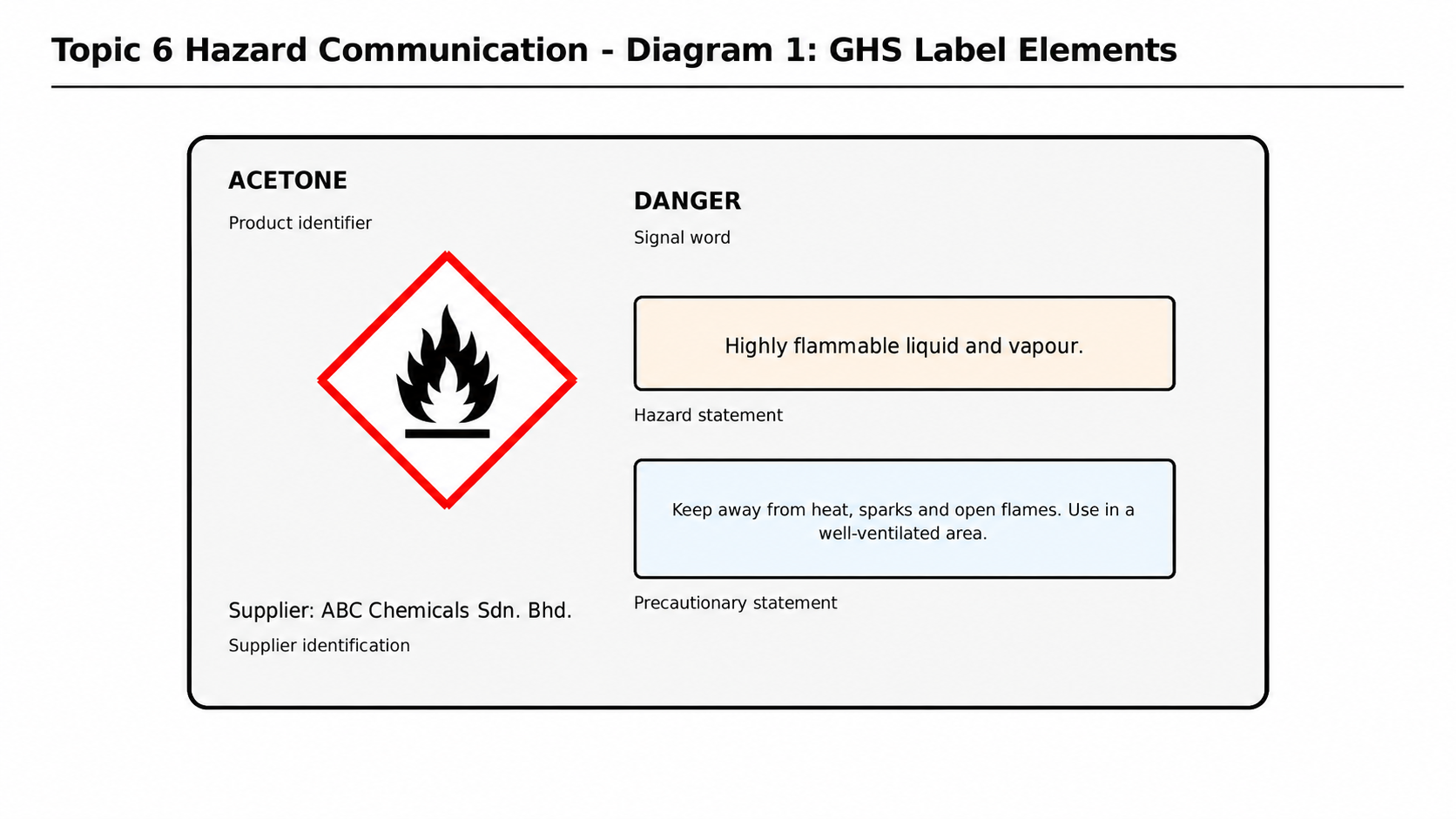
[C3] Apply the information in Topic 6 Hazard Communication - Diagram 1 and select the element that tells the worker the severity level associated with the chemical hazard.
A.The phrase Supplier identification.
B.The product identifier, ACETONE.
C.The signal word, DANGER.
D.The supplier company name.
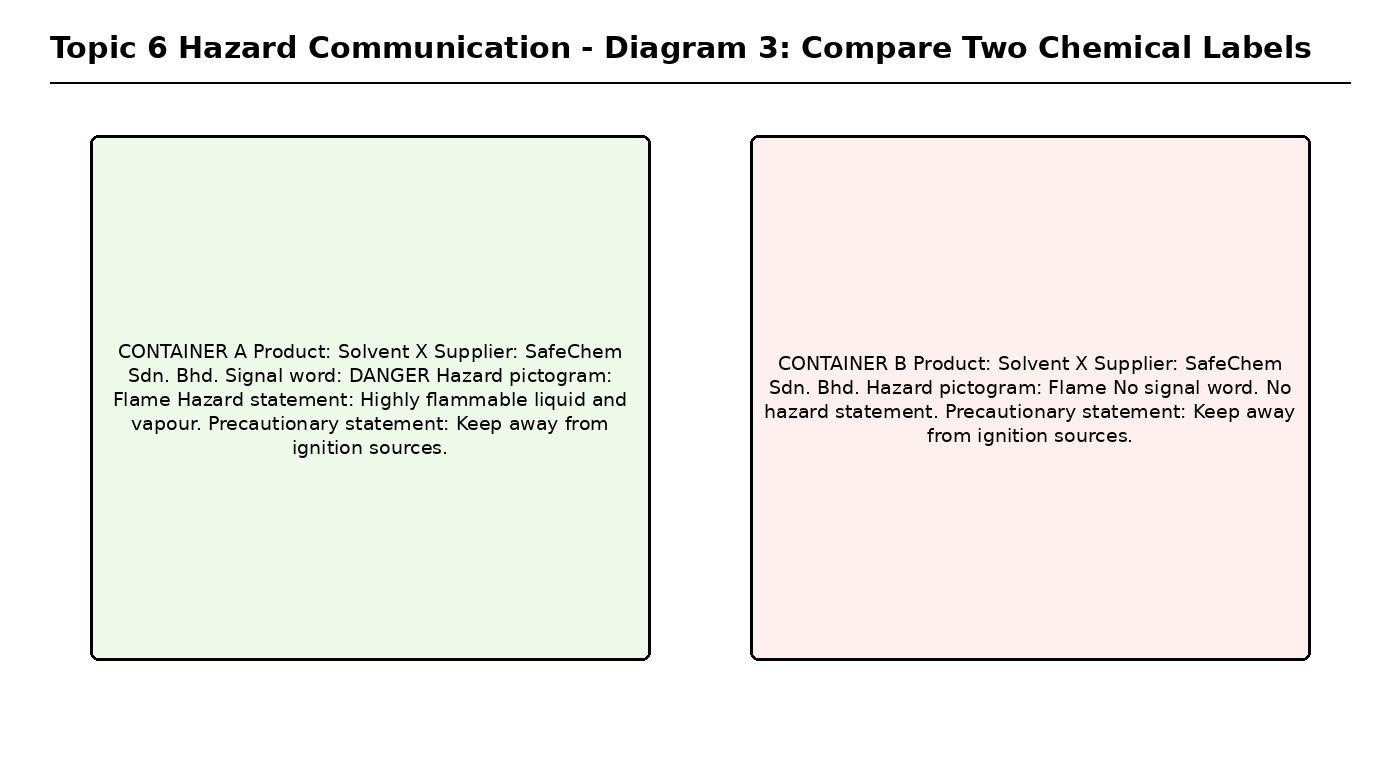
[C5] Evaluate the two labels in Topic 6 Hazard Communication - Diagram 3 and select the better compliance decision.
A.Reject Container A because hazard statements should never be shown on labels.
B.Accept Container B because precautionary statements replace all other label elements.
C.Accept both containers because the product identifier is the only essential element.
D.Accept Container A and correct Container B because Container B lacks a signal word and hazard statement.
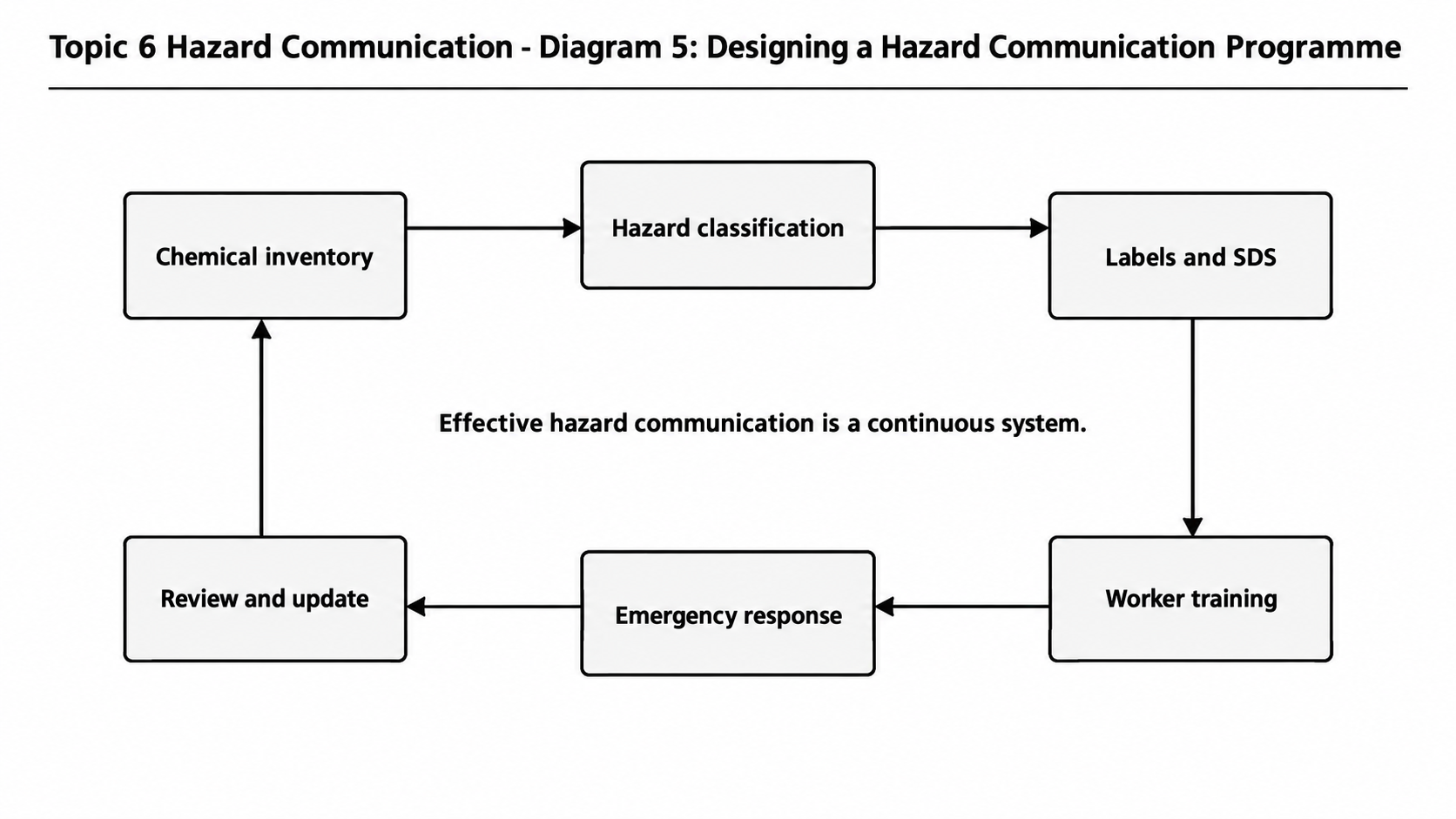
[C6] Design the strongest improvement to the system shown in Topic 6 Hazard Communication - Diagram 5.
A.Complete the chemical inventory once and discontinue all later reviews.
B.Provide training before labels and SDSs are available.
C.Use the six elements as a continuous cycle and trigger review and update whenever chemical information, classification, work processes, or emergency lessons change.
D.Use emergency response as the only element because it occurs after exposure.
[C5] Evaluate the GHS training example in the linked YouTube video and select the statement that best reflects the purpose of standardised pictograms, signal words, hazard statements, and SDSs.
A.They guarantee that every chemical presents the same level of risk.
B.They are used mainly to record the commercial price of chemicals.
C.They eliminate the need for workers to receive any training on chemical hazards.
D.They create a consistent system for communicating chemical hazards and protective measures to people who may handle or encounter the chemicals.
[C6] Design the most appropriate hazard communication improvement after reviewing the Valero refinery nitrogen asphyxiation case, where the investigation identified inadequate awareness of oxygen-deficient conditions outside a nitrogen-purged confined space.
A.Allow rescue attempts without atmospheric information because immediate action is always safer.
B.Training on the definition of nitrogen and omitting location-specific exposure scenarios.
C.Add warning signs, although experienced workers already know nitrogen hazards.
D.Add clear nitrogen and oxygen-deficiency warnings and barricades, revise procedures, and train workers and contractors on where hazardous atmospheres may extend beyond the confined space.
[C6] Design the most appropriate communication improvement after reviewing the DuPont La Porte methyl mercaptan release, where workers were exposed to a highly toxic chemical and the investigation identified major safety management deficiencies.
A.Rely on workers to recognise methyl mercaptan only by smell and informal experience.
B.Integrate detector alarms, written procedures, hazard information, emergency communication, and training so workers can recognise a toxic release and respond without entering an uncontrolled exposure area.
C.Use verbal instructions only and avoid written procedures during troubleshooting.
D.Keep detector information within management and avoid communicating it to operating personnel.
[C6] Design a hazard communication strategy for an ammonium nitrate storage facility using lessons from the West Fertilizer explosion.
A.Maintain accurate chemical hazard information and inventory, communicate the hazards to workers and emergency responders, and support pre-incident planning and hazardous-material training.
B.Treat ammonium nitrate as ordinary non-hazardous stock when preparing emergency information.
C.Exclude local emergency responders from chemical hazard communication because they are not employees.
D.Provide chemical information only after an emergency has already escalated.