[C1] Identify the modern emphasis of occupational safety and health management.
A.Preventing incidents through hazard identification, risk assessment, and proactive controls.
B.Responding only after serious accidents.
C.Separating safety from operational decisions.
D.Relying entirely on external enforcement.
[C1] Recall the four stages of the PDCA cycle.
A.Prepare, Decide, Control, Approve.
B.Prevent, Detect, Correct, Audit.
C.Plan, Do, Check, Act.
D.Plan, Develop, Comply, Assess.
[C1] Identify the management standard associated with occupational health and safety.
A.ISO 14001.
B.NADOPOD.
C.ISO 9001.
D.ISO 45001.
[C1] Define safety culture.
A.A schedule of equipment maintenance only.
B.A list of penalties imposed after accidents.
C.Collective attitudes, values, beliefs, and behaviours related to safety.
D.A set of environmental emission limits.
[C2] Explain the principle of self-regulation in OSH management.
A.Government inspectors manage every workplace hazard directly.
B.Employers and employees actively manage workplace risks rather than relying entirely on external enforcement.
C.Organisations act only after regulators issue penalties.
D.Employees transfer all safety responsibility to management.
[C2] Distinguish the Check stage from the Act stage of PDCA.
A.Check provides PPE, while Act identifies initial hazards.
B.Check establishes objectives, while Act conducts the first risk assessment.
C.Check and Act both refer only to employee training.
D.Check evaluates performance, while Act implements improvements based on the evaluation.
[C2] Explain the advantage of integrating safety, health, and environment management.
A.It prevents organisations from using quality management systems.
B.It assigns all environmental issues to employees.
C.It removes the need for regulatory compliance.
D.It improves coordination and reduces duplication across related management activities.
[C2] Describe the role of leadership in a positive safety culture.
A.Focus on production pressures regardless of safety.
B.Set priorities, allocate resources, and visibly support safe practices.
C.Limit communication about incidents and near misses.
D.Delegate all safety decisions to workers without resources.
[C3] Apply the Plan stage of PDCA to a new chemical process.
A.Conduct only a final audit after production begins.
B.Replace all monitoring with employee discipline.
C.Wait for an incident and then revise the policy.
D.Identify hazards, assess risks, and establish safety objectives before implementation.
[C3] Select an action that belongs to the Do stage of PDCA.
A.Compare annual performance against targets only.
B.Train employees and implement safe work procedures.
C.Establish initial safety objectives.
D.Analyse audit findings to revise policy.
[C3] Apply employee responsibilities when a worker observes a damaged machine guard.
A.Remove required PPE to inspect the machine more closely.
B.Continue working until management notices the damage.
C.Report the unsafe condition and follow established safety procedures.
D.Ignore the issue because risk assessment is only an employer duty.
[C3] Choose the most appropriate continuous-improvement action after several near misses.
A.Stop collecting incident information once no injury occurs.
B.Review the incidents, obtain worker feedback, and revise controls where needed.
C.Retain existing controls without evaluation.
D.Reduce training because the events caused no injury.
[C4] Analyse why a reactive safety system is weaker than a preventive system.
A.It always uses more engineering controls than preventive systems.
B.It waits for harm before acting instead of identifying and controlling hazards in advance.
C.It requires stronger employee participation before incidents.
D.It eliminates the need for incident investigation.
[C4] Differentiate ISO 45001, ISO 14001, and ISO 9001 within an integrated management framework.
A.They apply only to government enforcement activities.
B.They all regulate only occupational disease reporting.
C.They address occupational health and safety, environmental management, and quality management respectively.
D.They are three names for the same safety standard.
[C4] Analyse a site with frequent PPE violations, weak supervision, and poor communication.
A.The site should focus exclusively on environmental certification.
B.The problem can be solved only by replacing all workers.
C.The pattern indicates weaknesses in implementation and safety culture that require coordinated management action.
D.The pattern proves hazard identification is unnecessary.
[C4] Compare employer and employee responsibilities in OSH management.
A.Both groups have identical managerial authority.
B.Employers provide safe systems and resources, while employees follow procedures, use PPE, report hazards, and cooperate.
C.Employers only report hazards, while employees establish all safety policies.
D.Employees alone conduct risk assessments and provide training.
[C5] Evaluate the best response when an audit shows safety objectives are not being achieved.
A.Continue unchanged until a serious accident occurs.
B.Stop inspections because the audit has already been completed.
C.Use the findings to implement corrective actions and revise controls through the Act stage.
D.Remove the objectives so performance cannot be measured.
[C5] Assess a management proposal to improve safety only by issuing more rules without changing systems.
A.Accept because individual rules are sufficient for systematic management.
B.Reject the proposal because effective OSH management requires integrated policies, responsibilities, controls, monitoring, and improvement.
C.Reject only because ISO 14001 prohibits safety rules.
D.Accept because leadership resources are unrelated to safety performance.
[C5] Evaluate the strongest strategy for sustaining safety performance in a rapidly changing workplace.
A.Remove employee consultation to simplify decision-making.
B.Rely solely on annual enforcement visits.
C.Freeze procedures permanently once initial targets are met.
D.Use regular inspections, audits, incident learning, feedback, and ongoing training to adapt the system.
[C5] Judge the most effective leadership response to production pressure that conflicts with safe work procedures.
A.Stop communicating safety expectations during high-production periods.
B.Maintain safety priorities, provide resources, and address the operational conflict without bypassing controls.
C.Leave the decision entirely to individual workers.
D.Instruct workers to ignore procedures until output targets are met.
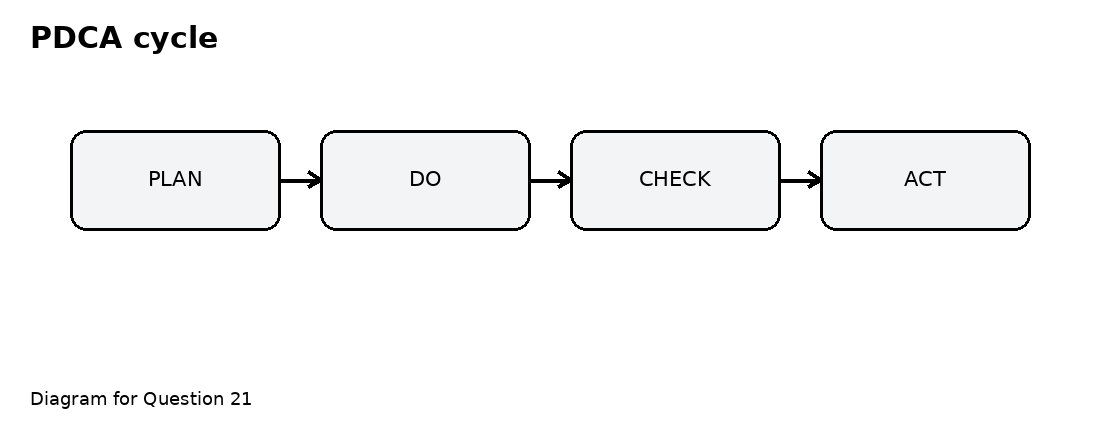
[C2] Interpret Diagram 1 and identify the PDCA stage represented by workplace inspections, audits, incident investigations, and performance reviews.
A.Do.
B.Check.
C.Plan.
D.Act.
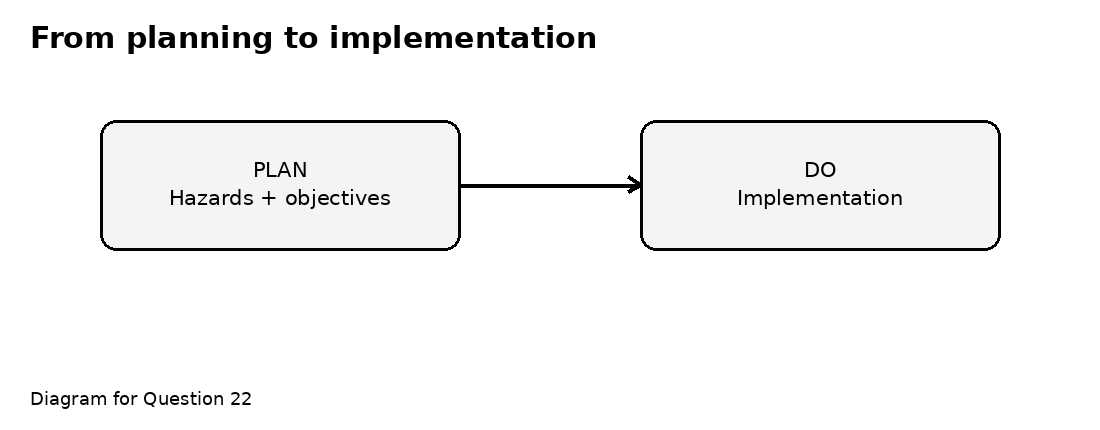
[C3] Apply Diagram 2 and select the action that best represents the Do stage.
A.Review audit findings and performance indicators.
B.Revise the policy after evaluation identifies deficiencies.
C.Set safety objectives and conduct initial risk assessment.
D.Provide training and implement safe work procedures.
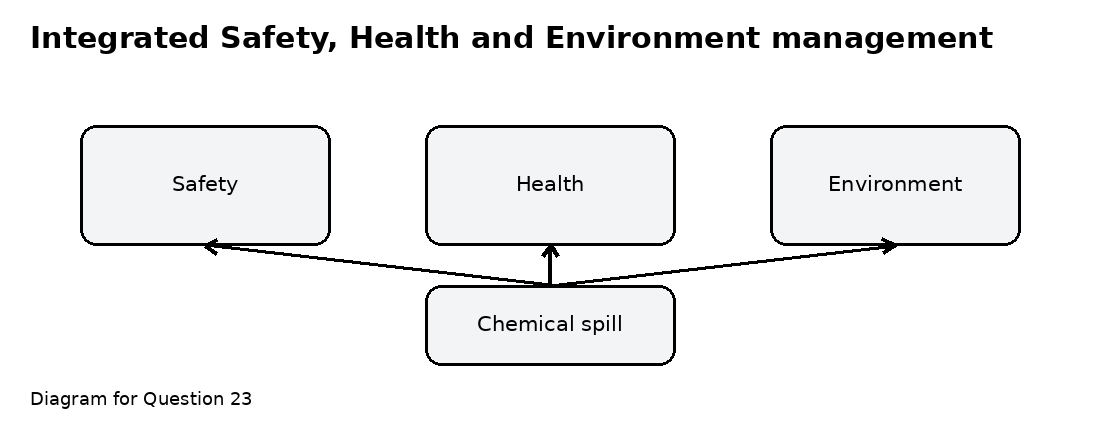
[C3] Apply the integrated SHE model in Diagram 3 to a chemical spill and identify the most appropriate management response.
A.Address environmental contamination only because spills are environmental events.
B.Control worker exposure and environmental contamination within an integrated response.
C.Use separate systems that prevent coordination between safety and environmental functions.
D.Address worker exposure only because environmental effects are outside SHE management.
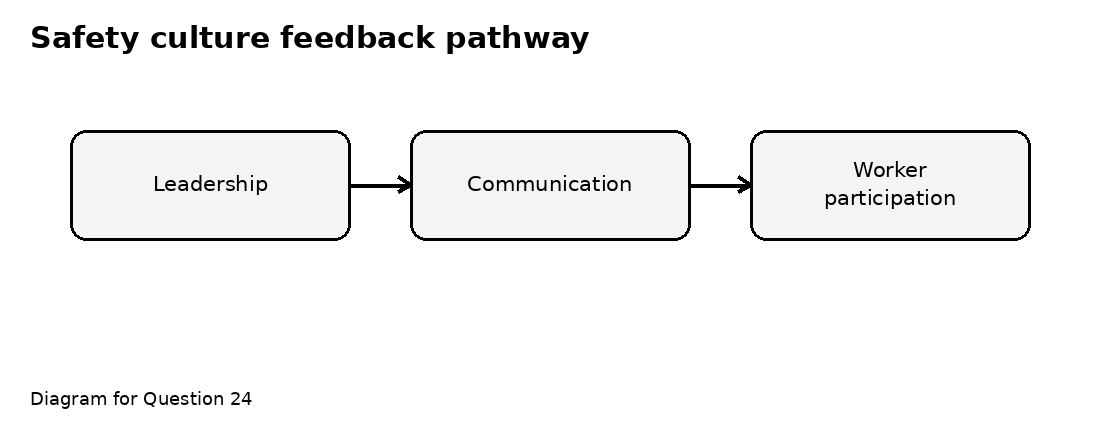
[C4] Analyse Diagram 4 and identify the organisational weakness most likely to undermine safety culture.
A.Regular safety meetings with employee participation.
B.Continuous learning from incidents and near misses.
C.Weak communication between supervisors and workers.
D.Visible leadership commitment to safety.
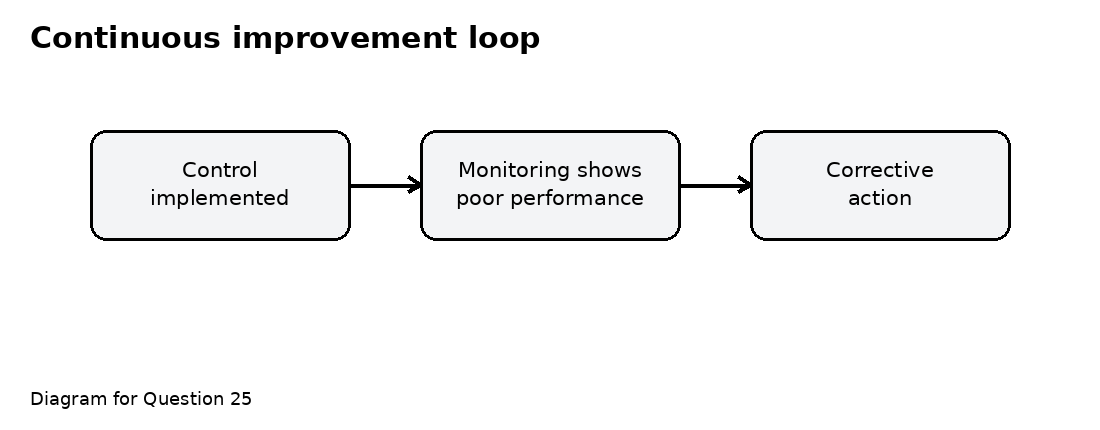
[C5] Evaluate Diagram 5 and select the best action after monitoring shows that an existing control is ineffective.
A.Revise the control and implement corrective action through the Act stage.
B.Return to production without reviewing the safety objective.
C.Stop monitoring because the Check stage has been completed.
D.Keep the existing control because it has already been implemented.