
HGE PART 1

Question 1
A pressure gage at elevatiom 6m at the side of a tank containing a liquid reads 80kPa. Another gage at elevation 4m reads 100kPa. What is the specifiv gravity of the liquid?
a. 1.02
b. 1.21
c. 1.04
d. 1.42
Question 2
A block of wood floats in water with 20cm projecting above the water surface. If placed in oil (SG = 0.80), it will float with 15cm projecting above the oil surface. What is the height of the block?
a. 35cm
b. 50cm
c. 40cm
d. 45cm
Question 3
A vertical triangular gate with top base horizontal is 1.5m wide and 3m high. It is submerged in oil in (SG = 0.82) with its top base submerged to a depth of 2m. Determine the magnitude of the total hydrostatic force acting on one side of the gate.
a. 66.2kN
b. 54.3kN
c. 44.5kN
d. 69.5kN
Question 4
A vertical triangular gate with top base horizontal is 1.5m wide and 3m high. It is submerged in oil in (SG = 0.82) with its top base submerged to a depth of 2m. Determine location of the total hydrostatic force acting on one side of the gate.
a. 3.167m
b. 2.500m
c. 4.250m
d. 2.667m
Question 5
An open cylindrical tank 2m in diameter and 4m high contains water to a depth of 3m. It is rotated about its own vertical axis with a constant speed ω. Note: Volume of parabola = (π/4)D^2H; D= diameter, H= height of paraboloid. What maximum value of ω (in rpm) can be imposed without spilling any liquid?
a. 65.42rpm
b. 59.78 rpm
c. 54.56 rpm
d. 61.28 rpm
Question 6
An open cylindrical tank 2m in diameter and 4m high contains water to a depth of 3m. It is rotated about its own vertical axis with a constant speed ω. Note: Volume of parabola = (π/4)D^2H; D= diameter, H= height of paraboloid. If ω = 8 rad/s, how much water is spilled out (in cubic meter)?
a. 1.577
b. 1.853
c. 1.627
d. 1.979
Question 7
An open cylindrical tank 2m in diameter and 4m high contains water to a depth of 3m. It is rotated about its own vertical axis with a constant speed ω. Note: Volume of parabola = (π/4)D^2H; D= diameter, H= height of paraboloid. If ω = 8 rad/s, to what depth will the water stand when brought to rest?
a. 0.630m
b. 0.724m
c. 0.750m
d. 0.667m
Question 8
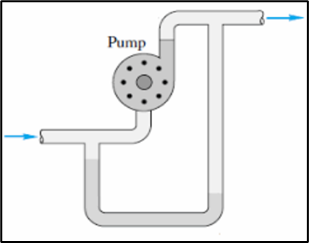
Kerosene (SG = 0.82) flows through the pump shown in Figure 1 at 0.07m^3/s. Head losses between 1 and 2 are 0.7m, and the pump delivers 8hp to the flow. Hint: 1 hp = 746W. What is the head delivered by the pump?
a. 11.65m
b. 14.21m
c. 10.60m
d. 8.69m
Question 9
Kerosene (SG = 0.82) flows through the pump shown in Figure 1 at 0.07m^3/s. Head losses between 1 and 2 are 0.7m, and the pump delivers 8hp to the flow. Hint: 1 hp = 746W. What should be the mercury manometer reading h be?
a. 1.10m
b.1.04m
c. 0.84m
d. 0.87m
Question 10
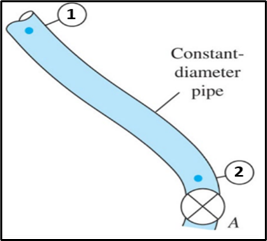
The long pipe shown in Figure 2 is filled with water. When valve A is closed, the pressure difference between points 1 and 2 is 75 kPa. When the valve is open and water flows at 250m^3.h, the differencerises up to 160 kPa. Find the frictional head loss between points 1 and 2.
a. 7.65m
b. 1.01m
c. 16.31m
d. 8.66m
Question 11
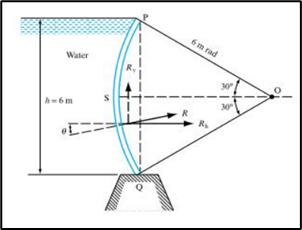
A sluice gate is in the form of a circular arc of radius 6m as shown in Figure 3. Determine the horizontal component of the force on the gate per unit length.
a. 179.46kN/m
b. 32.00kN/m
c. 102.4kN/m
d. 176.58kN/m
Question 12
A sluice gate is in the form of a circular arc of radius 6m as shown in Figure 3. Determine the vertical component of the force on the gate per unit length.
a. 179.46kN/m
b. 32.00kN/m
c. 102.4kN/m
d. 176.58kN/m
Question 13
A sluice gate is in the form of a circular arc of radius 6m as shown in Figure 3. Determine the resultant of the gate.
a. 179.46kN/m
b. 32.00kN/m
c. 102.4kN/m
d. 176.58kN/m
Question 14
A sluice gate is in the form of a circular arc of radius 6m as shown in Figure 3. Determine the inclination of the resultant with respect to the horizontal.
a. 10.27°
b. 32.00°
c. 14.15°
d. 24.76°
Question 15
A sluice gate is in the form of a circular arc of radius 6m as shown in Figure 3. The line of action of the resultant passes through.
a. Point P
b. Point Q
c. Point S
d. Point O
Question 16
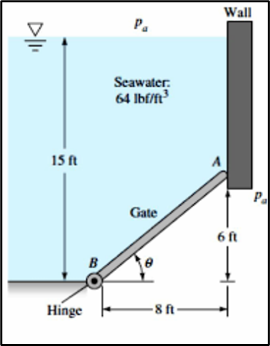
The gate in Figure 4 is 5ft wide, is hinged at point B, and rests against a smooth wall at point A. Determine the force on the gate due to seawater pressure
a. 6,300lbf
b. 29,300lbf
c. 38,400lbf
d. 30,700lbf
Question 17
The gate in Figure 4 is 5ft wide, is hinged at point B, and rests against a smooth wall at point A. Determine the distance between the center of gravity and center of pressure.
a. 0.417ft
b. 0.947ft
c. 0.612ft
d. 0.462ft
Question 18
The gate in Figure 4 is 5ft wide, is hinged at point B, and rests against a smooth wall at point A. Determine the horizontal force P exerted by the wall at point A.
a. 6,300lbf
b. 29,300lbf
c. 38,400lbf
d. 30,700lbf
Question 19
The gate in Figure 4 is 5ft wide, is hinged at point B, and rests against a smooth wall at point A. Determine the horizontal force P exerted by the wall at point A.
a. 6,300lbf
b. 29,300lbf
c. 38,400lbf
d. 30,700lbf
Question 20
The gate in Figure 4 is 5ft wide, is hinged at point B, and rests against a smooth wall at point A. Determine the horizontal reaction at hinge B.
a. 6,300lbf
b. 29,300lbf
c. 38,400lbf
d. 30,700lbf
Question 21
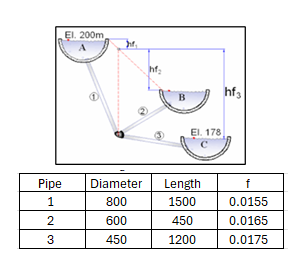
The three reservoirs A, B, and C, shown in Figure 5, are connected by pipelines A, B, and C, respectively. The elevation of reservoir A is 200m while that of C is 178. The discharge flowing towards reservoir B is 0.75m^3/s. Reservoir B is higher than that of C. What is the rate of flow out of reservoir A in m^3/s?
a. 0.91
b. 0.86
c. 0.98
d. 1.14
Question 22
The three reservoirs A, B, and C, shown in Figure 5, are connected by pipelines A, B, and C, respectively. The elevation of reservoir A is 200m while that of C is 178. The discharge flowing towards reservoir B is 0.75m^3/s. Reservoir B is higher than that of C. What is the rate of flow towards reservoir C in m^3/s?
a. 0.23
b. 0.16
c. 0.39
d. 0.11
Question 23
The three reservoirs A, B, and C, shown in Figure 5, are connected by pipelines A, B, and C, respectively. The elevation of reservoir A is 200m while that of C is 178. The discharge flowing towards reservoir B is 0.75m^3/s. Reservoir B is higher than that of C. What is the elevation of reservoir B in meters?
a. 191
b. 195
c. 188
d. 181
Question 24
A discharge of 1.2m^3/s flows on an open channel with a slope of 0.0062 and a coefficienr of roughness of 0.012. What is the depth of the channel for a most-efficient semi-circular section in meters?
a. 0.531
b. 0.463
c. 0.862
d. 0.764
Question 25
A discharge of 1.2m^3/s flows on an open channel with a slope of 0.0062 and a coefficienr of roughness of 0.012. What is the depth of the channel for a most-efficient rectangular section in meters?
a. 0.326
b. 0.485
c. 0.594
d. 0.717
Question 26
A discharge of 1.2m^3/s flows on an open channel with a slope of 0.0062 and a coefficienr of roughness of 0.012. 26. What is the depth of the channel for a most-efficient triangular section in meters?
a. 0.473
b. 0.556
c. 0.332
d. 0.686
Question 27
After a heavy downpour the depth of water over a weir was 2.5m. The total volume of discharge through the weir was 1.15x10^6m^3. How long (in minutes) will the flow over the weir last if a Cipoletti weir with a length of 235m is used?
a. 19.486
b. 22.198
c. 27.272
d. 26.394
Question 28
After a heavy downpour the depth of water over a weir was 2.5m. The total volume of discharge through the weir was 1.15x10^6m^3. How long (in minutes) will the flow over the weir last if a contracted weir is used with a length of 235m is used?
a. 26.192
b. 27.868
c. 22.475
d. 19.260
Question 29
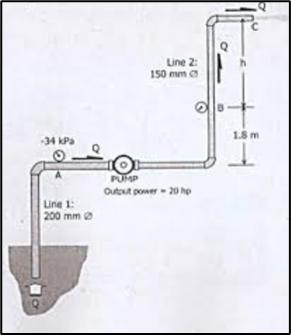
A 20-horsepower suction pump operating at 70% efficiency draws water from a suction line whose diameter is 200 mm and discharges into air through a line whose diameter is 150 mm as shown in Figure 6. The velocity in the 150 mm line is 3.6 m/s. The pressure at point A in the suction pipe is −34 kPa (the pressure is below the atmospheric pressure) and is 1.8 m below B. The head losses from A to B is 3 m and from B to C is 3 m. (1 hp = 0.746 kW or kN·m/s). What is the energy added by the pump in meters?
a. 19.784
b. 20.438
c. 23.246
d. 16.735
Question 30
A 20-horsepower suction pump operating at 70% efficiency draws water from a suction line whose diameter is 200 mm and discharges into air through a line whose diameter is 150 mm as shown in Figure 6. The velocity in the 150 mm line is 3.6 m/s. The pressure at point A in the suction pipe is −34 kPa (the pressure is below the atmospheric pressure) and is 1.8 m below B. The head losses from A to B is 3 m and from B to C is 3 m. (1 hp = 0.746 kW or kN·m/s). What is the pressure at point B in kPa?
a. 64.227
b. 78.653
c. 57.435
d. 84.878
Question 31
Consider an open chanel with a rectangular cross section. The channel has a width of 4m, slope of 0.005, and roughness coefficient of 0.030m^(-1/3)s. If the depth of flow is 2m, what is the hydraulic radius of the channel?
a. 1m
b. 2m
c. 4m
d. 8m
Question 32
Consider an open chanel with a rectangular cross section. The channel has a width of 4m, slope of 0.005, and roughness coefficient of 0.030m^(-1/3)s. What is the corresponding discharge in the channel?
a. 2.26m^3/s
b. 18.86m^3/s
c. 29.93m^3/s
d. 75.42m^3/s
Question 33
Consider an open chanel with a rectangular cross section. The channel has a width of 4m, slope of 0.005, and roughness coefficient of 0.030m^(-1/3)s. What is the critical depth of the channel?
a. 1.31m
b.1.79m
c. 2.00m
d. 4.00m
Question 34
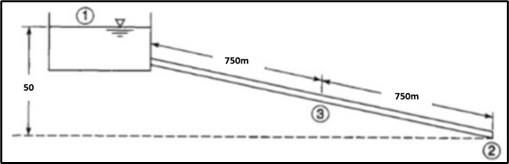
A steel pipe 1500 m long placed on a uniform slope has a 0.5-m diameter and 5-cm wall thickness as shown in Figure 7. The pipe carries water from a reservoir and discharges it into the air at an elevation 50 m below the reservoir free surface. A valve installed at the downstream end of the pipe allows a flow rate of 0.8 m³/s. The valve is completely closed in 2.4 seconds. Note: Neglect longitudinal stresses. Use E(water) = 2.17x10^9 N/m^2 and E(p) = 1.9x 10^11 N/m^2. Use a Darcy friction factor 0.0129. Which of the following gives the wave speed of the fluid?
a. 1,250m/s
b. 1,396m/s
c. 1.473m/s
d. 1,777m/s
Question 35
A steel pipe 1500 m long placed on a uniform slope has a 0.5-m diameter and 5-cm wall thickness as shown in Figure 7. The pipe carries water from a reservoir and discharges it into the air at an elevation 50 m below the reservoir free surface. A valve installed at the downstream end of the pipe allows a flow rate of 0.8 m³/s. The valve is completely closed in 2.4 seconds. Note: Neglect longitudinal stresses. Use E(water) = 2.17x10^9 N/m^2 and E(p) = 1.9x 10^11 N/m^2. Use a Darcy friction factor 0.0129. What is the increase in pressure caused by the water hammer?
a. 1,600kPa
b. 5,093kPa
c. 5,690kPa
d. 7,239kPa
Question 36
A steel pipe 1500 m long placed on a uniform slope has a 0.5-m diameter and 5-cm wall thickness as shown in Figure 7. The pipe carries water from a reservoir and discharges it into the air at an elevation 50 m below the reservoir free surface. A valve installed at the downstream end of the pipe allows a flow rate of 0.8 m³/s. The valve is completely closed in 2.4 seconds. Note: Neglect longitudinal stresses. Use E(water) = 2.17x10^9 N/m^2 and E(p) = 1.9x 10^11 N/m^2. Use a Darcy friction factor 0.0129. What is the total pressure at the valve?
a. 5,169kPa
b. 5,253kPa
c. 5,690kPa
d. 5,850kPa
Question 37
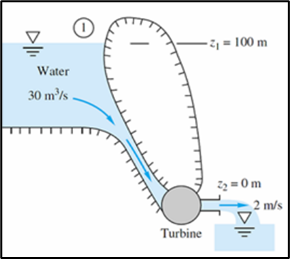
. A hydroelectric power plant shown in Figure 8 takes in 30m^3/s of water through its turbine and discharges it to the atmosphere at V2= 2m/s. The total head lost in the system is 20m. What is the energy head produced in the turbine in meters?
a. 57.84
b. 79.80
c. 93.43
d. 68.12
Question 38
. A hydroelectric power plant shown in Figure 8 takes in 30m^3/s of water through its turbine and discharges it to the atmosphere at V2= 2m/s. The total head lost in the system is 20m. What is the power generated by the turbine in MW?
a. 26.29
b. 29.05
c. 30.35
d. 23.49
Question 39
A tank filled with water has an orifice placed 5.50m below the water surface. The tank is placed in the platform where the orifice is located 1.50m from the ground. The coefficient of discharge is equal to 0.62, the coefficient of contraction is equal to 0.65 and the diameter of the origice is 45mm. What is the velocity of flow in the orifice on m/s?
a. 5.965
b. 9.909
c. 8.024
d. 7.889
Question 40
A tank filled with water has an orifice placed 5.50m below the water surface. The tank is placed in the platform where the orifice is located 1.50m from the ground. The coefficient of discharge is equal to 0.62, the coefficient of contraction is equal to 0.65 and the diameter of the origice is 45mm.What is the horizontal distance from the orifice that the water jet will strike the ground?
a. 5.48m
b. 7.08m
c. 6.12m
d. 9.59m
Question 41
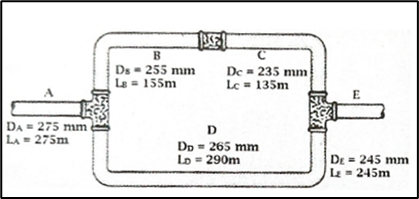
The pipe connection shown in Figure 9 is a series-parallel connection. The rate of flow in pipeline E is 310 L/s. Consider f = 0.0115 for all pipes and use Darcy-Weisbach equation for the head loss due to friction. What is the discharge in pipeline B in m^3/s?
a. 0.139
b. 0.302
c. 0.170
d. 0.263
Question 42
The pipe connection shown in Figure 9 is a series-parallel connection. The rate of flow in pipeline E is 310 L/s. Consider f = 0.0115 for all pipes and use Darcy-Weisbach equation for the head loss due to friction. What is the discharge in pipeline C in m^3/s?
a. 0.170
b. 0.263
c. 0.139
d. 0.302
Question 43
The pipe connection shown in Figure 9 is a series-parallel connection. The rate of flow in pipeline E is 310 L/s. Consider f = 0.0115 for all pipes and use Darcy-Weisbach equation for the head loss due to friction. What is the discharge in pipeline D in m^3/s?
a. 0.263
b. 0.139
c. 0.302
d. 0.170
Question 44
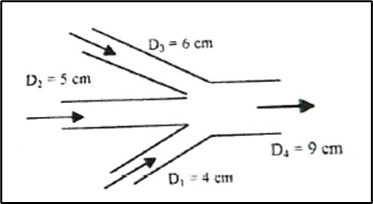
Three pipes with their corresponding diameters shown in Figure 10 steadily deliver water to a large exit pipe. The velocity V2, at the pipe with diameter D2 is 3.5m/s, and the exit flow rate Q4 = 100 m^2/hr in the pipe with diameter D4. What is the velocity of water in the pipe with diamerer D3 (in m/s) if it is known that Q3 is only half of Q4?
a. 3.847
b. 6.335
c. 5.895
d. 4.912
Question 45
Three pipes with their corresponding diameters shown in Figure 10 steadily deliver water to a large exit pipe. The velocity V2, at the pipe with diameter D2 is 3.5m/s, and the exit flow rate Q4 = 100 m^2/hr in the pipe with diameter D4. What is the velocity of water in the pipe with a diameter of D1 in m/s?
a. 2.925
b. 3.829
c. 5.584
d. 4.450
Question 46
A fluid has a mass of 500kg is placed in a container with a volume of 0.325m^3. What is the density of the fluid in kg/m^3?
a. 1408.45
b. 1538.46
c. 1420.45
d. 1587.30
Question 47
A fluid has a mass of 500kg is placed in a container with a volume of 0.325m^3. What is the unit weight of the fluid in kN/m^3?
a. 15.57
b. 13.83
c. 15.09
d. 13.93
Question 48
A tank contains oil (SG = 0.80), gasoline (SG = 0.90), and seawater (SG = 1.03). The depths of the fluids are 0.5m, 0.8m, and 1m for oil, gasoline, and seawater, respectively. What is the pressure at a depth of 1.2m in kPa?
a. 8.339
b. 9.418
c. 10.104
d. 13. 93
Question 49
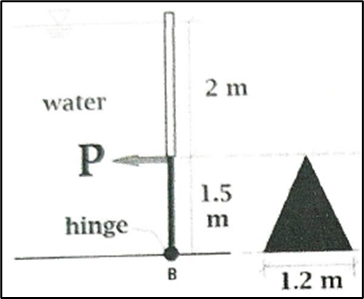
The triangular gate shown in figure 11 is hinged at B. Use γw = 9.79 kN/m^3. What is the magnitude of the hydrostatic force acting on the gate in kN?
a. 31.588
b. 26.433
c. 34.439
d. 42.621
Question 50
The triangular gate shown in figure 11 is hinged at B. Use γw = 9.79 kN/m^3. What is the magnitude of the force P required to hold the gate in kN?
a. 9.314
b. 12.453
c. 8.071
d. 11.125
Question 51
A reservoir of glycerin has a mass of 1200kg and a volume of 0.952m^3.What is the density on glycerin in kg/m^3?
a. 1408.45
b. 1260.50
c. 1420.45
d. 1387.30
Question 52
A reservoir of glycerin has a mass of 1200kg and a volume of 0.952m^3.What is the unit weight of glycerin in kN/m^3?
a. 14.186
b. 12.366
c. 16.379
d. 15.461
Question 53
A reservoir of glycerin has a mass of 1200kg and a volume of 0.952m^3.What is the scpecific gravity of glycerin?
a. 1.576
b. 1.446
c. 1.670
d. 1.261
Question 54
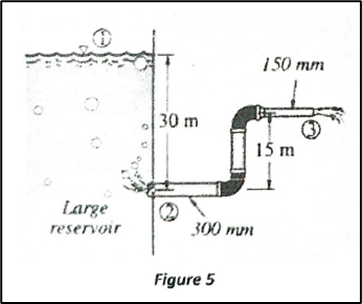
Water flows at a rate of 140L/s through the system shown in Figure 12. What is the velocity at point 2 in m/s?
a. 2.23
b. 2.05
c. 1.98
d. 1.67
Question 55
Water flows at a rate of 140L/s through the system shown in Figure 12. What is the pressure head at point 2 in meters?
a. 26.7
b. 24.2
c. 22.5
d. 29.8
Question 56
Water flows at a rate of 140L/s through the system shown in Figure 12. What is the head loss between points 2 and 3 in meters?
a. 15.7
b. 18.6
c. 13.9
d. 11.8
Question 57
The moist soil sample has the following properties: Volume = 1.2 m³, Mass = 2350 kg, moisture content = 8.6%, and Gs = 2.71. What is the void ratio?
a. 0.588
b. 0.653
c. 0.503
d. 1.67
Question 58
The moist soil sample has the following properties: Volume = 1.2 m³, Mass = 2350 kg, moisture content = 8.6%, and Gs = 2.71. What is the dry unit weight of the soil in kN/m³?
a. 16.083
b. 17.688
c. 15.910
d. 16.741
Question 59
The moist soil sample has the following properties: Volume = 1.2 m³, Mass = 2350 kg, moisture content = 8.6%, and Gs = 2.71. What is the degree of saturation of the soil?
a. 34.733 %
b. 39.636 %
c. 35.691 %
d. 46.334 %
Question 60
Figure 13 shows a layer of sandy soil in a tank with an upward seepage by applying water through the valve at the bottom of the tank. The sand has a void ratio of 0.52 and the specific gravity of solids is 2.67.What is the saturated unit weight of the sand in kN/m³?
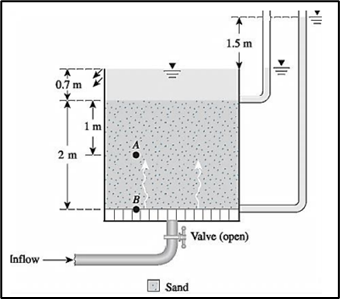
a. 22.317
b. 20.588
c. 18.674
d. 16.785
Question 61
Figure 13 shows a layer of sandy soil in a tank with an upward seepage by applying water through the valve at the bottom of the tank. The sand has a void ratio of 0.52 and the specific gravity of solids is 2.67.What is the effective stress (in kPa) at point A?
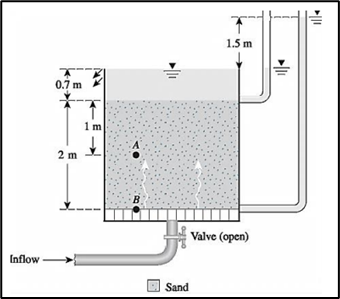
a. 5.427
b. 3.421
c. 4.576
d. 6.532
Question 62
Figure 13 shows a layer of sandy soil in a tank with an upward seepage by applying water through the valve at the bottom of the tank. The sand has a void ratio of 0.52 and the specific gravity of solids is 2.67.What is the effective stress (in kPa) at point B?
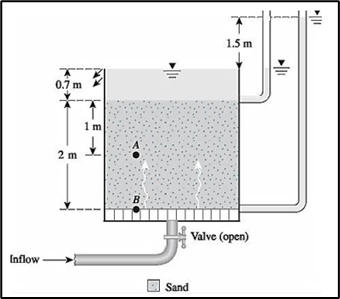
a. 5.817
b. 8.672
c. 7.854
d. 6.841
Question 63
A pumping test was made in a sand layer extending to a depth of 15.0 m until it reach an impermeable layer. The initial ground water table is located 2.0 m below the ground surface. Observation wells were sighted at distances 3.0 m and 7.5 m from the pumping well. Using a discharge of 0.4 m³/hr, a steady level is attained at the pumping well. The measured drawdowns at the two observation wells are 1.5 m and 0.35 m, respectively. What is the height of water at the farthest observation well in meters?
a. 13.58
b. 12.65
c. 11.50
d. 10.62
Question 64
A pumping test was made in a sand layer extending to a depth of 15.0 m until it reach an impermeable layer. The initial ground water table is located 2.0 m below the ground surface. Observation wells were sighted at distances 3.0 m and 7.5 m from the pumping well. Using a discharge of 0.4 m³/hr, a steady level is attained at the pumping well. The measured drawdowns at the two observation wells are 1.5 m and 0.35 m, respectively. What is the hydraulic conductivity of soil in cm/hr?
a. 0.63
b. 0.78
c. 0.57
d. 0.42
Question 65
A pumping test was made in a sand layer extending to a depth of 15.0 m until it reach an impermeable layer. The initial ground water table is located 2.0 m below the ground surface. Observation wells were sighted at distances 3.0 m and 7.5 m from the pumping well. Using a discharge of 0.4 m³/hr, a steady level is attained at the pumping well. The measured drawdowns at the two observation wells are 1.5 m and 0.35 m, respectively. What is the transmissivity of aquifer in m²/hr?
a. 0.051
b. 0.064
c. 0.038
d. 0.012
Question 66
A square footing has its bottom at a depth of 3.0 m from the ground surface. Groundwater table is located at a depth of 2.25 m below the ground. It was determined that the footing’s gross allowable bearing capacity was 87.806 kPa using Terzaghi’s bearing capacity equation with a factor of safety of 4 and considering a local shear failure mode. N'c = 11.85, N;q = 3.88, N'γ = 1.12. (Soil properties γ = 18.10kN/m³, γsat = 19.50kN/m³, c = 15.74 kPa, Φ = 20°.
Calculate the size of the footing.
a. 0.885 m
b. 0.865 m
c. 0.775 m
d. 0.795 m
Question 67
A square footing has its bottom at a depth of 3.0 m from the ground surface. Groundwater table is located at a depth of 2.25 m below the ground. It was determined that the footing’s gross allowable bearing capacity was 87.806 kPa using Terzaghi’s bearing capacity equation with a factor of safety of 4 and considering a local shear failure mode. N'c = 11.85, N;q = 3.88, N'γ = 1.12. (Soil properties γ = 18.10kN/m³, γsat = 19.50kN/m³, c = 15.74 kPa, Φ = 20°.
What is the ultimate bearing capacity of the soil in kPa?
a. 423.678
b. 351.225
c. 415.124
d. 338.153
Question 68
A square footing has its bottom at a depth of 3.0 m from the ground surface. Groundwater table is located at a depth of 2.25 m below the ground. It was determined that the footing’s gross allowable bearing capacity was 87.806 kPa using Terzaghi’s bearing capacity equation with a factor of safety of 4 and considering a local shear failure mode. N'c = 11.85, N;q = 3.88, N'γ = 1.12. (Soil properties γ = 18.10kN/m³, γsat = 19.50kN/m³, c = 15.74 kPa, Φ = 20°.
What is the net allowable bearing capacity of the soil in kPa?
a. 82.125
b. 75.808
c. 79.265
d. 338.153
Question 69
A dry soil is mixed with water and compacted. The water content of the soil was 17%. The wet soil has a volume of 0.001 m³ and a mass of 1.6 kg. The specific gravity of soil solids is found to be 2.7.
What is the dry unit weight of the soil in kN/m³?
a. 16.548
b. 14.652
c. 13.415
d. 17.362
Question 70
A dry soil is mixed with water and compacted. The water content of the soil was 17%. The wet soil has a volume of 0.001 m³ and a mass of 1.6 kg. The specific gravity of soil solids is found to be 2.7.
What is the void ratio of the soil?
a. 0.734
b. 0.974
c. 0.679
d. 0.851
Question 71
A dry soil is mixed with water and compacted. The water content of the soil was 17%. The wet soil has a volume of 0.001 m³ and a mass of 1.6 kg. The specific gravity of soil solids is found to be 2.7.
What is the degree of saturation of the soil?
a. 47.125%
b. 36.453
c. 54.382%
d. 29.827%
Question 72
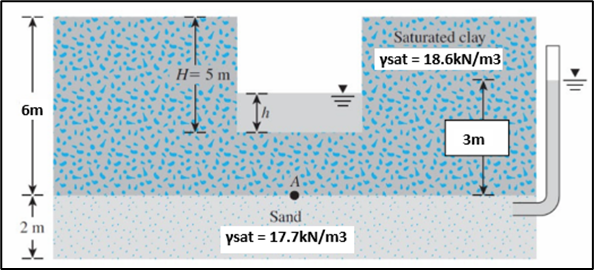
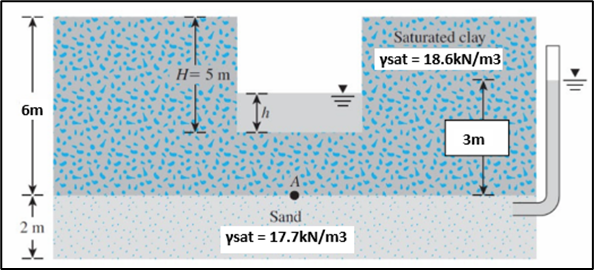
. A cut is made in a saturated clay that is underlain by a layer of sand as shown in Figure 14. The saturated unit weight of clay is 19 kN/m³ and that of sand is 18 kN/m³.
What should be the height (in meters) of the water, h, in the cut so that the stability of clay is not lost?
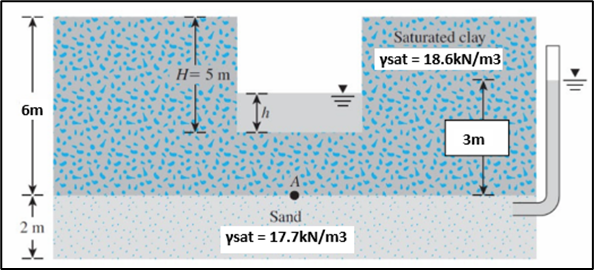
a. 2.431
b. 1.586
c. 1.176
d. 2.664
Question 73
. A cut is made in a saturated clay that is underlain by a layer of sand as shown in Figure 14. The saturated unit weight of clay is 19 kN/m³ and that of sand is 18 kN/m³.
What is the total stress (in kPa) at the bottom of the clay layer considering that the maximum height of water in the cut is present?
a. 51.248
b. 29.893
c. 42.157
d. 34.335
Question 74
. A cut is made in a saturated clay that is underlain by a layer of sand as shown in Figure 14. The saturated unit weight of clay is 19 kN/m³ and that of sand is 18 kN/m³.
What is the effective stress (in kPa) at the bottom of the sand layer if the stability of the clay is not lost?
a. 16.380
b. 18.354
c. 20.285
d. 19.450
Question 75
A circular footing having a diameter of 1.2 m has its bottom at a depth of 2.8 m from the ground surface. The water table is located at a depth of 1.20 m below the ground. The soil has the following properties: γd = 18.10kN/m³, γsat = 19.30kN/m³, c = 15.74 kPa, Nc = 35, Nq = 22, Nγ = 19.
Assuming general shear failure, find the ultimate bearing pressure using Terzaghi’s equation.
a. 1925.9kPa
b. 1592.9kPa
c. 1352.6kPa
d. 1953.6kPa
Question 76
A circular footing having a diameter of 1.2 m has its bottom at a depth of 2.8 m from the ground surface. The water table is located at a depth of 1.20 m below the ground. The soil has the following properties: γd = 18.10kN/m³, γsat = 19.30kN/m³, c = 15.74 kPa, Nc = 35, Nq = 22, Nγ = 19.
What is the net allowable load on the footing using a factor of safety of 3?
a. 586.6kN
b. 518.3kN
c. 551.12kN
d. 612.98kN
Question 77
A masonry wall is to be constructed on a 6-meter thick clay layer that overlies impervious rock. A laboratory test that simulated the field conditions shows the void ratio of the soil before and after application of the load are 0.91 and 0.89, respectively. What is the settlement of the structure in mm?
a. 62.83
b. 57.62
c. 71.24
d. 43.55
Question 78
An unconsolidated-undrained triaxial test was conducted on a sample of saturated clay. The results showed that σ3 = 123kN/m^2 and deviator stress = 456kN/m^2 when failure occurred. What is the shear strength of the clay sample in kPa?
a. 341
b. 228
c. 564
d. 712
Question 79
In a falling head permeability test, the following data were obtained:
Length of soil specimen = 40cm
Area of soil specimen = 1325 cm²
Area of standpipe = 0.375 cm²
Head difference at t = 0 = 95cm
Head difference at t = 15 mins = 82cm
What is the hydraulic conductivity of soil in mm/hr?
a. 0.053
b. 0.067
c. 0.048
d. 0.074
Question 80
In a constant head permeability test, the following data were obtained:
Length of soil specimen = 30cm
Area of soil specimen = 175 cm²
Constant head difference = 50cm
Water collected in 3mins = 620 cm³
What is the hydraulic conductivity of soil in cm/min?
a. 0.918
b. 0.709
c. 0.832
d. 0.621
Question 81
A consolidated-undrained triaxial test was done on two samples of cohesive soil.
What is the angle of internal friction of the cohesive soil?

a. 34.361°
b. 42.416°
c. 38.128°
d. 23.578°
Question 82
A consolidated-undrained triaxial test was done on two samples of cohesive soil.
What is the cohesion of the cohesive soil in kPa?
a. 37.315
b. 42.081
c. 22.913
d. 31.435
Question 83
A consolidated-undrained triaxial test was done on two samples of cohesive soil.
What is the shear stress at failure of sample 1 in kPa?
a. 117.612
b. 141.004
c. 105.40
d. 122.507
Question 84
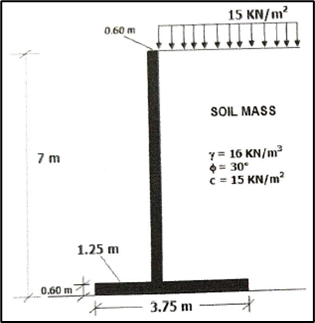
A concrete retaining wall is shown in Figure 15. Consider an active lateral earth pressure and neglect the effect of earthquake. Use γ_concrete = 23.6 kN/m³.
What is the righting moment of the wall in kN-m per meter of the wall?
a. 1,315
b. 1,209
c. 1,763
d. 1,405
Question 85
A concrete retaining wall is shown in Figure 15. Consider an active lateral earth pressure and neglect the effect of earthquake. Use γ_concrete = 23.6 kN/m³.
What is the overturning moment of the wall in kN-m per meter of the wall?
a. 682
b. 663
c. 574 d. 427
d. 427
Question 86
A concrete retaining wall is shown in Figure 15. Consider an active lateral earth pressure and neglect the effect of earthquake. Use γ_concrete = 23.6 kN/m³.
What is the value of the factor of safety against overturning of the wall?
a. 2.83
b. 2.59
c. 2.29
d. 2.12
Question 87
A cut slope is to be made in which the unit weight of soil is 20 kN/m³, the angle of internal friction is 25°, and the cohesion is 25 kPa.
The cut slope has a height of 15 m and makes an angle of 28° with the horizontal.
Consider that the trial failure plane is 15° from the horizontal.
What is the weight of soil (in kN) above the trial failure plane?
a. 3,318.412
b. 3,964.760
c. 4,165.480
d. 4,005.391
Question 88
A cut slope is to be made in which the unit weight of soil is 20 kN/m³, the angle of internal friction is 25°, and the cohesion is 25 kPa.
The cut slope has a height of 15 m and makes an angle of 28° with the horizontal.
Consider that the trial failure plane is 15° from the horizontal.
What is the value of the frictional force (in kN)?
a. 1,876.210
b. 1,078.106
c. 1,760.408
d. 1,424.678
Question 89
A cut slope is to be made in which the unit weight of soil is 20 kN/m³, the angle of internal friction is 25°, and the cohesion is 25 kPa.
The cut slope has a height of 15 m and makes an angle of 28° with the horizontal.
Consider that the trial failure plane is 15° from the horizontal.
What is the value of the factor of safety against sliding?
a. 3.226
b. 2.593
c. 3.084
d. 2.467
Question 90
A uniformly distributed load of 142 kPa was applied at the ground surface of a site due to the construction of a building that caused the 6-meter clay layer to undergo primary consolidation settlement.
The soil stratification in the site consists of:
4-meter sand layer (γ = 16.75 kN/m³, γ_sat = 20.14 kN/m³)
Underlain by 6-m clay layer (γ_sat = 17.86 kN/m³, e₀ = 1.3, LL = 35)
The groundwater table is located at 2.5 m below the ground surface.
What is the average effective stress at the mid-height of the clay layer in kPa?
a. 68.06
b. 95.46
c. 75.18
d. 81.52
Question 91
A uniformly distributed load of 142 kPa was applied at the ground surface of a site due to the construction of a building that caused the 6-meter clay layer to undergo primary consolidation settlement.
The soil stratification in the site consists of:
4-meter sand layer (γ = 16.75 kN/m³, γ_sat = 20.14 kN/m³)
Underlain by 6-m clay layer (γ_sat = 17.86 kN/m³, e₀ = 1.3, LL = 35)
The groundwater table is located at 2.5 m below the ground surface.
What is the value of the swell index if it is considered to be 30% of the compression index?
a. 0.0675
b. 0.0813
c. 0.0637
d. 0.0505
Question 92
A uniformly distributed load of 142 kPa was applied at the ground surface of a site due to the construction of a building that caused the 6-meter clay layer to undergo primary consolidation settlement.
The soil stratification in the site consists of:
4-meter sand layer (γ = 16.75 kN/m³, γ_sat = 20.14 kN/m³)
Underlain by 6-m clay layer (γ_sat = 17.86 kN/m³, e₀ = 1.3, LL = 35)
The groundwater table is located at 2.5 m below the ground surface.
What is the primary consolidation settlement (in mm) of the clay layer if the preconsolidation pressure was 185 kPa?
a. 127
b. 84
c. 111
d. 98
Question 93
How much pressure will it take 1.25 m³ of water to reduce to 1 m³ given that its elasticity is 2 GPa?
a. 200 MPa
b. 300 MPa
c. 400 MPa
d. 500 MPa
Question 94
Find the capillary rise when a semi-circular tube with a diameter of 2.4 mm is placed on a container of water with a specific weight of 9,810 N/m³ and a surface tension of 0.065 N/m.
a. 3.52 mm
b. 5.52 mm
c. 9.04 mm
d. 11.04 mm
Question 95
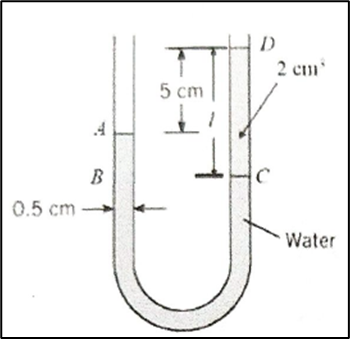
A U-tube manometer shown in Figure 16 is used to obtain the specific weight of a fluid by placing a volume of 2 cm³ on the manometer next to water. The diameter of the tube is 0.5 cm. The specific weight of water is 9,810 N/m³.
What is the depth h in the tube?
a. 5.19 cm
b. 10.19 cm
c. 15.19 cm
d. 18.15 cm
Question 96
A U-tube manometer shown in Figure 16 is used to obtain the specific weight of a fluid by placing a volume of 2 cm³ on the manometer next to water. The diameter of the tube is 0.5 cm. The specific weight of water is 9,810 N/m³.
Which of the following is nearest to the specific weight (in N/m³) of the fluid placed next to the water?
a. 5,000
b. 6,500
c. 7,200
d. 8,400
Question 97
A 5-kg rectangular prism with a length of 40 cm, a width of 20 cm, and a height of 10 cm is partially submerged in water. How much of the prism is submerged in the water? The specific weight of water is 9,790 N/m³.
a. 20%
b. 37%
c. 50%
d. 63%
Question 98
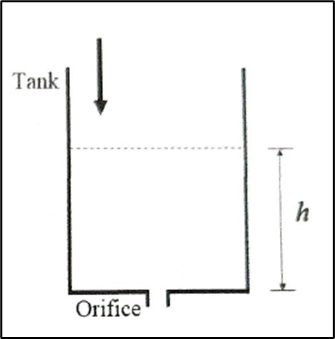
Consider the 0.15-m diameter cylindrical tank shown in Figure 17 with a 0.01-m diameter orifice at the bottom. It is supplied with water at an unknown rate. Let h be the depth of the water inside the tank that is equal to 0.3 m at the instant shown. The speed at the outlet is given by v = (2gh)^1/2
.
If the time rate of increase of the fluid depth is 0.0005 m/s, what is the inflow rate (in m³/s) in the tank?
a. 8.83x10^-6
b. 1.83x10^-4
c. 1.91x10^-4
d. 2.00x10^-4
Question 99
Consider the 0.15-m diameter cylindrical tank shown in Figure 17 with a 0.01-m diameter orifice at the bottom. It is supplied with water at an unknown rate. Let h be the depth of the water inside the tank that is equal to 0.3 m at the instant shown. The speed at the outlet is given by v = (2gh)^1/2
.
At what depth h (in m) will the flow be steady?
a. 0.27
b. 0.30
c. 0.33
d. 0.39
Question 100
A consolidated-drained triaxial test was done on a sample of cohesive soil. The following results were obtained: chamber pressure = 50kPa, deviator stress = 270kPa, and angle of internal friction = 24°
What is the soil's cohesion in kPa?
a. 65.409
b. 71.885
c. 76.867
d. 58.895
Question 101
A consolidated-drained triaxial test was done on a sample of cohesive soil. The following results were obtained: chamber pressure = 50kPa, deviator stress = 270kPa, and angle of internal friction = 24°
What is the soil's normal stress at failure in kPa?
a. 122.643
b. 130.091
c. 141.551
d. 138.392
Question 102
A consolidated-drained triaxial test was done on a sample of cohesive soil. The following results were obtained: chamber pressure = 50kPa, deviator stress = 270kPa, and angle of internal friction = 24°
What is the soil's shear stress at failure in kPa?
a. 138.632
b. 163.245
c. 141.374
d. 123.329