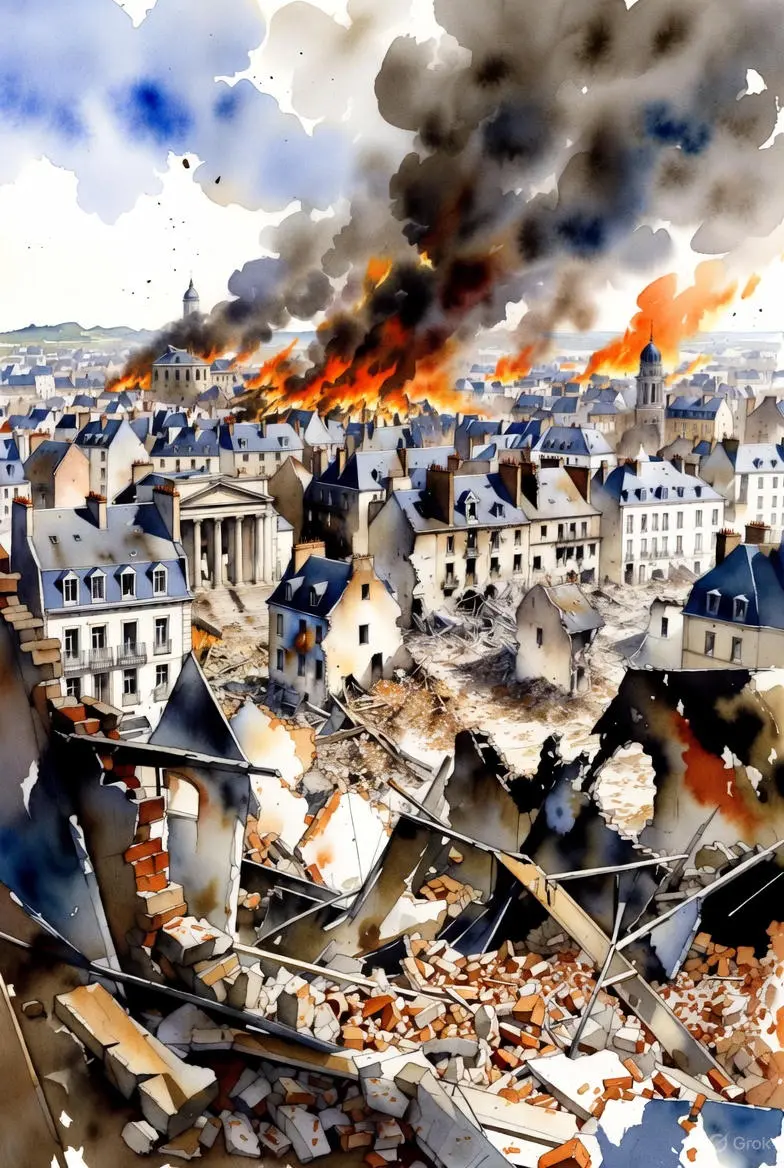
AP Lit 6th All The Light We Cannot See Reading 2

Question 1
The description of the bombing in the opening section of the excerpt primarily serves to
Question 2
In the line "Flames scamper up walls. Parked automobiles catch fire, as do curtains and lampshades and sofas and mattresses," the personification of flames functions to
Question 3
Marie-Laure's repetition of "Papa Papa Papa Papa" reveals her
Question 4
The metaphor of the ground beneath Saint-Malo as "knitted together all along by the root structure of an immense tree" suggests Marie-Laure's perspective is shaped by
Question 5
Werner's flashback to Zollverein and the mules' grave primarily functions to
Question 6
The detail that "Swifts, flushed from chimneys, catch fire and swoop like blown sparks out over the ramparts" contributes to the reader's interpretation by
Question 7
Volkheimer's action of closing Bernd's mouth after the collapse reveals his motive as one of
Question 8
The conflict in Marie-Laure's descent down the stairs is primarily internal, as evidenced by her
Question 9
In the thesis "The excerpt illustrates how sensory deprivation heightens internal conflicts during wartime chaos," relevant evidence would include
Question 10
The setting detail of "Bits of living rooms, cafés, trees. People" in the smoke primarily functions to
Question 11
Marie-Laure's final words in her section, "Ce n’est pas la réalité," reveal a motive driven by
Question 12
The event of the Hotel of Bees becoming "almost weightless for a moment, lifted in a spiral of flame" signifies
Question 13
In developing commentary for the claim "Characters' unchanged traits amplify conflicts," evidence from Werner's rational steps would
Question 14
The comparison of Volkheimer's chin to "a continent" contributes to the reader's interpretation of him as
Question 15
The primary conflict in the "Trapped" section intersects with others when
Question 16
A defensible thesis about the excerpt could be "Sensory details underscore characters' incompatible perspectives on survival," supported by
Question 17
The function of the artillery shells whistling overhead is to
Question 18
Evidence is sufficient in supporting the line of reasoning that "War forces characters to confront internal changes" when it includes
Question 19
Control over composition elements is demonstrated in the excerpt through
Question 20
What literary device is used in "Flames scamper up walls."?
Question 21
Here are some vocabulary words you need to know. Write them down in your composition book.
- Personification: Giving human qualities or actions to non-human things, often to reveal perspectives or heighten conflict in a setting.
- Simile: A comparison using "like" or "as" to describe a character or event, contributing to the interpretation of motives or conflicts.
- Metaphor: A direct comparison without "like" or "as," used to convey character perspectives or the significance of events in a narrative.
- Alliteration: Repetition of initial consonant sounds in words, enhancing descriptions of settings or conflicts for rhythmic effect.
- Hyperbole: Exaggeration for emphasis, often to illustrate the intensity of a character's internal conflict or the scale of destruction.
- Imagery: Vivid sensory details that create mental pictures, revealing settings, character motives, or the function of significant events.
- Flashback: A shift to an earlier event or memory, developing character by contrasting past and present perspectives or conflicts.
- Paradox: A statement that seems contradictory but reveals a truth, often highlighting inconsistencies in character values or plot.
Question 22
What literary device is used in "swoop like blown sparks"?
Question 23
What literary device is used in "the ground beneath Saint-Malo has been knitted together all along by the root structure of an immense tree"?
Question 24
What literary device is used in "smoke chases dust; ash chases smoke."?
Question 25
What literary device is used in "the appetite for oxygen is such that objects heavier than housecats are dragged into the flames"?
Question 26
What literary device is used in "Great distending clouds of chalk and earth and granite spout into the sky."?
Question 27
What literary device is used in Werner's memory of standing above a grave for two mules in Zollverein as a child?
Question 28
What literary device is used in "It sounds both beautiful and strange, as though gemstones were raining from the sky."?