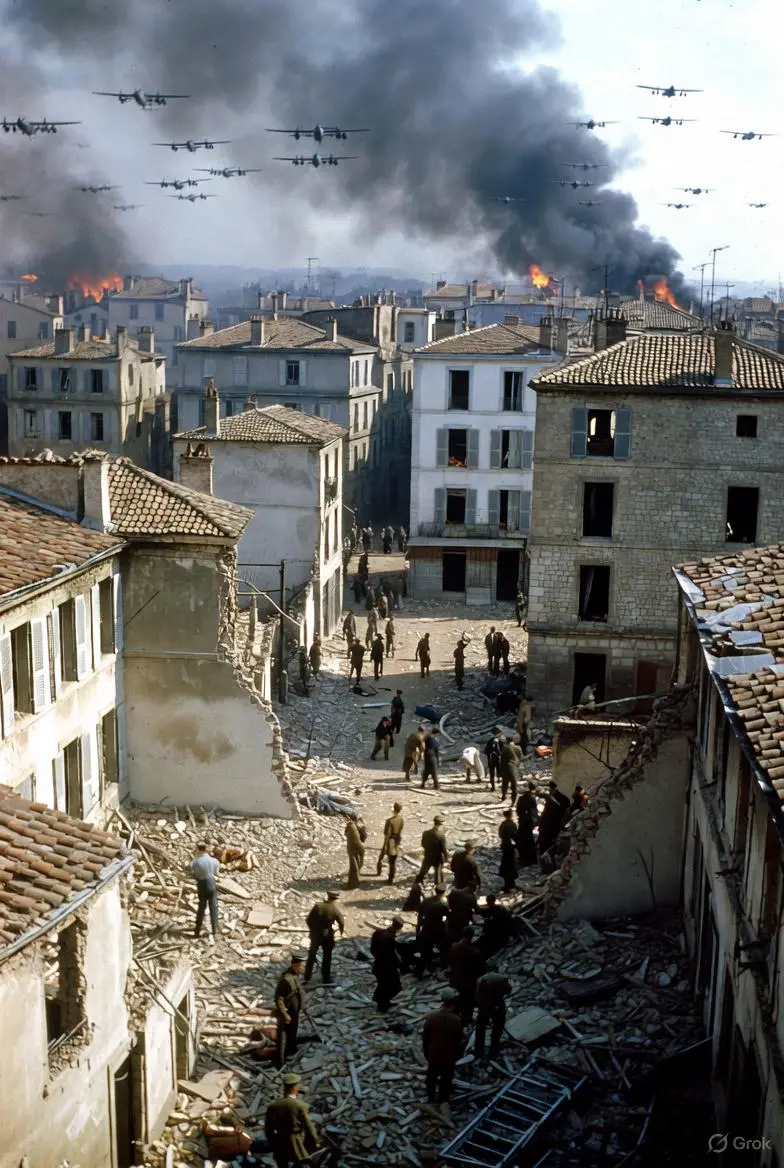
1st AP Lit: All The Light We Cannot Reading 1 Literary Terms
Literary Terms found in All the Light We Cannot See Reading 1

Question 1
Which best defines "theme" as applied to the excerpt's exploration of unseen forces in war?
A recurring image or idea
The central message or insight about life
A character's personality type in the narrative
Word choice selected by the author carefully
Question 2
The description "the walled city... looks like an unholy tooth, something black and dangerous" primarily uses what figurative language to convey the bombardiers' perspective?
Simile comparing city to a tooth
Metaphor equating city to a tooth
Personification giving city human traits
Hyperbole exaggerating city's dark appearance
Question 3
What tone is conveyed in "Leaflets" through diction like "pour," "flutter," and "swirl"?
Joyful excitement in the falling papers
Ominous urgency in the warning messages
Peaceful calm in the evening scene
Humorous lightness in the chaotic swirl
Question 4
Marie-Laure is best classified as what character type based on details like her tracing the model city despite blindness?
Static figure with unchanging traits
Flat figure with minimal depth
Round figure with complex layers
Foil figure contrasting others sharply
Question 5
How is characterization primarily achieved for Marie-Laure in "The Girl"?
Through dialogue expressing her thoughts
Through actions and sensory descriptions
Through setting details surrounding her
Through epigraph references to history
Question 6
The Hotel of Bees functions most as an allegory for what in the context of war?
Peaceful isolation from external threats
Society's transformation under occupation
Individual blindness to surrounding dangers
Aerial bombardment destroying safe havens
Question 7
Panicked sheep run zigzagging between rocks" serves as an example of what to build mood
Symbol representing chaos in nature
Imagery depicting panic and disorder
Tone conveying fear and urgency
Static character showing no change
Question 8
What do Marie-Laure's actions (e.g., filling buckets, tracing the model) reveal about her motives?
Indifference to the approaching danger
Preparation and instinct for survival
Aggression toward the invading forces
Joy in the midst of isolation
Question 9
Werner remains largely unchanged in "The Boy," functioning primarily to:
Demonstrate dynamic growth through events
Highlight war's impact on young people
Resolve the narrative's external conflict
Shift the story's overall perspective
Question 10
The event of leaflets falling functions to:
Resolve the story's central conflict quickly
Introduce tension and foreshadow destruction
Change the characters' core motives deeply
Establish a peaceful and calm mood
Question 11
Multiple conflicts intersect most clearly when:
Bombers approach and characters react personally
Only external war elements dominate the scene
Leaflets become the narrative's sole focus
Epigraphs provide isolated historical context
Question 12
The epigraph by Goebbels ("It would not have been possible... without the radio") symbolizes what in relation to the narrative?
Physical destruction of cities during war
Power and propaganda in wartime control
Sensory deprivation like blindness theme
Allied bombing technology advancing rapidly
Question 13
The mood in "The Girl" is best described as tense and isolated, primarily created by what?
Joyful diction highlighting positive elements
Auditory imagery like hum inside seashell
Visual symbols representing light motifs
Static character descriptions without change
Question 14
Werner and Marie-Laure function as foils by contrasting:
Allied perspectives versus Axis viewpoints
Soldier's duty versus civilian vulnerability
External wealth versus internal transformation
Dynamic motives versus static characteristics
Question 15
The diction in "the roar of oncoming bombers is the roar of what? Deliverance? Extirpation?" creates tension by:
Using consistent positive connotations throughout
Contrasting hope with ideas of destruction
Focusing on literal sounds without ambiguity
Avoiding any form of internal conflict
Question 16
The recurring motif of approaching sounds (e.g., "intercoms crackle," "threads of red light") functions to:
Resolve character arcs in the narrative
Heighten suspense and foreshadow conflict
Shift to a peaceful tone gradually
Symbolize personal growth for individuals
Question 17
The setting detail "walled city with sieges and German fortifications" conveys what cultural value?
Eternal peace amid historical tranquility
Resilience amid periods of occupation
Complete isolation from outside forces
Technological advancement in defenses
Question 18
The sheep in "Bombers" symbolize:
Organized resistance against invading threats
Chaos and panic during wartime events
Static environmental elements without motion
Internal character changes over the narrative
Question 19
The epigraph about Saint-Malo's destruction sets what structural function?
Climax resolution for the main plot
Foreshadowing of the narrative outcome
Character introduction in early sections
Humorous tone to lighten the mood
Question 20
Marie-Laure's perspective shifts subtly from calm to anxiety, revealed through:
Direct dialogue stating her emotions
Sensory details like whispering to hums
External actions without internal insight
Unchanged motives throughout the scene
Question 21
Prompt: In the following excerpt from Anthony Doerr's All the Light We Cannot See (2014), the narrator describes the approach of bombers during WWII. Read the passage carefully. Then, in a well-organized paragraph, analyze how Doerr uses one literary element or technique (such as imagery or diction) to convey an intersecting external and internal conflict in the passage. Include a defensible claim, specific evidence from the text, and commentary explaining how the evidence contributes to the passage's meaning.
Shortened Passage:
- August 1944 the historic walled city of Saint-Malo, the brightest jewel of the Emerald Coast of Brittany, France, was almost totally destroyed by fire.... Of the 865 buildings within the walls, only 182 remained standing and all were damaged to some degree. —Philip Beck
- It would not have been possible for us to take power or to use it in the ways we have without the radio. —Joseph Goebbels
Leaflets
- At dusk they pour from the sky. They blow across the ramparts, turn cartwheels over rooftops, flutter into the ravines between houses. Entire streets swirl with them, flashing white against the cobbles. Urgent message to the inhabitants of this town, they say. Depart immediately to open country.
- The tide climbs. The moon hangs small and yellow and gibbous. On the rooftops of beachfront hotels to the east, and in the gardens behind them, a half-dozen American artillery units drop incendiary rounds into the mouths of mortars.
Bombers
- They cross the Channel at midnight. There are twelve and they are named for songs: Stardust and Stormy Weather and In the Mood and Pistol-Packin’ Mama. The sea glides along far below, spattered with the countless chevrons of whitecaps. Soon enough, the navigators can discern the low moonlit lumps of islands ranged along the horizon.
France
- Intercoms crackle. Deliberately, almost lazily, the bombers shed altitude. Threads of red light ascend from anti-air emplacements up and down the coast. Dark, ruined ships appear, scuttled or destroyed, one with its bow shorn away, a second flickering as it burns. On an outermost island, panicked sheep run zigzagging between rocks.
- Inside each airplane, a bombardier peers through an aiming window and counts to twenty. Four five six seven. To the bombardiers, the walled city on its granite headland, drawing ever closer, looks like an unholy tooth, something black and dangerous, a final abscess to be lanced away.
Question 22
Prompt: In many works of literature, a character experiences tension between competing values, such as duty and survival or perception and reality. In a well-organized paragraph, identify a character from Anthony Doerr's All the Light We Cannot See who experiences such a tension (e.g., Marie-Laure or Werner). Then, analyze how this internal conflict contributes to an interpretation of the work as a whole. Do not merely summarize the plot. Include a defensible claim, specific evidence from the provided passage, and commentary explaining how the evidence supports your interpretation.
Passage:
The Girl (Marie-Laure's tension: Blindness heightens unseen threats, duty to wait vs. urge to flee)
- In a corner of the city, inside a tall, narrow house at Number 4 rue Vauborel, on the sixth and highest floor, a sightless sixteen-year-old named Marie-Laure LeBlanc kneels over a low table covered entirely with a model. The model is a miniature of the city she kneels within, and contains scale replicas of the hundreds of houses and shops and hotels within its walls.... She hears the bombers when they are three miles away. A mounting static. The hum inside a seashell.
The Boy (Werner's tension: Propaganda-fueled duty vs. personal fear/moral doubt)
- Five streets to the north, a white-haired eighteen-year-old German private named Werner Pfennig wakes to a faint staccato hum.... Werner's blood gallops through his ventricles, his thoughts on a wire between present and future and back again.... The roar of oncoming bombers is the roar of what? Deliverance? Extirpation?