
SILICA AND SILICATE
Welcome to the Silica & Silicate Comprehension Challenge! In this quiz, you will test your knowledge of minerals.

Question 1
What is the basic unit in Silica?
SiO₂
SiO₄⁴⁻
CO₂
H₂O
Question 2
What is the basic unit in Silicate?
CO
SiO₂
NaCl
SiO₄⁴⁻
Question 3
How does the tetrahedral arrangement differentiate Silica and Silicate?
Silica has isolated tetrahedral, Silicate has network tetrahedral
Silica has continuous tetrahedral network, Silicate tetrahedral linked to metals
Silica contains metals, Silicate does not
Silicate forms glass, Silica does not
Question 4
Why do Silicates usually contain metals besides Si and O?
To make them colorful
To balance the negative charge of SiO₄⁴⁻
To increase solubility in water
To reduce melting point
Question 5
Why is Quartz hard while Clay is soft?
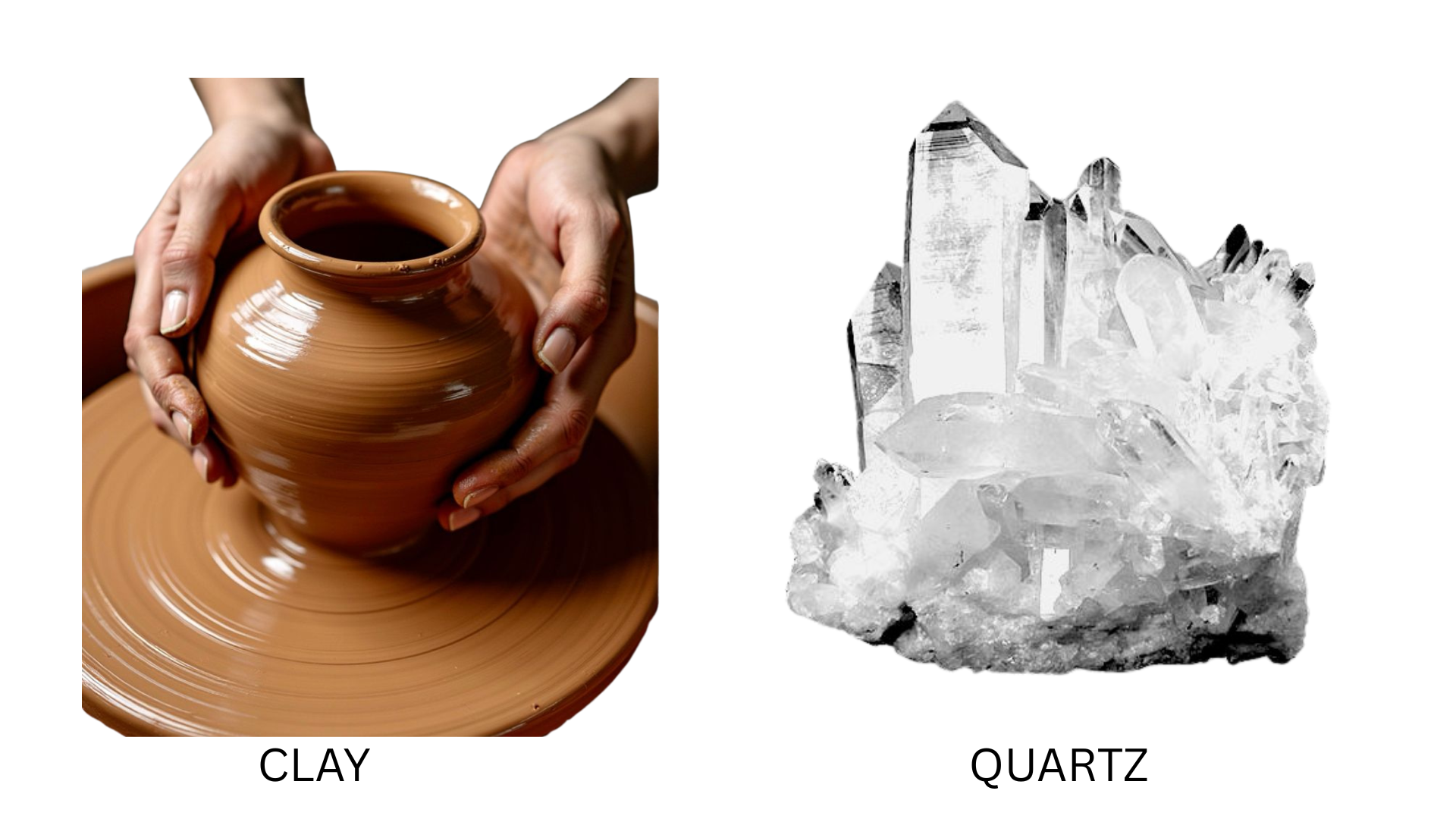
Quartz has weak bonding,Clay has strong bonding
Quartz contains metals,Clay does not
Quartz has rigid 3D tetrahedral network,Clay has layered weak bonds
Clay is crystalline,Quartz is amorphous
Question 6
How does tetrahedral arrangement affect mineral hardness?
Strong network → harder; weak/ layered → softer
Layered tetrahedra → harder; network → softe
Metals increase hardness
Solubility affects hardness
Question 7
Why are some Silicates more soluble in water than Silica?
Silicates have smaller molecules
Silica contains metals
Silica is amorphous
Silicates have metals & layers
Question 8
Why is Silica used in glass making?
Silica is soft and flexible
Silica is cheap to extract
Strong network melts into transparent durable material
Silica reacts violently with water
Question 9
If you want heat-resistant glass, use Silica or Silicate?
Silicate
Silica
Both
Neither
Question 10
How can students identify a mineral as Silica or Silicate by observation?
Silica → hard, transparent; Silicate → layered/colored
Silica → soft & colored; Silicate → transparent
Silica → magnetic; Silicate → not
Silica → reacts with water; Silicate → melts easily