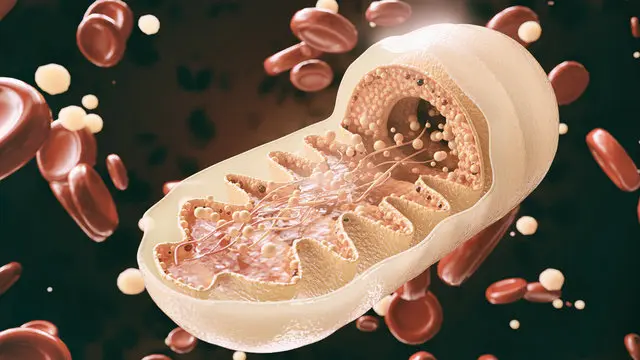
Oxidative Phosphorylation
Cellular respiration converts glucose into energy (ATP) using oxygen, producing carbon dioxide and water. It occurs in three stages: glycolysis, the Krebs cycle, and oxidative phosphorylation.

Question 1
Almost all of the oxygen consumes in breathing is converted to:
Water
Carbon dioxide
NADH
FADH2
Question 2
Which of the following statements about the chemiosmosis theory is false?
Electron transfer in mitochondria is accompanied by an unequal release of protons on one side of the inner mitochondrial membrane.
The ATP synthase has no significant role in the chemiosmotic theory.
Energy is conserved as a transmembrane pH gradient.
Question 3
Why is CoQ mobile in phospholipid bilayer?
It is a water-soluble molecule that can move freely within the hydrophilic exterior of the bilayer.
It is a lipid-soluble molecule that can move freely within the hydrophobic interior of the bilayer.
It is positively charged and attracted to the negatively charged phosphate heads of the bilayer.
It is too large to pass through the bilayer and remains on the surface.
Question 4
In normal mitochondria, the NADH oxidation will:
occur in the intermembrane space.
occur with the presence of NADH dehydrogenase.
occur during the pyruvate oxidation to produce acetyl CoA.
occur with the presence of succinate dehydrogenase.
Question 5
What would happen to oxidative phosphorylation in aerobic respiration if oxygen is absent?
It would cease to occur.
It would switch to anaerobic respiration.
It would increase in efficiency.
It would switch to fermentation.
Question 6
ATP synthesis catalysed by ATP synthase is driven by?
Oxidation of electron carrier
Electron movement
Proton movement
Water movement
Question 7
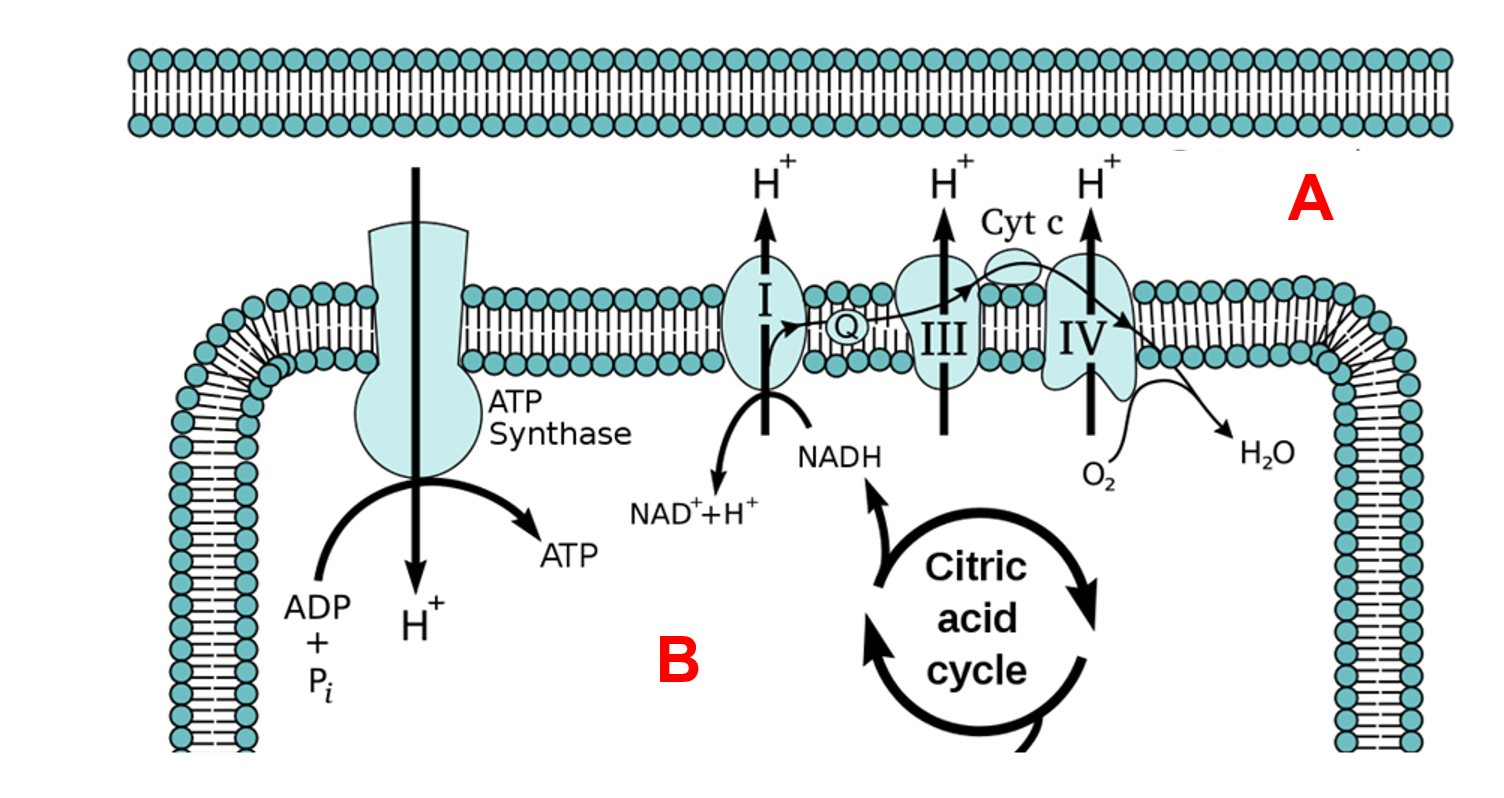
Location B has a lower pH.
Question 8
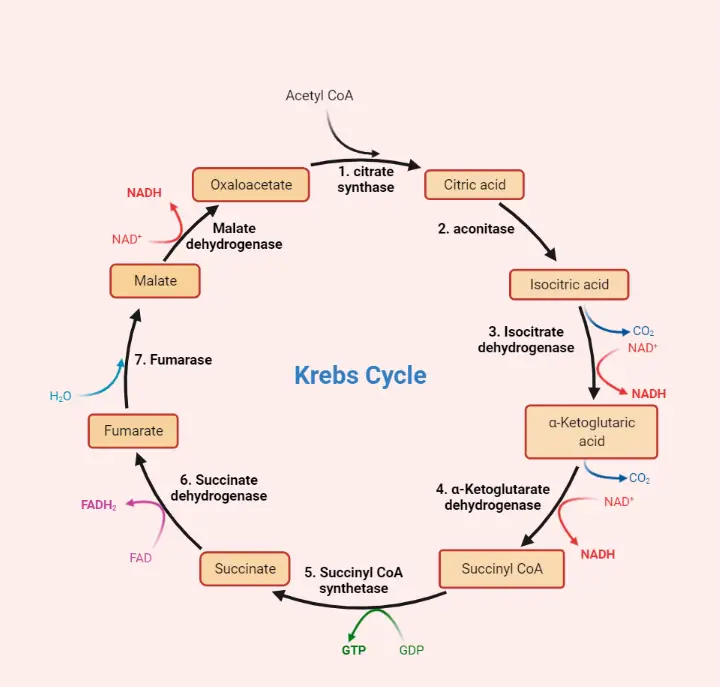
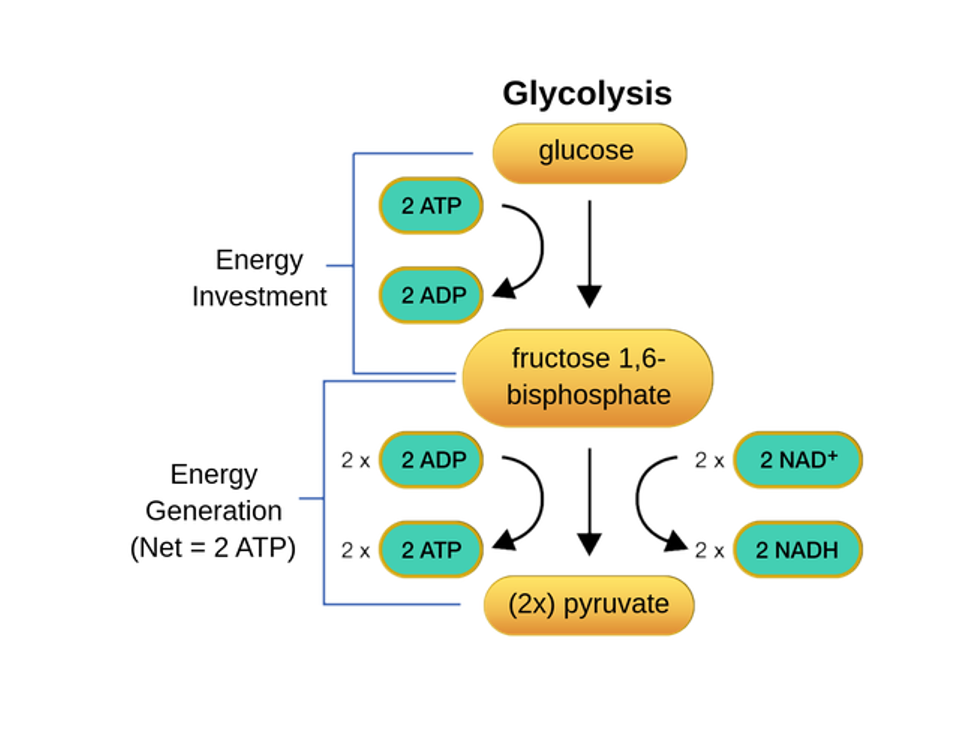
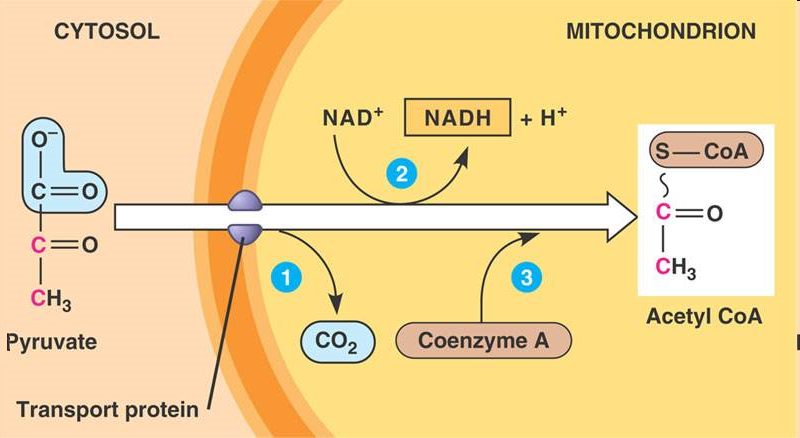
Which of the following is a process that produces FADH2?
Question 9
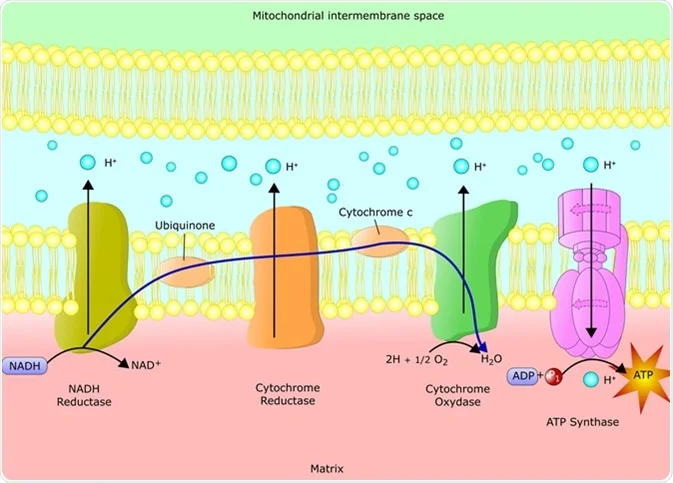
The steps leading to chemiosmosis across the inner membrane of the mitochondrion?
Activation of proton pumps.
Generates proton / H+ gradient.
Electron transfer along the ETC via redox reaction.
Oxidation of NADH and FADH2.
Generates proton motive force.
Question 10
H+ moves down their concentration gradient by _________ back into the matrix.
Simple diffusion
Proton pump
Facilitated diffusion
Osmosis
Question 11
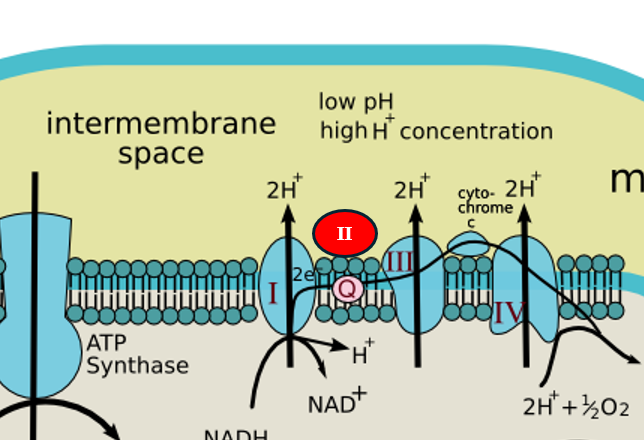
Is the location of succinate dehydrogenase (red-coloured) correct?
Question 12
The pathway of electrons from the oxidation of NADH.
NADH dehydrogenase
Cytochrome c reductase
Cytochrome c
Cytochrome c oxidase
Ubiquinone
Question 13
Which of the following is NOT produced during oxidative phosphorylation?
Water
Carbon dioxide
ATP
NAD+ and FAD