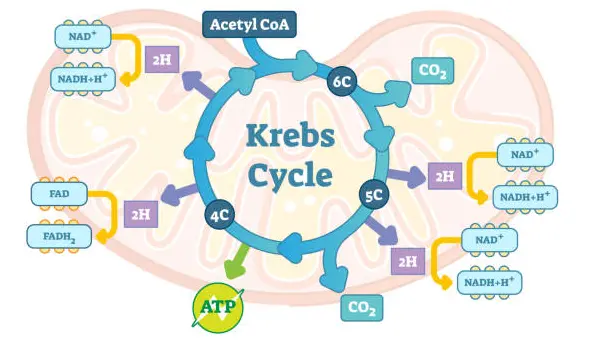
Krebs Cycle
Understand the steps that occur in the Krebs cycle.

Question 1
Krebs cycle occurs in the __________ of eukaryotic cells.
Question 2
The overall purpose of Krebs cycle is to ___
synthesize DNA
produce oxygen
generate energy in the form of ATP
regulate body temperature
Question 3
What product of pyruvate oxidation enters the cycle?
Pyruvate
Acetyl CoA
NADH
Carbon dioxide
Question 4
What happens to the coenzyme A (CoA) that is released in the Krebs cycle?
Destroyed and excreted from the body
Converted into a different type of coenzyme
Stored in the liver for future use
Recycled and used in other metabolic reactions
Question 5
Why is Krebs cycle also called the citric acid cycle?
Because it begins with the formation of citric acid
Because it is a cycle that involves the breakdown of citric acid
Because it is primarily found in citrus fruits
Because it is named after a scientist named Citric
Question 6
How many times does the cycle take place per molecule of glucose?
Once
Twice
Thrice
Four times
Question 7
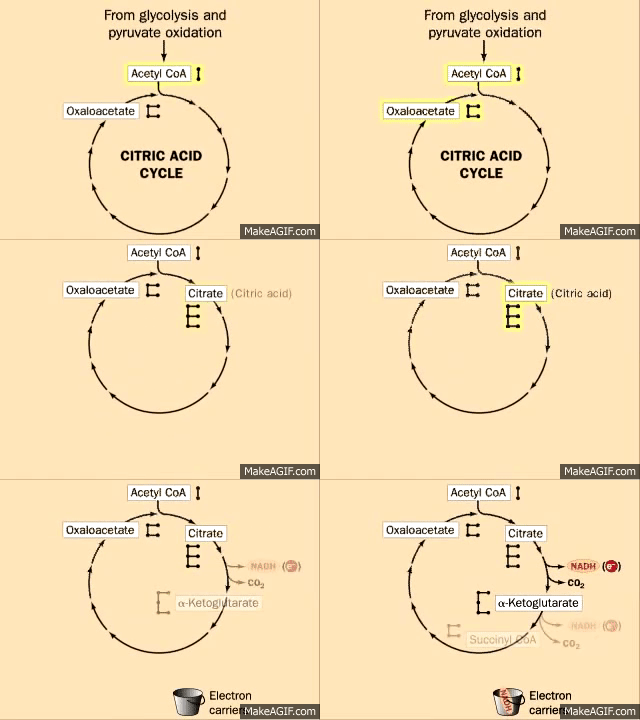
The first step of the Krebs cycle is the [[1]] of [[2]] with 4-carbon compound [[3]] to form 6C [[4]], [[5]] is released
condensation
acetyl CoA
oxaloacetate
citrate
coenzyme A
Question 8
At the end of the cycle, what is left of the original glucose molecule?
carbon dioxide and water
carbon dioxide and hydrogen
oxaloacetate and water
oxaloacetate and hydrogen
Question 9
How many oxidations occur in one Krebs cycle?
3
4
5
6
Question 10
How many decarboxylations occur in one Krebs cycle?
Four times
Once
Twice
Thrice
Question 11
How many NADH molecules are yielded from each pyruvate?
Question 12
What is the number of FADH2 molecules yielded from each glucose?
Question 13
Arrange the molecules in the order they are formed during the Kreb cycle.
Citrate, Isocitrate, Succinyl CoA, Succinate, Alpha-ketoglutarate, Fumarate, Malate, Oxaloacetate
Citrate, Isocitrate, Alpha-ketoglutarate, Succinyl CoA, Succinate, Fumarate, Malate, Oxaloacetate
Isocitrate, Citrate, Alpha-ketoglutarate, Succinyl CoA, Succinate, Fumarate, Malate, Oxaloacetate
Alpha-ketoglutarate, Citrate, Isocitrate, Succinyl CoA, Succinate, Fumarate, Malate, Oxaloacetate
Question 14
Why is FAD used instead of NAD+?
FAD is less stable than NAD+
FAD is lower-energy than the NAD+
FAD is unable to transfer electrons to the electron transport chain
NAD+ is more efficient at carrying electrons and protons
Question 15
What happens to the electron carriers (NADH and FADH2) after the Krebs cycle?
They are excreted from the body.
They donate their electrons to the electron transport chain.
They are used to produce ATP in the cytoplasm.
They are stored in the mitochondria.
Question 16
How many ATP are formed through substrate level phosphorylation from one molecule of glucose when it is completely oxidised?
6
8
2
4