Wave Behavior
Topic 4.4

Question 1
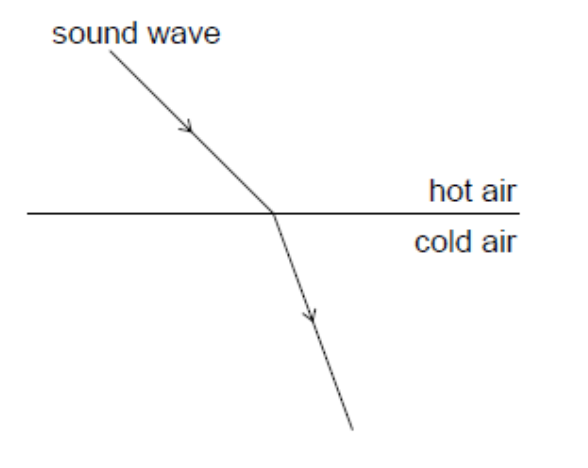
When a sound wave travels from a region of hot air to a region of cold air. What changes occur in the frequency and wavelength of the sound as it passes from the hot air to the cold air?
Frequency: unchanged / Wavelength: increases
Frequency: unchanged / Wavelength: decreases
Frequency: increases / Wavelength: increases
Frequency: decreases / Wavelength: decreases
Question 2
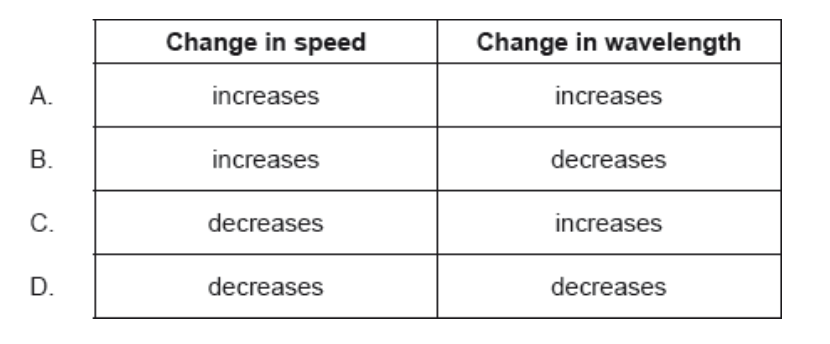
What are the changes in the speed and in the wavelength of monochromatic light when the light passes from water to air?
A
B
C
D
Question 3
What statement about X-rays and ultraviolet radiation is correct?
X-rays travel faster in a vacuum than ultraviolet waves.
X-rays have a higher frequency than ultraviolet waves.
X-rays cannot be diffracted unlike ultraviolet waves.
Microwaves lie between X-rays and ultraviolet in the electromagnetic spectrum.
Question 4
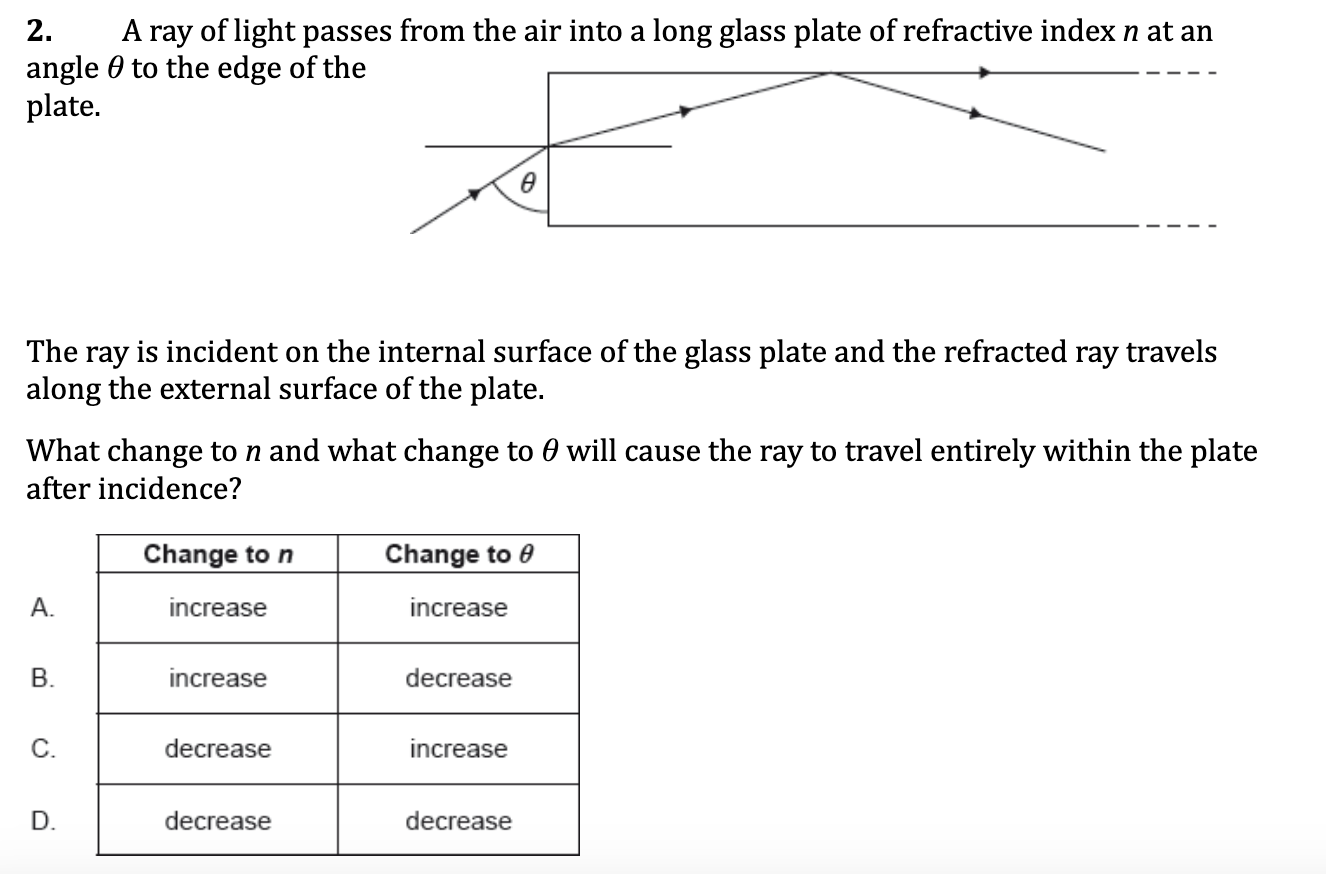
A ray of light passes from the air into a long glass plate of refractive index n at an angle θ to the edge of the plate. The ray is incident on the internal surface of the glass plate and the refracted ray travels along the external surface of the plate.
What change to n and what change to θ will cause the ray to travel entirely within the plate after incidence?
A
B
C
D
Question 5
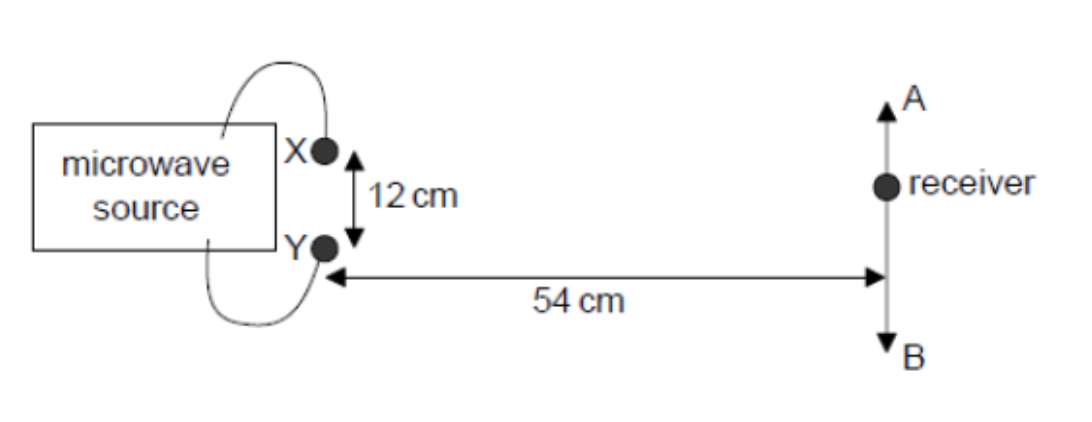
Two microwave transmitters, X and Y, are placed 12 cm apart and are connected to the same source. A single receiver is placed 54 cm away and moves along a line AB that is parallel to the line joining X and Y. Maxima and minima of intensity are detected at several points along AB. Explain the formation of the intensity minima.
Question 6
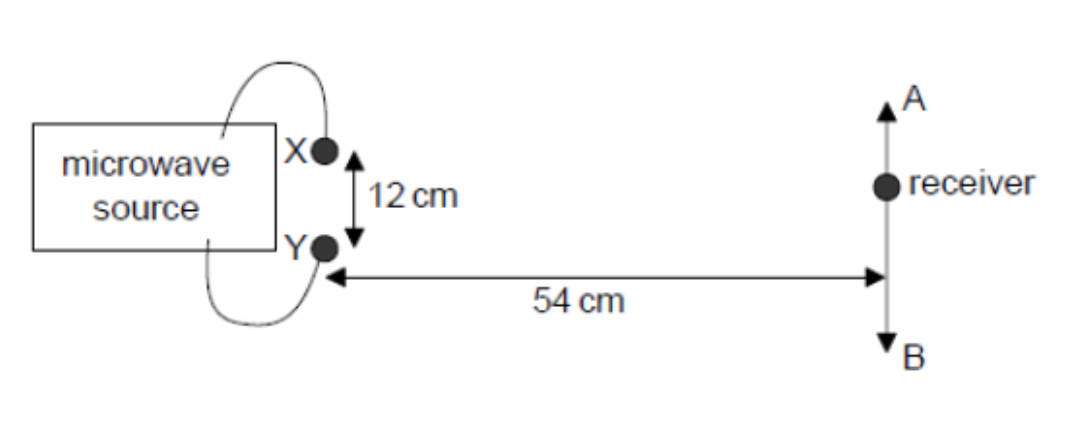
The distance between the central maximum and the first minimum is 7.2 cm. Calculate the wavelength of the microwaves. Make sure to round the the correct number of SF.
Question 7
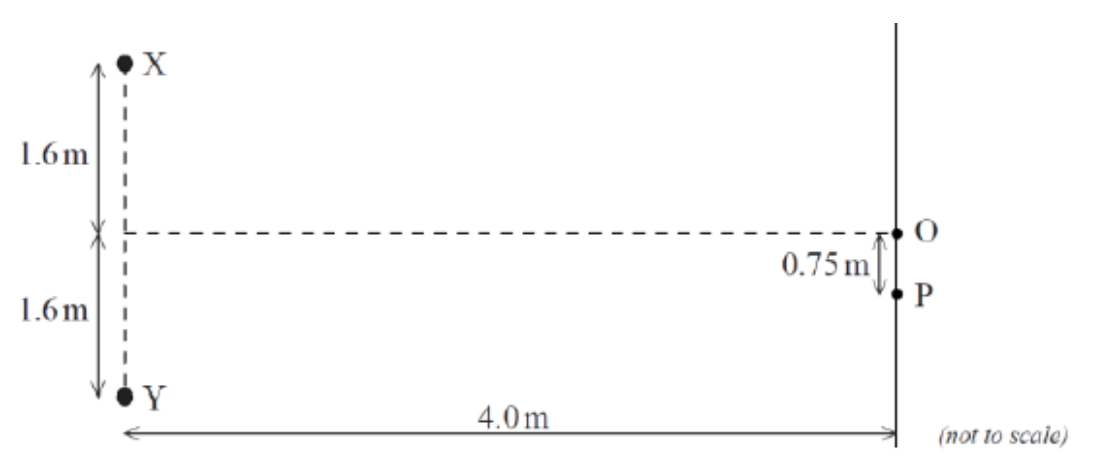
The diagram shows two point sources of sound, X and Y. Each source emits waves of wavelength 1.1 m and amplitude A. Over the distances shown, any decrease in amplitude can be neglected.
The two sources vibrate in phase. Points O and P are on a line 4.0 m from the line connecting X and Y. O is opposite the midpoint of XY and P is 0.75 m from O.
Statement: You will be able to hear sound at P.