Mass Production of Insulin with cDNA
Gene Cloning using cDNA to produce insulin for diabetic treatment.

Question 1
Which technology below would probably be the most important to a diabetic patient who has to take insulin daily?
Using recombinant DNA to produce human hormones from bacteria.
Engineering fruits and vegetables that resist insects and other pests.
Testing parents for genetic disorders before they have children.
Developing ways to identify criminals through DNA fingerprinting.
Question 2
The ______ strand is isolated from ________ cell.
mRNA; liver
mRNA; pancreatic
DNA; liver
DNA; pancreatic
Question 3
Why is insulin gene obtained from mRNA rather than DNA?
(The answer can be MORE than ONE)
mRNA does not contain introns.
mRNA carries code for specific target gene.
Difficult to find one gene among all the genes in the nucleus.
mRNA is easily isolated from target cell.
Question 4
Arrange the correct sequence 1-5 of the steps below.
Reverse transcriptase produces the first cDNA strand.
Ribonuclease degrades mRNA.
Adapter ligation to add restriction sequence at both ends of cDNA.
DNA polymerase produces the second cDNA strand to form double-stranded cDNA.
mRNA is isolated from human pancreatic cell.
Question 5
The scientists cut the [[1]] DNA (cDNA) at the [[2]] with [[3]] to produce [[4]].
complementary
adapter
restriction enzyme
sticky ends
Question 6
What is added at both ends of double stranded cDNA during the process of adapter ligation?
restriction sequence
restriction endonuclease
palindrome sequence
base sequence
Question 7
In nature, restriction enzymes are meant to protect
Humans from bacteria
Bacteria from viruses
Bacteria from other bacteria
Viruses from bacteria
Question 8
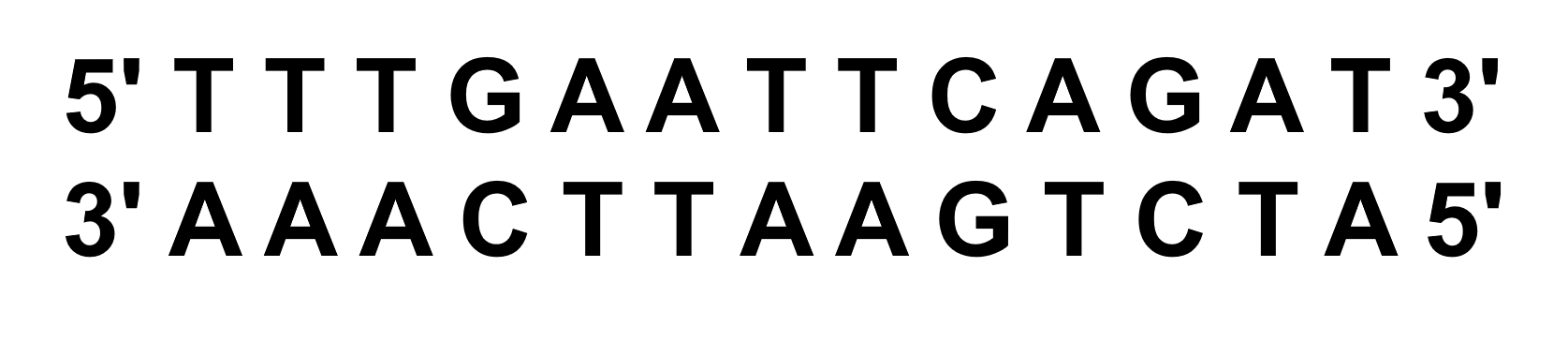
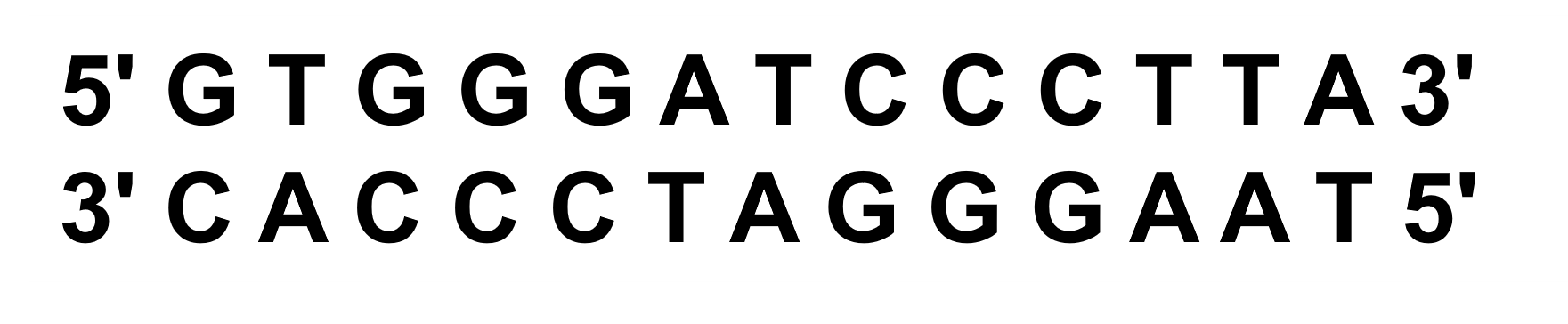
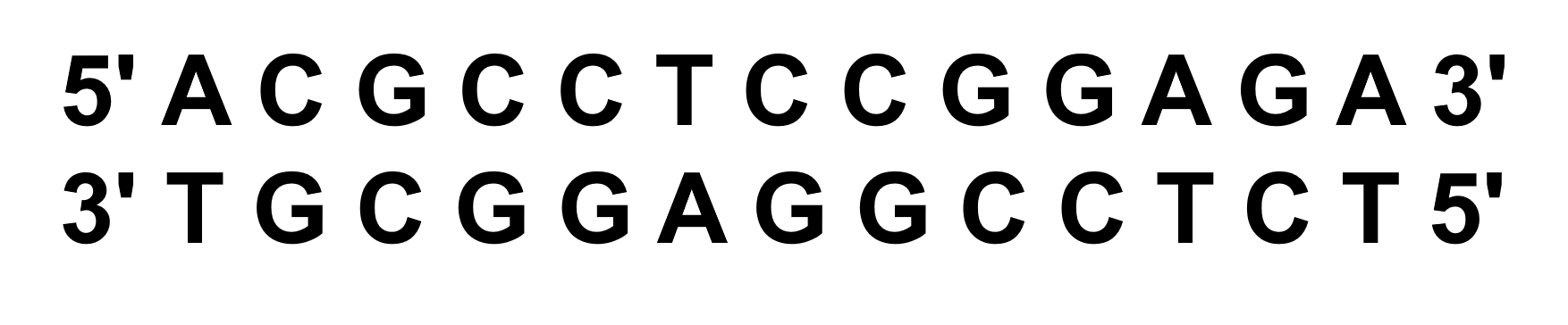
On each of the sequences below, determine which restriction sequence could be spliced by EcoRI.

Question 9
BamHI recognizes 6 base pairs of DNA in a palindromic DNA sequence. If the first part of the sequence is shown in the diagram, what is the rest of it?

5’ CAA 3’
5’ AAC 3’
5’ TTG 3’
5’ GTT 3’
Question 10
Using plasmids to form recombinant DNA is a crucial part of cloning DNA.
Which of the following statements correctly describes the plasmids?
They are found more commonly in viruses than in bacteria.
They are single-stranded circles.
They are too small to be useful as vectors for the cloning of mammalian DNA segments.
They sometimes enhance bacterial resistance to antibiotics.
Question 11
What enzyme joins the sugar-phosphate backbone of the restricted cDNA and the plasmid together in step 3?
Question 12
Which of the following best describes the process of transformation in cloning DNA sequences?
Generating a double-stranded molecule of DNA from a section of mRNA.
Incorporating a genetically modified plasmid into a bacterial cell.
Selecting and removing a section of DNA using restriction enzymes.
Combining sections of DNA from two different sources.
Question 13
The diagram provided shows a basic outline of the process used to form recombinant DNA. In this process, What acts as the host cell?
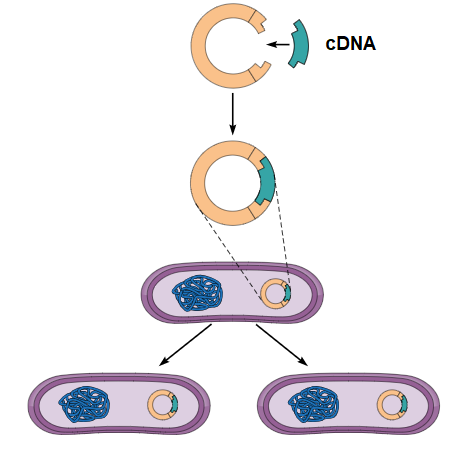
The organism the DNA was taken from.
The bacterial plasmid.
The bacterial cell.
The section of DNA to be cloned.
Question 14
Which one of the following is FALSE about blue/white screening?
Can identify the transformed bacteria that have recombinant plasmid.
White colonies shows bacteria consist of recombinant plasmid.
Blue colonies shows bacteria consist of non-recombinant plasmid.
Bacteria that have non-recombinant plasmid has disrupted lacZ gene.
Question 15
A scientist is trying to express human insulin gene in bacteria. After cloning the cDNA from the gene into a plasmid with the appropriate cDNA, and transfecting the plasmid into bacteria the scientist notices that he forgot to add antibiotics. What will greet him the next day?
A mostly normal petri dish - antibiotics are just used as a safe-guard against other bacteria.
A petri dish completely overrun with untransformed and transformed bacteria.
A petri dish with separate colonies of transformed and untransformed bacteria.
A petri dish with only untransformed bacteria, the antibiotics are required for transfection.
Question 16
What is benefits of insulin produced by genetic engineering?
(The answer can be more than ONE)
Insulin produced similar to human insulin.
Non-allergic.
Cheaper and can reproduce in large scale.
The gene used if from the host cell.
Question 17
A student adds Taq Polymerase, nucleotides, and primer to a test tube. What procedure are they most likely going to do next?