
FINAL STUDY - FAMILY EXAM #3

Question 1
A 32 weeks' gestation newborn in the neonatal intensive care is being assessed for hyperbilirubinemia. Which diagnostic tests would the nurse expect to be done? Select all that apply.
sodium levels
blood type
direct Coombs
bilirubin levels
hematocrit
hemoglobin
Question 2
a nurse is caring for a pregnant adolescent client, who is in her first trimester, during a visit to the maternal child clinic. Which of the following is an important area that the nurse should address during assessment of the client?
Sexual development of the client
whether sex was consensual
options for birth control in the future
knowledge of child development
Question 3
a nurse is caring for an infant born after a prolonged and difficult maternal labor. What are the nursing interventions involved when assessing for trauma and birth injuries in the newborn?
Examine the newborn skin for cyanosis
be alert for signs of apathy and listlessness
assess the baby for any temperature instability
note any absence of or decrease in deep tendon reflexes
Question 4
Based on this assessment of a newborn client, which interventions should the nurse perform? Select all that apply
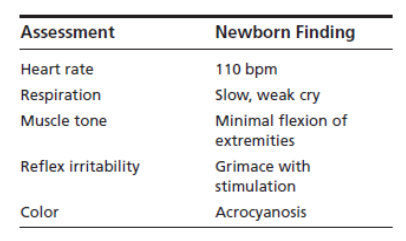
Suction the mouth and nose
Provide oxygen via face mask
Administer epinephrine endotracheally
Initiate an IV line of normal saline
Assess for need to administer naloxone
Question 5
A nurse is newly posted to the obstetric unit of the health care facility. which of the following are the causes of intrauterine fetal demise in late pregnancy that the nurse should be aware of?
Prolonged pregnancy
hydramnios
multiple fetal gestations
Malpresentation
hypertension
Question 6
A woman presents to her first postpartum visit reporting she does not feel well. Which findings would lead the nurse to suspect that she has developed endometritis? Select all that apply.
leukocytosis
flank pain
hematuria
pain on both sides of the abdomen
odorless lochia
Question 7
a pregnant client is brought to the health care facility with signs of premature rupture of membranes, which of the following are associated conditions and complications of premature rupture of membranes? Select all that apply
prolapsed cord
placenta abruption
spontaneous abortion
placenta previa
preterm labor
Question 8
a nurse has placed an infant with asphyxia on a radiant warmer. Which of the following signs indicate that the resuscitation methods have been successful?
Heart rate above 80 beats per minute
tremors
bluish tongue
good cry
Question 9
You're providing an in-service to a group of new labor and delivery nurse graduates about the pathophysiology of preeclampsia. Which statement by one of the group participants demonstrates they understood how this condition develops?
"The cardiovascular system of the mother fails to compensate for the increased blood flow from the fetus and placental ischemia occurs."
"If the mother experience uncontrolled hypertension and proteinuria, it compromises blood flow to the placenta and leads to preeclampsia."
"The placenta experiences ischemia because the spiral arteries of the uterus fail to reshape and increase in diameter."
"The basal arteries of the myometrium fail to widen to support blood flow to the placenta."
Question 10
the nurse is caring for a client in the early stages of Labor. What maternal factors will alert the nurse to plan for the possibility of a small fridge stational age newborn? Select all that apply
smoking
hypotension
asthma
drug use
pregnancy weight gain of 20 pounds
Question 11
a nurse is monitoring a client with spontaneous abortion who has been prescribed misoprostol. the nurse knows that which of the following symptoms are common adverse effects of this medication? Select all that apply
Constipation
dyspepsia
headache
hypotension
tachycardia
Question 12
During a prenatal visit, a health care provider decides to admit a client to the hospital. Based on the nurse's admission note below, which complication of pregnancy of pregnancy would the health care provider suspect?
"30-year-old female, admitted with nausea, vomiting. Client is 16 weeks pregnant, and reports thirst and vertigo. BP 120/70, RR 20, HR 104, Temp 100 F. Client has had nothing to eat or drink in 24 hours."
Iron deficiency anemia
Placenta previa
Pregnancy-induced hypertension
Hyperemesis gravidarum
Question 13
The expected respiratory rate of a neonate within 3 minutes of birth may be as high as
60
100
80
50
Question 14
Which of the following neonates is at highest risk for cold stress syndrome?
Infant of diabetic mother
Infant with Rh incompatibility
Postdates neonate
Down syndrome neonate
Question 15
The nurse receives a report at the beginning of the shift about a client with an intrauterine fetal demise. When collecting data on assessment of the client, the nurse expects to note which finding?
Intractable vomiting and dehydration
Elevated blood pressure and proteinuria
Uterine size greater than expected for gestational age
Regression of pregnancy symptoms and absence of fetal heart tones
Question 16
Which intrapartal assessment should be avoided when caring for a client with HELLP syndrome?
Abdominal palpation
Venous sample of blood
Checking deep tendon reflexes
Auscultation of the heart and lungs
Question 17
A client is admitted with vaginal bleeding at approximately 10 weeks of gestation. Her fundal height is 13 cm. Which potential problem should be investigated?
Placenta previa
Hydatidiform mole
Abruptio placentae
Disseminated intravascular coagulation (DIC)
Question 18
A placenta previa when the placental edge just reaches the internal os is called:
total.
partial.
low-lying.
marginal.
Question 19
Which finding on a prenatal visit at 10 weeks might suggest a hydatidiform mole?
Blood pressure of 120/80 mm Hg
Complaint of frequent mild nausea
Fundal height measurement of 18 cm
History of bright red spotting for 1 day weeks ago
Question 20
A client taking magnesium sulfate has a respiratory rate of 10 breaths/min. In addition to discontinuing the medication, which action should the nurse take?
Increase the clients IV fluids.
Administer calcium gluconate.
Vigorously stimulate the client.
Instruct the client to take deep breaths.
Question 21
Which finding could cause the nurse to suspect gestational trophoblastic disease in a client at 8 weeks gestation?
Blood pressure of 128/70 mm Hg
Fundal height of 12 cm
Nausea and vomiting
Weight gain of 3 pounds
Question 22
Fraternal twins are delivered by your Rh-negative client. Twin A is Rh-positive and twin B is Rh-negative. Prior to administering Rho(D) immune globulin (RhoGAM), the nurse should determine the results of the:
direct Coombs test of twin A.
direct Coombs test of twin B.
indirect Coombs test of the mother.
transcutaneous bilirubin level for both twins.
Question 23
Which interventions may be indicated for the clinical management of hyperemesis gravidarum (HEG)? (SATA)
Pyridoxine (Vitamin B6)
Diphenhydramine (Benadryl)
Omeprazole (Prilosec)
Promethazine (Phenergan)
Levaquin (Levofloxacin)
Total Parenteral Nutrition (TPN) in severe cases