
FAMILY - COMBINED OLD - EXAM #3

Question 1
A new young mother has tested positive for HIV. When discussing the situation with the client, the nurse should advise the mother that she should avoid which activity?
handling the infant with open sores
future pregnancies
breastfeeding
cesarean birth
Question 2
A woman with systemic lupus erythematosus is interested in preconception counseling to discuss her desire to get pregnant. The nurse explains that it would be best if she is symptom-free or in remission for how long before getting pregnant?
12 months
9 months
3 months
6 months
Question 3
Cytomegalovirus infection can result in different congenital anomalies. It can also be transmitted via different routes. When discussing this infection with a pregnant woman, the nurse integrates understanding that permanent fetal disability can occur with which type of transmission of CMV?
in utero transmission
with any transmission
during birth transmission
after birth transmission
Question 4
A pregnant client at 14 weeks' gestation calls the clinic. When talking with the nurse, the client reports continued, frequent nausea and vomiting. She states, "This has been happening since I got pregnant and now I cannot keep anything down." Which intervention would be the priority for this client?
Stopping all intake of food and drink
Obtaining serum electrolyte levels
Administering an antiemetic
Initiating intravenous access for fluids
Question 5
A woman is being closely monitored and treated for severe preeclampsia with magnesium sulfate. Which finding would alert the nurse to the development of magnesium toxicity in this client?
seizures
serum magnesium level of 6.5 mEq/L
diminished reflexes
elevated liver enzymes
Question 6
A nurse is providing care to a client who has been diagnosed with a common benign form of gestational trophoblastic disease. The nurse identifies this as:
placenta accrete.
hydramnios.
hydatidiform mole.
ectopic pregnancy.
Question 7
A woman has presented to the emergency department with symptoms that suggest an ectopic pregnancy. Which finding would lead the nurse to suspect that the fallopian tube has ruptured?
nausea
vaginal spotting
breast tenderness
referred shoulder pain
Question 8
Some women experience a rupture of their membranes before going into true labor. A nurse recognizes that a woman who presents with premature prelabor rupture of membranes (PPROM) has completed how many weeks of gestation?
less than 40 weeks
less than 37 weeks
less than 38 weeks
less than 39 weeks
Question 9
A pregnant woman is being evaluated for HELLP. The nurse reviews the client's diagnostic test results. An elevation in which result would the nurse interpret as helping to confirm this diagnosis?
hematocrit
white blood cells
platelet count
LDH
Question 10
A nurse is assessing a pregnant client for the possibility of preexisting conditions that could lead to complications during pregnancy. The nurse suspects that the woman is at risk for hydramnios based on which preexisting condition?
diabetes
isoimmunization
hypertension
late maternal age
Question 11
A nurse is providing care to a pregnant client hospitalized with preeclampsia. The nurse immediately notifies the health care provider that the client has developed eclampsia based on which finding?
Seizure activity
Blood pressure greater than 160/100 mm Hg
Proteinuria
Hyperreflexia
Question 12
A woman at 12 weeks' gestation comes to the clinic with vaginal bleeding. When assessing the woman further, the nurse would suspect a threatened abortion based on which finding?
cervical dilation
passage of fetal tissue
slight vaginal bleeding
high beta human chorionic gonadotropin (hCG) level
Question 13
The nurse recognizes that documenting accurate blood pressures is vital in the diagnosing of preeclampsia and eclampsia. The nurse suspects preeclampsia based on which finding?
BP of 160/110 mm Hg on two occasions after 28 weeks' gestation
BP of 130/90 mm Hg on three occasions 3 hours apart
BP of 140/90 mm Hg last week and at current visit
BP of 140/90 mm Hg on three occasions after 20 weeks' gestation
Question 14
Which finding would lead the nurse to suspect that a large-for-gestational-age newborn is developing hyperbilirubinemia?
temperature
instability
feeble sucking
tea-colored urine
Question 15
A nurse in a newborn nursery is monitoring a preterm newborn for respiratory distress syndrome. Which assessment signs noted in the newborn would alert the nurse to the possibility of this syndrome?
Tachypnea and retractions.
Acrocyanosis and grunting.
Hypotension and bradycardia.
Presence of a barrel chest with acrocyanosis.
Question 16
A pregnant client diagnosed with hyperemesis gravidarum is prescribed intravenous fluids for rehydration. When preparing to administer this therapy, which solution would the nurse anticipate being prescribed initially?
Normal saline
Albumin
Dextrose 5% and water
0.45% sodium chloride
Question 17
The nurse begins frequent oral feedings for a small-for-gestational-age newborn to prevent which occurrence?
meconium
aspiration
polycythemia
asphyxia
hypoglycemia
Question 18
A nurse is planning care for a newborn of a diabetic mother. A priority nursing diagnosis for this infant is:
Hyperthermia related to excess fat and glycogen
Risk for injury related to low blood glucose levels
Risk for delayed development related to excessive size
Risk for aspiration related to impaired suck and swallow reflexes
Question 19
A pregnant woman is diagnosed with abruptio placentae. When reviewing the woman's physical assessment in her medical record, which finding would the nurse expect?
firm, rigid uterus on palpation
absence of pain
bright red vaginal bleeding
fetal heart rate within normal range
Question 20
A newborn in the observational nursery demonstrates signs of neonatal abstinence syndrome. What findings would correlate with this diagnosis? Select all that apply.
lethargy
frequent yawning and sneezing
positive Moro reflex
respiration rate 25 breaths per minute
high-pitched cry
loose, watery stools
Question 21
You're providing an in-service to a group of new labor and delivery nurse graduates about the pathophysiology of preeclampsia. Which statement by one of the group participants demonstrates they understood how this condition develops?
"The cardiovascular system of the mother fails to compensate for the increased blood flow from the fetus and placental ischemia occurs."
"If the mother experience uncontrolled hypertension and proteinuria, it compromises blood flow to the placenta and leads to preeclampsia."
"The placenta experiences ischemia because the spiral arteries of the uterus fail to reshape and increase in diameter."
"The basal arteries of the myometrium fail to widen to support blood flow to the placenta."
Question 22
During pregnancy a woman's blood volume increases to accommodate the growing fetus to the point that vital signs may remain within normal range without showing signs of shock until the woman has lost what percentage of her blood volume?
20%
50%
30%
40%
Question 23
Periventricular-intraventricular hemorrhage is suspected in a newborn of 30 weeks' gestation. The nurse would anticipate preparing the newborn for which diagnostic tool to confirm the diagnosis?
chest X-ray
cranial ultrasound
blood glucose level
arterial blood gases
Question 24
The nurse is monitoring a client in the immediate postpartum period for signs of hemorrhage. Which sign, if noted, would be an early sign of excessive blood loss?
A temperature of 100.4
An increase in the pulse rate from 88 to 102 beats/minutes
A blood pressure change from 130/88 to 124/80
An increase in the respiratory rate from 18-22 breaths/minute
Question 25
The nurse is teaching new parents the best way to prevent hypothermia. Which mechanism would the nurse include when explaining about the newborn's primary method of heat production?
nonshivering thermogenesis
thermoregulation
thermoconduction
shivering thermogenesis
Question 26
A client is Rh-negative and has given birth to a newborn that is Rh-positive. Within how many hours should the mother receive the Rh immunoglobulin?
72 hours
48 hours
90 hours
36 hours
Question 27
A nurse is caring for a newborn with hypoglycemia. What symptoms should the nurse monitor the infant for? Select all that apply (4)
Lethargy
Low-Pitched Cry
Cyanosis
Skin Rashes
Jitteriness
High-Pitched Cry
Question 28
A nurse is caring for a newborn with transient tachypnea. What nursing interventions should the nurse perform while providing supportive care to the newborn? Select all that apply (3)
Provide warm water to drink
Provide oxygen supplementation
Massage the newborn's back
Ensure the newborn's warmth
Observe respiratory status frequently
Question 29
Which of the following manifestations should the nurse observe in the infant to confirm the occurrence of cold stress?
Change in the color of the urine
Increased Body Temp
Lethargy and Hypotonia
Skin Color Changes
Question 30
Based on this assessment of a newborn client, which interventions should the nurse perform? Select all that apply
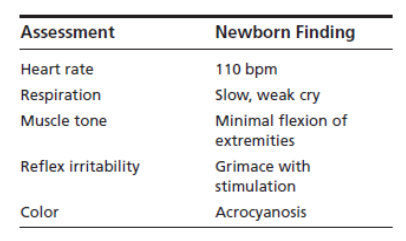
Suction the mouth and nose
Provide oxygen via face mask
Administer epinephrine endotracheally
Initiate an IV line of normal saline
Assess for need to administer naloxone
Question 31
Which assessment data warrants immediate intervention for the client in labor who is receiving an oxytocin infusion via pump?
The uterus periodically becomes hard and firm
The client reports an urgency to void
The client denies the urge to push
The FHR does not return to baseline
Question 32
When should the nurse assess the newborns initial blood glucose level?
After the newborn has been fed
24 hours after admission to the nursery
On admission to the nursery
Within 5 hours of admission to the nursery
Question 33
During physical assessment of a client who gave birth 3 hours ago, a nurse finds that the client has completely saturated a perinea! pad within 15 minutes. Which nursing actions would be appropriate? Select all that apply.
Begin an intravenous infusion of lactated Ringer's solution.
Palpate the client's fundus.
Assess the client's vital signs.
Place the client in high Fowler's position.
Place client on bedrest.
Question 34
A nurse is providing care to a woman who is 6 hours postpartum. The nurse suspects urinary retention based on which finding?
Moderate amount of lochia rubra
50 to 70 mL urine per void every hour
Fundus at the level of the umbilicus
Urine clear yellow in color
Question 35
The nurse in a labor room is monitoring a client with dysfunctional labor for signs of fetal or maternal compromise. Which assessment finding would alert the nurse to a compromise?
Maternal Fatigue
Coordinated Uterine Contractions
Progressive Changes in the Cervix
Persistent non-reassuring fetal heart rate
Question 36
A G3, P2 woman arrives at the birthing center stating that she has been in labor for the past 18 hours. The nurse suspects a protracted labor pattern disorder based on which finding?
Fetal face presentation
Poor contraction quality and intensity
slower than usual cervical dilation
Incomplete relaxation of the uterus between contractions
Question 37
A 19-year-old nulliparous is in early labor with erratic contractions. An assessment notes that she is remaining at 3 cm. There is also a concern that the uterus is not fully relaxing between contractions. The nurse suspects which complication?
cephalopelvic disproportion
ruptured uterus
precipitate labor
reduced oxygen to the fetus
Question 38
The nurse knows that preeclampsia tends to occur during what time in a pregnancy?
Before 20 weeks
In the 3rd trimester and postpartum
After 20 weeks
In the first and second trimester
Question 39
A client presents to the birthing center in labor. The client's membranes have just ruptured. Which assessment is the nurse's priority?
FHR
Fetal Position
Maternal Comfort Level
Signs of Infection
Question 40
A woman is in the fourth stage of labor. During the first hour of this stage, the nurse would assess the woman's fundus at which frequency?
every 15 minutes
every 10 minutes
every 20 minutes
every 5 minutes
Question 41
a nurse is assigned to care for a newborn with hyperbilirubinemia . The newborn is relatively large in size and shows signs of listlessness. What would have most likely happened to have caused these conditions to occur in the infant? …
The infant's mother must have had a low birth weight
the infant's mother must have been a diabetic
the infant must have experienced birth trauma
the infant's mother must have abused alcohol
Question 42
a nurse is caring for an infant born with a high bilirubin level. When planning infant care, what interventions will assist in reducing the bilirubin level? Select all that apply
hydration
increased water intake
early feedings
vitamin supplements
phototherapy
Question 43
a nurse is caring for an infant born with hypoglycemia. What care should the nurse administer to a newborn with hypoglycemia?
Maintain fluid and electrolyte balance
give dextrose IV before oral feedings
place the infant on a radiant warmer immediately
focus on decreasing blood viscosity
Question 44
when caring for a preterm infant, what intervention will most address the sensorimotor needs of the infant?
Rocking and massaging
swaddling and positioning
using a minimal amount of tape
using distraction through objects
Question 45
a nurse is caring for an antenatal mother diagnosed with umbilical cord prolapse. Which of the following should the nurse monitor for in a fetus in a case of umbilical cord prolapse?
Fetal hypoxia
pre eclampsia
coagulation defects
placental pathology
Question 46
A nurse is caring for obstetric clients. The nurse should be aware of which of the following as an indication for labor induction?
Chorioamnionitis
Complete Placenta Previa
Placental Abruption
Transverse Fetal Lie
Question 47
A nurse is caring for a pregnant client. The initial interview reveals that the client is accustomed to drinking coffee at regular intervals. What possible effect of maternal coffee consumption during pregnancy should the nurse make the client aware of?
Increased risk of heart disease
increase risk of anemia
increase risk of rickets
increased risk of scurvy
Question 48
Caring for a client undergoing treatment for an ectopic pregnancy. Which of the following symptoms is observed in a client if the rupture or hemorrhaging occurs before the ectopic pregnancy is successfully treated?
Phrenic Nerve irritation
painless bright red vaginal bleeding
fetal distress
Tetanic contractions
Question 49
the nurse is required to assess a client for HELLP syndrome. Which of the following are the signs and symptoms of this condition? Select all that apply
blood pressure higher than 160 /110
epigastric pain
Oliguria
upper right quadrant pain
hyperbilirubinemia
Question 50
the nurse is assessing a client who was in her 24th week of pregnancy the nurse knows which of the following presenting symptoms should be further assessed as a possible sign of pre-term labor? Select all that apply
increase in vaginal discharge
Phrenic Nerve Irritation
rupture of membranes
uterine contractions
hypovolemic shock
Question 51
A nurse is caring for a client who has just undergone delivery. What is the best method for the nurse to assess this client for postpartum hemorrhage?
Assessing skin turgor
Assessing BP
Assessing Uterine Involution
By monitoring hCG titers
Question 52
The nurse is caring for a pregnant client with severe preeclampsia. Which of the following nursing interventions should a nurse perform to institute and maintain seizure precautions in this client?
Provide a well lit room
keep the head of the bed slightly elevated
place the client in a supine position
keep the suction equipment readily available
Question 53
of the following clients is at the greatest risk for developing placenta previa
the 23-year-old client
a client with a history of alcohol ingestion
a client with a structurally defective cervix
a client who has undergone a myomectomy to remove fibroids
Question 54
During the assessment of a pregnant client, the nurse learns that the client has CVD. Which of the following should the nurse identify as a major risk that can be faced by the newborn of the client?
Respiratory distress syndrome
congenital varicella syndrome
SIDS
prune belly syndrome
Question 55
the nurse is caring for a pregnant client who indicates that she is fond of meat, works with children, and has a pet cat. Which of the following instructions should the nurse give this client to prevent toxoplasmosis transmission? Select all that apply
eat meat cooked thoroughly to 160 to 165 degrees
avoid cleaning the cats litter box
keep the cat outdoors at all times
avoid contact with children when they have a cold
avoid outdoor activities such as gardening
Question 56
Which of the following is a contraindication for oxytocin administration?
Dysfunctional Labor Pattern
Postterm Status
Prolonged Rupture of Membranes
Overdistended Uterus
Question 57
Fetal growth is dependent on: Genetics, placental, and maternal factors
Question 58
which of the following is a risk to newborn because of meconium in the amniotic fluid
bradycardia
perinatal asphyxia
acute respiratory complications
polycythemia
Question 59
which maternal factors should the nurse consider that could lead to a newborn being large for gestational age? Select all that apply
diabetes mellitus
Postdate gestation
alcohol use
glucose intolerance
renal infection
Question 60
which of the following indicates meconium aspiration and a newborn?
Bluish skin discoloration
listlessness or lethargy
stained umbilical cord
pink tongue
Question 61
A 19-year-old woman presents to the emergency department in the late stages of active labor. Assessment reveals she received no prenatal care. As part of her examination, a rapid HIV screen indicates she is HIV positive. To reduce the perinatal transmission to her infant, which intravenous medication would the nurse anticipate administering?
Benzodiazepines
Antaractic
Antibiotics
Antiretroviral
Question 62
A potential complication for the mother and fetus is Rh incompatibility; therefore, assessment should include blood typing. If the mother is Rh negative, her antibody titer should be evaluated. If treatment with Rho(D) immune globulin is indicated, the nurse would expect to administer it at which time?
only at birth
28 weeks
32 weeks
36 weeks
Question 63
At what point in the pregnancy is it possible for the fetus to survive outside the womb?
The end of the third trimester
The end of the first trimester
The end of the second trimester
The end of the fourth trimester
Question 64
a nurse is caring for an infant born after a prolonged and difficult maternal labor. What are the nursing interventions involved when assessing for trauma and birth injuries in the newborn?
Examine the newborn skin for cyanosis
be alert for signs of apathy and listlessness
assess the baby for any temperature instability
note any absence of or decrease in deep tendon reflexes
Question 65
the nurse is caring for a client in the early stages of Labor. What maternal factors will alert the nurse to plan for the possibility of a small fridge stational age newborn? Select all that apply
smoking
hypotension
asthma
drug use
pregnancy weight gain of 20 pounds
Question 66
the nurse is performing a newborn assessment. What findings will alert the nurse to the development of polycythemia in the newborn?
Jaundice
restlessness
temperature instability
wheezing
Question 67
a nurse is assessing a term newborn and finds the blood glucose level is 23 MG per DL and the newborn has a weak cry, is irritable, and has Bradycardia. Which intervention is most important?
Administer dextrose intravenously
monitor the infants hematocrit levels
administer IV glucose immediately
place the infant on a radiant warmer
Question 68
which of the following interventions should the nurse perform to promote thermal regulation in a preterm newborn?
Assess the newborns temperature every five hours until stable
set the temperature of the radiant warmer at a fixed level
observe for clinical signs of cold stress such as a weak cry
check the blood pressure of the infant every two hours
Question 69
a nurse has placed an infant with asphyxia on a radiant warmer. Which of the following signs indicate that the resuscitation methods have been successful?
Heart rate above 80 beats per minute
tremors
bluish tongue
good cry
Question 70
A nurse is caring for an infant born with polycythemia . Which intervention is most appropriate when caring for the infant?
Focus on decreasing blood viscosity by increasing fluid volume
check blood glucose within two hours of birth
repeat screening every two to three hours or before feeds
focus on monitoring and maintaining blood glucose levels
Question 71
which of the following precautions should a nurse take to prevent infection in a newborn? Select all that apply
avoid coming to work when ill
cover jewelry while washing hands
use sterile gloves for invasive procedures
avoid using disposable equipment
monitor lab test results for changes
Question 72
A nurse is newly posted to the obstetric unit of the health care facility. which of the following are the causes of intrauterine fetal demise in late pregnancy that the nurse should be aware of?
Prolonged pregnancy
hydramnios
multiple fetal gestations
Malpresentation
hypertension
Question 73
A nurse is assessing the cause of multiple gestations. Which of the following factors should the nurse assess as contributors to an increased probability of multiple gestations?
Infertility treatments
medications
advanced maternal age
adolescent pregnancies
Question 74
a nurse is caring for a newborn with fetal alcohol spectrum disorder. What characteristic of fetal alcohol spectrum disorder should the nurse assess for in the newborn?
Small head circumference
decrease blood glucose level
poor breathing pattern
wide eyes
Question 75
a nurse is assigned to care for a client who has been diagnosed with placental abruption. The nurse knows that which of the following could have led to the abruption?
Obesity or excess weight gain
CVD
gestational diabetes
gestational hypertension
Question 76
a nurse is caring for a pregnant adolescent client, who is in her first trimester, during a visit to the maternal child clinic. Which of the following is an important area that the nurse should address during assessment of the client?
Sexual development of the client
whether sex was consensual
options for birth control in the future
knowledge of child development
Question 77
A nurse is caring for a pregnant client who works at a daycare center and is in regular contact with children. What instructions should the nurse give this client in order to minimize risk of transmission of cytomegalovirus to the fetus?
ensure thorough hand washing
seek consultation for antibiotics
avoid interacting with children
drink plenty of fluids
Question 78
a nurse is monitoring a client with spontaneous abortion who has been prescribed misoprostol. the nurse knows that which of the following symptoms are common adverse effects of this medication? Select all that apply
Constipation
dyspepsia
headache
hypotension
tachycardia
Question 79
a pregnant client is brought to the health care facility with signs of premature rupture of membranes, which of the following are associated conditions and complications of premature rupture of membranes? Select all that apply
prolapsed cord
placenta abruption
spontaneous abortion
placenta previa
preterm labor
Question 80
A nurse is caring for a pregnant client with an eclamptic seizure. Which of the following should the nurse know as a characteristic of eclampsia?
Muscle rigidity is filled by facial twitching
respirations are rapid during a seizure
Coma occurs after the seizure
respirations fall after the seizure
Question 81
A nurse is monitoring a client with PROM who is in labor and observes meconium in the amniotic fluid. What does this indicate?
Cord Compression
Fetal Distress Related to Hypoxia
Infection
CNS Involvement
Question 82
a client with pre-eclampsia is receiving magnesium sulfate to suppress or control seizures. Which of the following nursing intervention should the nurse perform to determine the effectiveness of therapy?
assessing deep tendon reflexes
monitor intake and output
assess mucus membranes
assess client's vital signs and skin turgor which
Question 83
A nurse has been assigned to assess a pregnant client for placental abruption. Which of the following is a classic manifestation of this condition that the nurse should assess for?
Painless bright red vaginal bleeding
increased fetal movement
knife like abdominal pain with vaginal bleeding
generalized vasospasms