
EXAM #2 - FAMILY NURSING - #3

Question 1
A nurse is caring for a 1-day postpartum client. The progress note below informs the nurse that the client is in which phase of the postpartum period.
Letting Go
Taking In
Holding Out
Taking Hold
Question 2
Given to enhance pain relief and cause sedation. May be used to decrease nausea and vomiting.
Diazepam (Valium)
Midazolam (Versed)
Promethazine (Phenergan)
Prochlorperazine (Compazine)
Hydroxyzine (Vistaril)
Question 3
Not used for analgesic but for amnesia. Used adjunct to other meds. Is expressed in breastmilk, given IV
Diazepam (Valium)
Midazolam (Versed)
Promethazine (Phenergan)
Prochlorperazine (Compazine)
Hydroxyzine (Vistaril)
Question 4
Used for nausea and vomiting when combined with opioids. Causes sedation and reduced apprehension. May contribute to maternal hypotension and neonatal depression. Can be given IV or IM
Diazepam (Valium)
Midazolam (Versed)
Prochlorperazine (Compazine)
Hydroxyzine (Vistaril)
Promethazine (Phenergan)
Question 5
Does not relieve pain, but reduces anxiety, and potentiates opioid analgesic effects. Decreases nausea and vomiting. Can only be given IM
Diazepam (Valium)
Midazolam (Versed)
Promethazine (Phenergan)
Prochlorperazine (Compazine)
Hydroxyzine (Vistaril)
Question 6
Frequently given with morphine for sleep during prolonged latent phase. Counteracts the nausea that opioids cause. Can be given IV or IM
Diazepam (Valium)
Midazolam (Versed)
Promethazine (Phenergan)
Prochlorperazine (Compazine)
Hydroxyzine (Vistaril)
Question 7
Decreases uterine contractions. Can cause maternal and neonatal CNS depression. Rapidly crosses the placenta. Causes a decrease in FHR variability. May be given IV or epidurally
Meperidine (Demerol)
Morphine
Butorphanol (Stadol)
Nalbuphine (Nubain)
Fentanyl (Sublimaze)
Question 8
Can cause CNS depression. Decreases fetal variability. May be given IV intrathecally, or epidurally with maximal fetal uptake 2-3 hours after administration
Meperidine (Demerol)
Morphine
Butorphanol (Stadol)
Nalbuphine (Nubain)
Fentanyl (Sublimaze)
Question 9
Causes maternal hypotension, maternal and fetal respiratory depression. Rapidly crosses the placenta. Given IV or epidurally
Meperidine (Demerol)
Morphine
Butorphanol (Stadol)
Nalbuphine (Nubain)
Fentanyl (Sublimaze)
Question 10
Rapidly transferred across the placenta. Causes neonatal respiratory depression. Given IV
Meperidine (Demerol)
Morphine
Butorphanol (Stadol)
Nalbuphine (Nubain)
Fentanyl (Sublimaze)
Question 11
Causes maternal nausea and vomiting. Causes decreased FHR variability, fetal bradycardia, and respiratory depression. Given IV
Meperidine (Demerol)
Morphine
Butorphanol (Stadol)
Nalbuphine (Nubain)
Fentanyl (Sublimaze)
Question 12
Which assessment data warrants immediate intervention for the client in labor who is receiving an oxytocin infusion via pump?
The uterus periodically becomes hard and firm
The client reports an urgency to void
The client denies the urge to push
The FHR does not return to baseline
Question 13
Which statement best indicates the scientific rationale for administering erythromycin ophthalmic ointment to a newborn client?
It prevents ophthalmia neonatorum in infants of mothers who have gonorrhea
It prevents otitis externa in infants with mother’s that have herpes simplex virus
It prevents the transient strabismus in infants with mother’s that have chlamydia
It prevents blindness in infants of mothers with cytomegalovirus
Question 14
Based on this assessment of a newborn client, which interventions should the nurse perform? Select all that apply
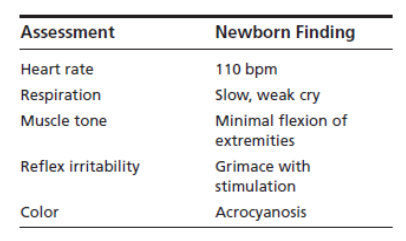
Suction the mouth and nose
Provide oxygen via face mask
Administer epinephrine endotracheally
Initiate an IV line of normal saline
Assess for need to administer naloxone
Question 15
Which statement best indicates the scientific rationale for administering vitamin K to the newborn infant?
It promotes blood clotting in the infant
It prevents conjunctivitis in the infants eyes
It stimulates peristalsis in the small intestines
It helps the digestive process in the newborn
Question 16
Which of the following maternal physiologic responses should the nurse monitor for the client as she progresses through childbirth? Select all that apply (3)
Increased HR
Increased BP
Increased RR
Slight Decrease in Body Temp
Increased Gastric Emptying and pH
Question 17
A pregnant client is admitted to a maternity clinic for childbirth. Which assessment findings indicates that the client's fetus is in the transverse lie position?
The long axis of the fetus is at 60 degrees to that of the mother
The long axis of the fetus is parallel to that of the mother
The long axis of the fetus is perpendicular to that of the mother
The long axis of the fetus is at 45 degrees to that of the mother
Question 18
What is the importance of pauses between contractions during labor?
Effacement and dilation of the cervix
Shortening of the upper uterine segment
Reduction in the length of the cervical canal
Restoration of blood flow to the uterus and placenta.
Question 19
A nurse is performing an admission assessment on the phone for a pregnant client. Which of the following information should the nurse obtain from them? Select all that apply (3)
Estimated Due Date
Characteristics of Contractions
History of Drug Abuse
The appearance of vaginal blood
History of drug allergies
Question 20
How often should the nurse monitor the pregnant client who is in the active stage of labor?
15-30 minutes
30 minutes
30-60 minutes
Every 2 hours
Question 21
How often should the nurse monitor the FHR with the doppler or electronic monitoring for a client in the latent phase of labor?
Every 30 minutes
Every 1 hour
Every 45 minutes
Continously
Question 22
Which of the following factors should the nurse assess to monitor uterine contractions? Select all that apply (3)
Uterine Resting Tone
Frequency of Contractions
Intensity of Contractions
Change in Maternal Temperature
Change in Maternal BP
Question 23
What interventions should the nurse perform for a pregnant client in labor with the FHR below 110. Select all that apply (3)
Turn the client on her left side
Reduce IV Fluid rate
Administer oxygen by mask
Assess the client for underlying causes
Ignore questions from the client
Question 24
Which of the following should the nurse consider when assisting the client that opted for hydrotherapy for pain management during labor.
Initiate the technique only when the client is in active labor
Do not allow the client to stay in the bath for long
Ensure the water temperate exceeds body temperature
Allow the client into the way only if her membranes have ruptured
Question 25
Which of the following techniques should the nurse suggest for slow-paced breathing?
Inhale through the mouth at a rate of 4 breaths every 5 seconds
Inhale slowly through the nose and exhale through pursed lips
Punctuated breathing by a forceful exhalation through pursed lips every few breaths
Hold breath for 5 seconds after every 3 breaths
Question 26
A client was administered an anesthetic block during labor. Which of the following are risks the nurse should watch for? Select all that apply. (3)
Incomplete emptying of the bladder
Bladder distention
Ambulation Difficulty
Urinary Retention
Perineal Laceration
Question 27
A client is Rh-negative and has given birth to a newborn that is Rh-positive. Within how many hours should the mother receive the Rh immunoglobulin?
72 hours
48 hours
90 hours
36 hours
Question 28
The nurse is assessing a client during the postpartum period. Which of the following indicates a normal postpartum adjustment? Select all that apply. (3)
Abdominal Pain
Active Bowel Sounds
Tender Abdomen
Passing Gas
Nondistended abdomen
Question 29
Which are the expected neurobehavioral responses of the newborn? Select all that apply (4)
Orientation
Habituation & Motor Maturity
Self-Quieting Ability
Social Behaviors
Vigorous Crying
Acrocyanosis
Question 30
Which of the following factors increases HR and BP in a newborn? Select all that apply. (3)
Feeding
Wakefulness
Sleeping
Movement
Crying
Skin-to-Skin Contact
Question 31
Which of the following are the benefits of delayed cord clamping after birth? Select all that apply (3)
Improved cardiopulmonary adaptation and oxygen transport
Prevention of Anemia
Increased Apgar Score
Increased BP and RBC flow
Increased ability to strive
Question 32
Which of the following immunoglobulins does breast milk contain that boosts the newborns immune system?
IgA
IgD
IgE
IgM
Question 33
What guidance should the nurse give to the client before discharge regarding care of the newborn at home?
Ensure cool air is circulating over the newborn to prevent excessive heat
Keep the newborn wrapped in a blanket with a cap on their head
Hold the newborn close to the body after taking a shower
Refrain from using clothing and blankets in the crib
Question 34
Which of the following are factors that increase the risk of overheating in a newborn? Select all that apply. (3)
Limited Sweating ability
Underdeveloped Lungs
Too-Warm Crib
Limited Insulation
Lack of Brown Fat
Question 35
Which of the following manifestations should the nurse observe in the infant to confirm the occurrence of cold stress?
Change in the color of the urine
Increased Body Temp
Lethargy and Hypotonia
Skin Color Changes
Question 36
When should the nurse assess the newborns initial blood glucose level?
After the newborn has been fed
24 hours after admission to the nursery
On admission to the nursery
Within 5 hours of admission to the nursery
Question 37
A nurse is caring for a newborn with transient tachypnea. What nursing interventions should the nurse perform while providing supportive care to the newborn? Select all that apply (3)
Provide warm water to drink
Provide oxygen supplementation
Massage the newborn's back
Ensure the newborn's warmth
Observe respiratory status frequently
Question 38
A nurse is caring for a newborn with hypoglycemia. What symptoms should the nurse monitor the infant for? Select all that apply (4)
Lethargy
Low-Pitched Cry
Cyanosis
Skin Rashes
Jitteriness
High-Pitched Cry
Question 39
A nurse is performing a detailed newborn assessment of a female baby. Which of the following observations indicates a normal finding? Select all that apply (3)
Mongolian Spots
Swollen Genitals
Enlarged Fontanelles
Low-Set Ears
Short, Creased Neck