Refraction and Lenses

Question 1
Reflection is the change in direction of a wave as it changes speed while moving from one medium to another.
Question 2
A lens is a transparent object with at least one curved side that causes light to change direction.
Question 3
The more curved the sides of a lens, the less the light changes direction as it passes through the lens.
Question 4
A concave lens is curved outward on at least one side so it is thicker in the middle.
Question 5
The light rays converge (comes to a single point) as they pass through the convex lens.
Question 6
When an object is farther than one focal length from a convex lens, the image is upside down.
Question 7
When an object is less than one focal length from a convex lens, the image is smaller and upside down.
Question 8
A concave lens is curved inward on at least one side and thicker at the edges.
Question 9
Concave lenses are usually used in combinations with other lenses in instruments such as telescopes and microscopes.
Question 10
Each color of light has a different wavelength and frequency.
Question 11
Waves with longer wavelengths travel at slower speeds in the material than waves with shorter wavelengths.
Question 12
The cornea is a concave lens made of transparent tissue located on the outside of the eye.
Question 13
The iris is the dark opening into the interior of the eye.
Question 14
The iris is the colored part of the eye.
Question 15
When the iris changes size, the amount of light that enters the eye changes.
Question 16
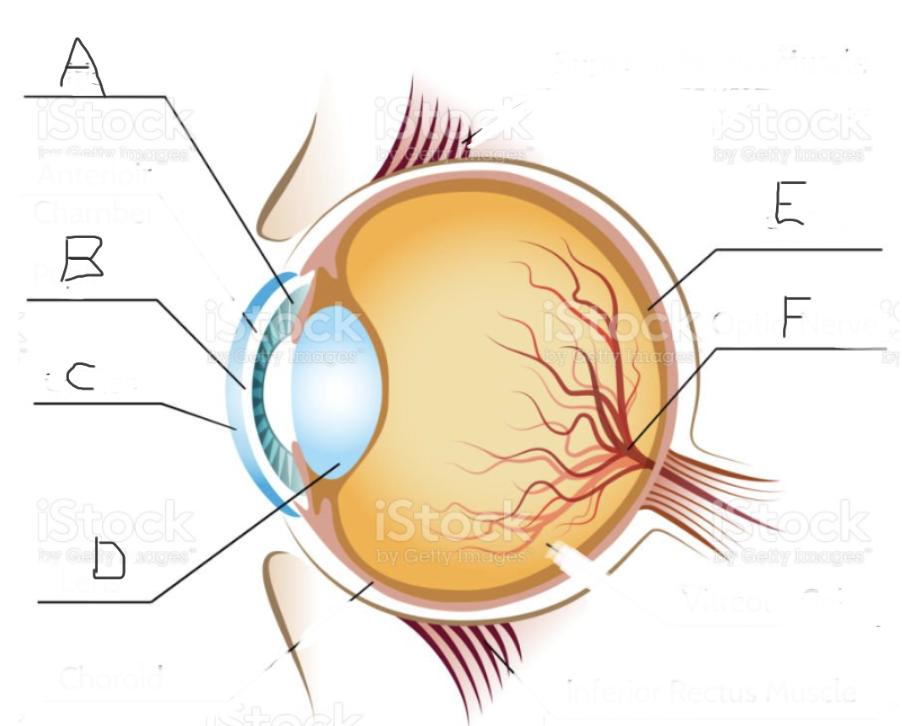
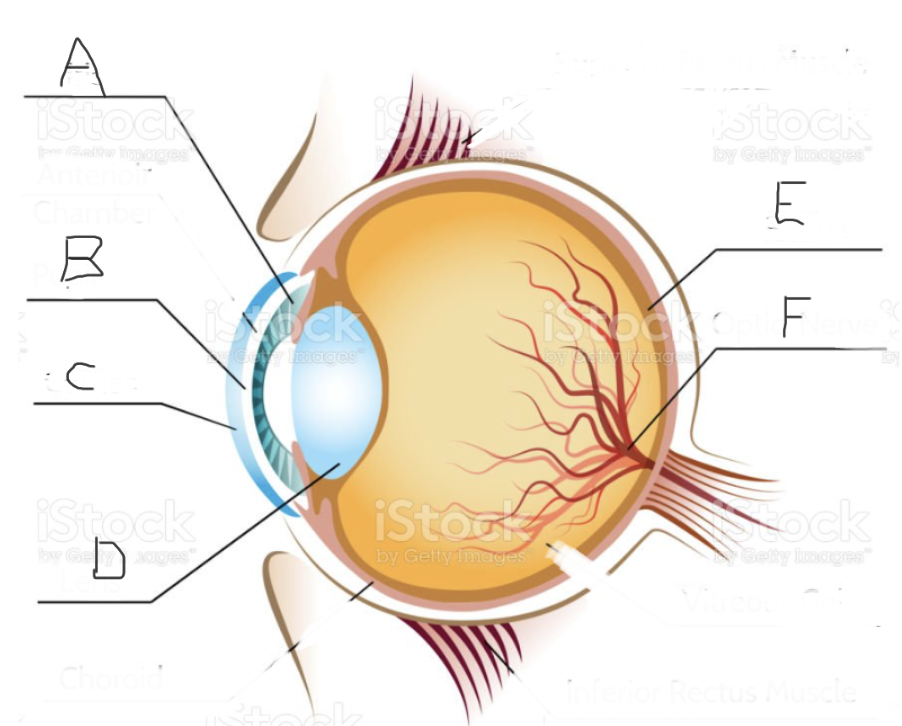
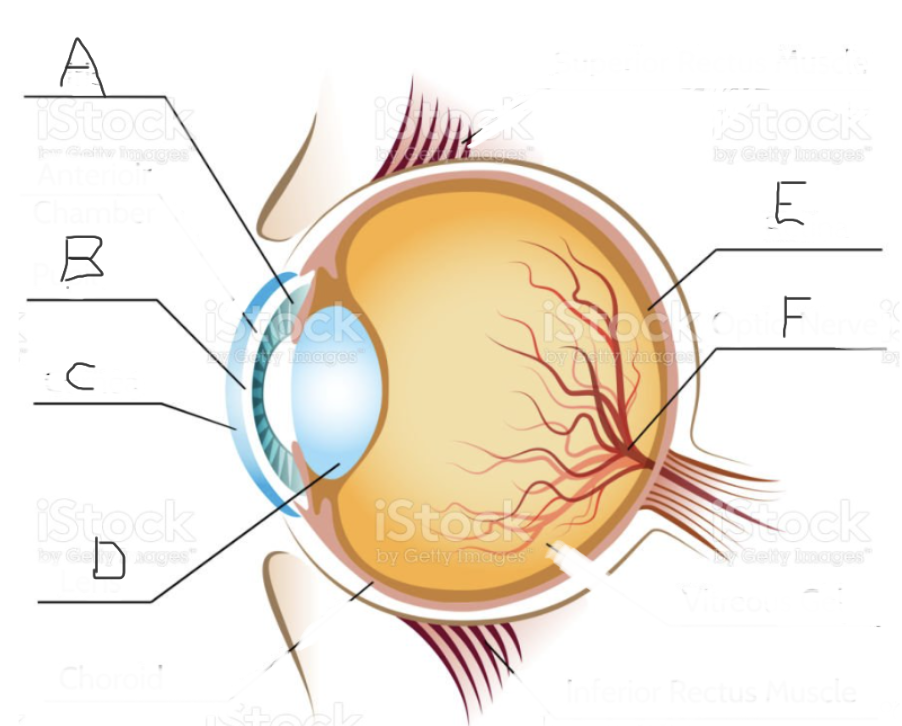
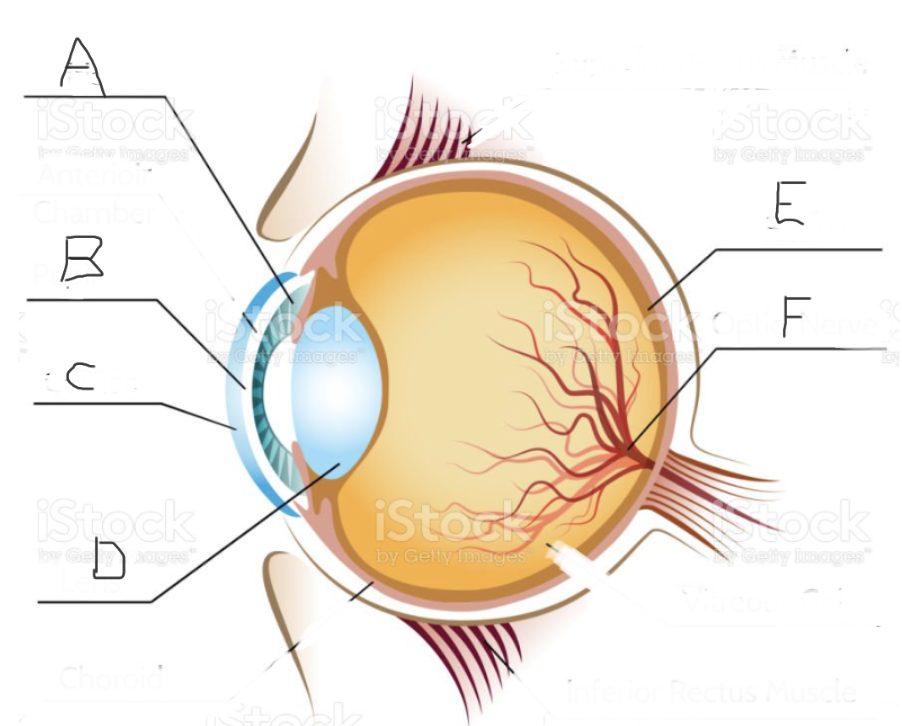
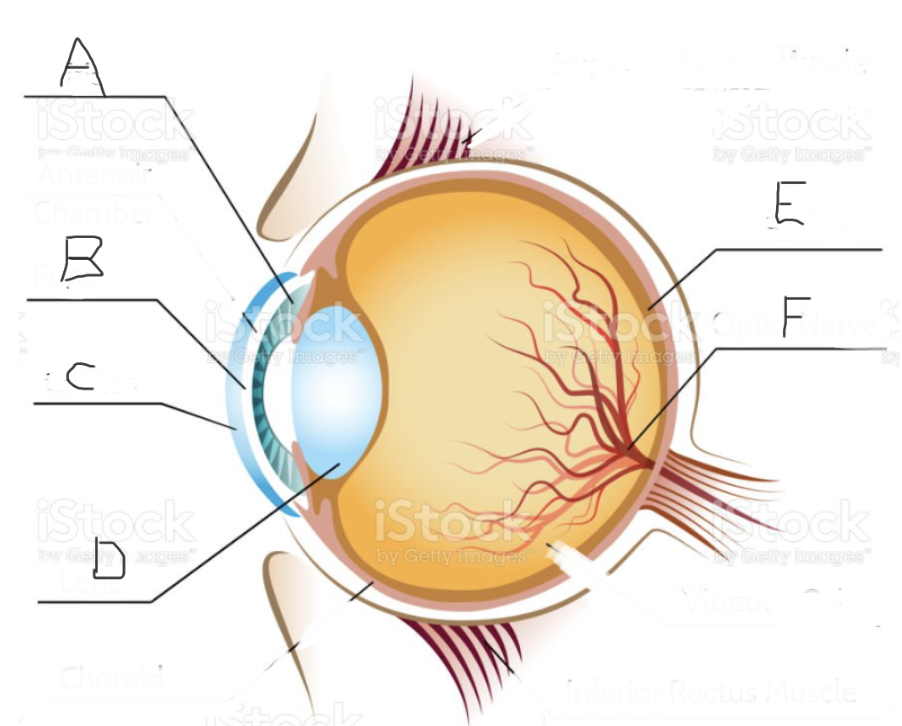
What is the name of the part in the eye that is labeled A from the picture below?
Question 17
What is the name of the part in the eye that is labeled B from the picture below?
Question 18
What is the name of the part in the eye that is labeled C from the picture below?
Question 19
What is the name of the part in the eye that is labeled D from the picture below?
Question 20
What is the name of the part in the eye that is labeled E from the picture below?
Question 21
What is the name of the part in the eye that is labeled F from the picture below?