MKT3351 Quiz 11 (Ch. 13)
1. Retailers using a(n) ________ strategy frequently—often weekly—discount the initial prices for merchandise through sales promotions.
A.A) disintermediated pricing
B.B) penetration pricing
C.C) high/low pricing
D.D) price skimming
E.E) everyday low-pricing.
2. A(n) ________ strategy emphasizes the continuity of retail prices at a level somewhere between the regular nonsale price and the deep-discount sale price of high/low retailers.
A.A) leader pricing
B.B) keystoning
C.C) high/low pricing
D.D) price skimming
E.E) everyday low-pricing
3. Which of the following statements holds true for an everyday low-pricing (EDLP) strategy?
A.A) Slow-selling merchandise can be sold by discounting the price.
B.B) It allows retailers to charge higher prices to customers who are not price sensitive.
C.C) Customers need to wait for items to go on sale.
D.D) The use of EDLP increases the need for advertising.
E.E) EDLP retailers do not have to incur the labor costs of changing price tags.
4. Which of the following is not a factor that retailers consider in setting prices?
A.A) Price sensitivity of consumers
B.B) The cost of the merchandise and services
C.C) Competition
D.D) Legal restrictions
E.E) Language barriers
5. Cliff is struggling with the price of produce at his well-established produce markets. The reputation of the markets attracts repeat customers from a 50-mile radius. Recently, local farmers started increasing produce prices for him due to the upsurge in gas prices. Now, Cliff feels it is time to pass the costs onto his customers. Which of the following should Cliff estimate to determine the effect of price changes?
A.A) Price elasticity
B.B) Break-even point quantity
C.C) Fixed costs
D.D) Reference price
E.E) Markup percentage
6. Which of the following items has the most price elasticity?
A.A) Fast food
B.B) Branded luxury goods
C.C) Prescription medication
D.D) Movie tickets
E.E) Gasoline
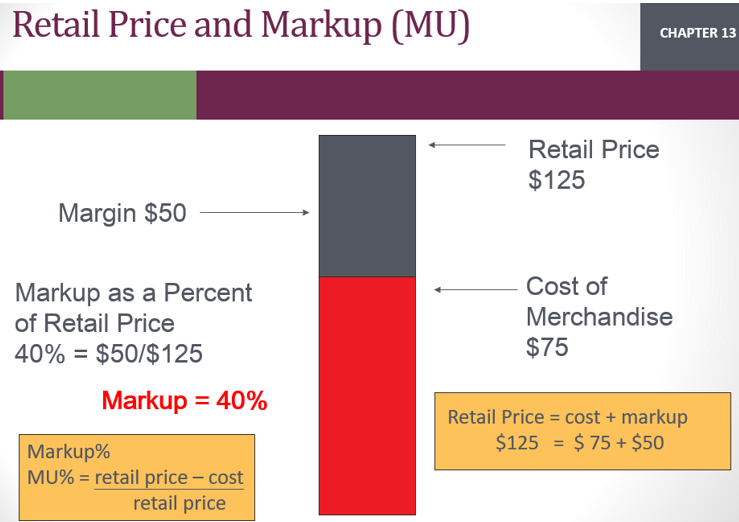
7. A drugstore purchases hand cream at $2 per jar and sells the jars for $15. What is the markup percentage?
A.A) 60%
B.B) 87%
C.C) 40%
D.D) 5%
E.E) 22%
8. Which of the following statements is not true of markdowns?
A.A) Markdowns are part of the cost of doing business, and thus buyers plan for them.
B.B) A buyer's objective is to minimize markdowns.
C.C) Retailers have a set of arbitrary rules for taking markdowns.
D.D) Buyers employ markdowns to promote merchandise and increase sales.
E.E) Markdowns can increase customer traffic flow.
9. How does optimization software help retailers in taking markdowns?
A.A) It gives retailers the point at which it is optimal to job-out and consolidate.
B.B) It updates pricing based upon actual sales and factors in differences in price sensitivities.
C.C) It continually updates buyers on sales by price beginning at the point of sale.
D.D) It dictates markdown merchandise into one percentage markdown per week in the store.
E.E) It indicates markdowns based on how long the merchandise has been in the store.
10. ________ is the practice of pricing certain items lower than normal to increase customers' traffic flow or boost sales of complementary products.
A.A) Stimulus pricing
B.B) Leader pricing
C.C) Follow-up pricing
D.D) Price lining
E.E) Odd pricing