1. A student left a sealed jar of water outside her home. Water can be a solid, liquid, or gas. When she put it outside, the water was a solid. Twelve hours later, the water had changed phase and was a liquid. What happened to the water molecules?
A.a. Before the student left, the molecules were moving in place. After, the molecules were moving around each other.
B.b. Before the student left, the molecules were moving around each other. After, the molecules were moving away from each other.
C.c. Before the student left, the molecules were moving around each other. After, the molecules were moving in place.
D.d. Before the student left, the molecules were moving away from each other. After, the molecules were moving around each other.
2. Lily is doing a science experiment with a substance in a sealed jar. At first, the substance’s molecules are moving around each other. What will happen to Lily’s substance if she transfers energy into the substance and causes a phase change?
A.After the phase change, the substance’s molecules will move . . . faster, and the substance will be a liquid.
B.After the phase change, the substance’s molecules will move . . . faster, and the substance will be a gas.
C.After the phase change, the substance’s molecules will move . . . slower, and the substance will be a solid.
D.After the phase change, the substance’s molecules will move . . . slower, and the substance will be a liquid.
3. Divers found two substances at the bottom of the ocean. At room temperature, both substances are liquid. Scientists then transferred the same amount of energy out of both substances. When a scientist checked again, Substance 1 had changed phase, but Substance 2 had not. How are Substances 1 and 2 different?
A.Substance 1 has a . . . weaker attraction between its molecules than Substance 2. Its molecules now move in place.
B.Substance 1 has a . . . weaker attraction between its molecules than Substance 2. Its molecules now move around each other.
C.Substance 1 has a . . . stronger attraction between its molecules than Substance 2. Its molecules now move away from each other.
D.Substance 1 has a . . . stronger attraction between its molecules than Substance 2. Its molecules now move in place.
4. Anh measured the temperature of a pond near his house. Before he left for school, the water in the pond was 18°C. When he came home from school, the temperature of the pond was higher than it was in the morning. What happened to the water molecules while he was at school?
A.The molecules got closer together.
B.The molecules started moving faster.
C.The water lost cold molecules.
D.The molecules became larger.
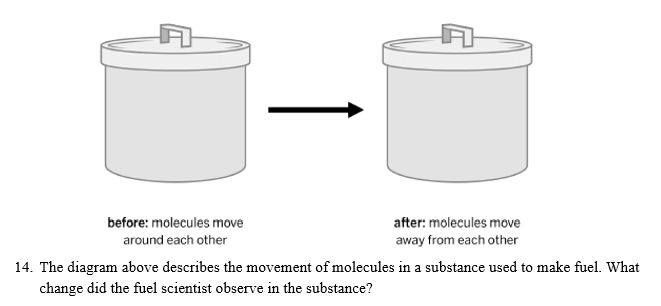
5. A scientist has a container with a substance inside. At first, the molecules in the substance move away from each other. Later, the molecules move around each other. What change did the scientist observe in the substance?
A.a. Before, the substance was a liquid. Later, it was a solid.
B.b. Before, the substance was a gas. Later, it was a liquid.
C.c. Before, the substance was a liquid. Later, it was a gas.
D.d. Before, the substance was a solid. Later, it was a liquid.
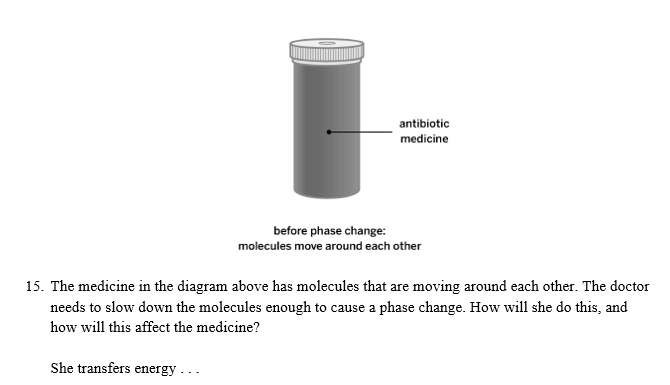
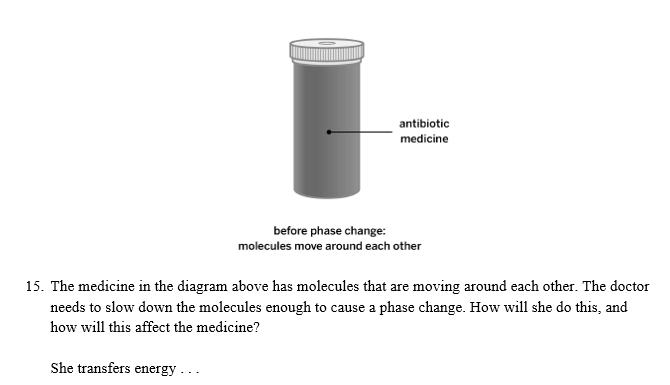
6. Scientists digging in a cave found an unknown substance. The scientists found that the substance’s molecules were moving around each other. The scientists increased the speed of the substance’s molecules and caused a phase change. How did the scientists do this, and how did this affect the substance?
The scientists transferred energy . . .
A.a. into the substance, and the substance changed into a gas.
B.b. into the substance, and the substance changed into a liquid.
C.c. out of the substance, and the substance changed into a solid.
D.d. out of the substance, and the substance changed into a liquid.
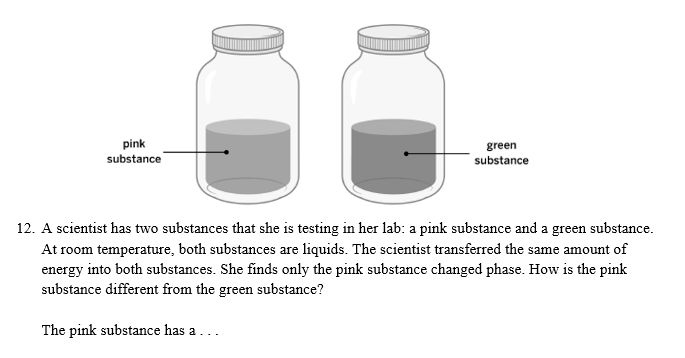
7. A cook had a jar containing a sweet food and a jar containing a sour food. The image above shows the sweet and sour foods. At room temperature, both foods are liquids. The same amount of energy was transferred into both substances. Later, one of the foods had changed phase while the other had not. Which food changed phase, and how did it change?
A.a. The sweet food changed because the molecules were able to move fast enough to overcome the attraction between them. Its molecules now move away from each other.
B.b. The sweet food changed because the strong attraction between molecules made their movement slower. Its molecules now move around each other.
C.c. The sour food changed because the weak attraction between molecules let them move faster. Its molecules now move away from each other.
D.d. The sour food changed because the molecules were able to move fast enough to overcome the attraction between them. Its molecules now move in place.
9. What happens to molecules when their kinetic energy decreases?
A.a. They move slower.
B.b. They move faster.
C.c. They get heavier.
D.It depends on the type of molecules.
13. The fuel tank of an airplane has a device that measures the fuel’s temperature. Before the airplane took off, the temperature of the fuel was 27°C. After the airplane had been flying for one hour, the temperature of the fuel had decreased to 3°C. Which of the following must have happened to the molecules of the fuel?
A.a. The molecules get farther apart.
B.b. The molecules started moving slower.
C.c. The fuel gained cold molecules.
D.d. The molecules became smaller in size.
Jamil's bicycle is made of aluminum. When are the aluminum molecules in his bicycle moving? The aluminum molecules are ...
A.a. only moving when Jamil is riding his bicycle.
B.b. only moving when Jamil is not riding his bicycle.
C.c. always moving.
D.d. never moving.
18. How is the kinetic energy of molecules changing when the molecules move faster? The kinetic energy ...
A.a. is not changing.
B.b. depends on the molecules.
C.c. is decreasing.
D.d. is increasing.