Determine in which situation a quadrat can be used.
A.When the organisms are not sessile.
B.When the size of organisms are too large.
C.When the organisms are hard to observe.
D.When the number of organisms is too large.
Indicate why a quadrat should be placed randomly.
A.To facilitate the count of organisms inside the quadrat.
B.To reduce the chance of damaging slow-moving animals.
C.To get a valid representative sample.
D.To get as many species as possible in the quadrat.
Choose the factor that does not contribute to the type of soil.
A.Soil structure.
B.The direction of wind blowing on the soil surface.
C.The moisture content of the soil.
D.The pH of the soil.
Select the incorrect statement about line transect.
A.The line transect shows how the diverse types of plants vary across a section.
B.The line transect consists of a square frame.
C.The line transect is marked off at regular intervals.
D.The line transect is usually pegged down at both ends.
Determine why herbarium is useful.
A.To understand the distribution of plants.
B.To observe the habitat of plants.
C.To identify plants.
D.To indicate a list of plants in a particular area.
Choose the best way to test a soil’s ability to hold water.
A.Add soil to a beaker full of water and observe if the soil sinks.
B.Stir the soil into a bowl of water and observe if the soil disappears.
C.Pouring water through a funnel of soil and measuring how much water drips out.
D.Measuring the size of soil particles under a microscope.
Select the insects that are not pinned on a spreading board.
A.Juvenile giant grasshoppers.
B.Adult butterflies.
C.Larvae of beetles.
D.Worker bees
Indicate what type of insects a beating tray would collect.
A.Insects that spend much of their lives in the water.
B.Insects that are nocturnal and attracted to light.
C.Insects that frequently attach to plants and are reluctant to fly or run.
D.Insects that scurries across the ground rather than fly.
Select the type of equipment used by entomologists to collect insects from leaf litter and soil samples.
A.Tullgren funnel
B.Pitfall trap
C.Aspirator
D.Sweep net
Select the animals that can be measured with a quadrat.
A.Grasshoppers
B.Corals
C.Crabs
D.Rodents
Several students investigate the characteristics of the soil. The students observe samples of common soil. In one sample they observe that water drains through the soil easily. When they rub the soil between their fingers, it feels rough and scratchy, and its particles feel hard. The soil the students observed is most likely
A.clay
B.silt
C.loam
D.sandy
Many plants cannot grow in sandy soil. Why is this true?
A.
Sandy soil does not hold enough water.
B.Air cannot pass through sandy soil.
C.Roots cannot easily push through sandy soil.
D.Sandy soil has too many nutrients.
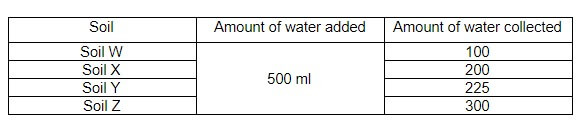
Some students added 500 ml of water to equal amounts of four different samples of soil. In this investigation, which sample of soil held the most water, and predict the type of soil.
A.Soil W – loam soil
B.Soil W – clay soil
C.Soil X – loam soil
D.Soil Z – sandy soil
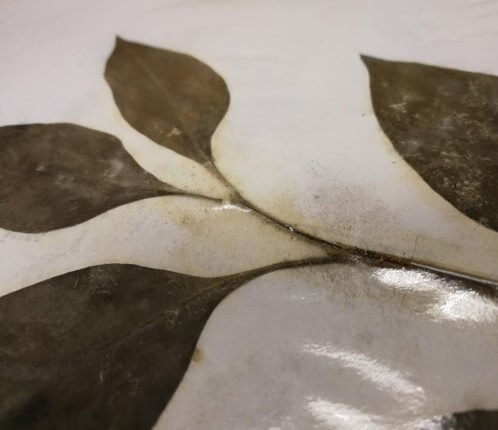
Photo 1 is an example of a herbarium sheet containing mold spores. Evaluate the product and select the best statement.
A.The sample is already damaged before the herbarium process.
B.The sample is not being dried properly before laminating with a plastic cover.
C.The sample contains a lot of water content, thus needed more time to dry.
D.The sample should have been sterilised with steam under pressure before herbarium preparation.
The following items are the tools that you will be using when preparing insect preservation. Identify which is not the appropriate tool.
A.Collecting tube.
B.Net.
C.Lamp.
D.Plastic folder.
The following items are the tools that you will be using when preparing a herbarium. Identify which is not the appropriate tool.
A.Plastic folder
B.Glue
C.Net
D.Knife
Which property of soil could students determine by rubbing a sample between their fingers?
A.The colour of the soil.
B.The texture of the soil.
C.The soil’s pH.
D.The processes that formed the soil.
Identify the correct sequence of plant preservation.
A.labelling – pressing – collecting – drying – mounting
B.collection – pressing – drying – labelling – mounting
C.collection – pressing – drying – mounting – labelling
D.collection – pressing – labelling – drying – mounting
You are not allowed to collect a sample that is considered an endangered species. Identify which is the least reason for this regulation.
A.Accelerating the extinction of species.
B.Hard to find other similar species elsewhere.
C.Lack of mates for producing offspring.
D.Good for human health benefits.
The list below is the importance of field investigations EXCEPT
A.Essential for the application of key concepts.
B.To make sure all the laboratory experiments can be done properly.
C.To discover the applications of science in technology and research.
D.Significant gains in learning may be achieved only through field experiences.