Energy changes and chemical reaction

Question 1
Chemical bonds contain what form of energy?
Products energy
Thermal energy
Reactants energy
Chemical energy
Question 2
Chemical reactions that absorb thermal energy are what type of reaction?
Endothermic reaction
Exothermic reaction
Thermal reaction
Chemical reaction
Question 3
In an endothermic reactions; reactants → products + thermal energy.
Question 4
In an exothermic reaction; reactants + thermal energy → products
Question 5
Activation energy is the minimum amount of energy needed to start a chemical reaction.
Question 6
If a reaction has high activation energy, less energy is needed to start the reaction.
Question 7
The rate of a reaction is the volume at which it occurs
Question 8
Chemical reactions occur faster if particles collide less often or move slower when they collide.
Question 9
Increased surface area decreases reaction rate because more particles on the surface of a solid come into contact with the particles of another substance.
True
False
Question 10
At higher temperatures, the average speed of particles is greater, particles collide more often, and collisions with more energy are more likely to break chemical bonds.
Question 11
At higher temperatures, the average speed of particles is decrease.
Question 12
Increasing the concentration of one or more reactants increases collisions between particles, resulting in a fast reaction rate.
Question 13
In gases, an increase in pressure pushes gas particles closer together, resulting in less collisions.
Question 14
A catalyst is a substance that slows, or even stops, a chemical reaction.
Question 15
An inhibitor is a substance that slows, or even stops, a chemical reaction.
Question 16
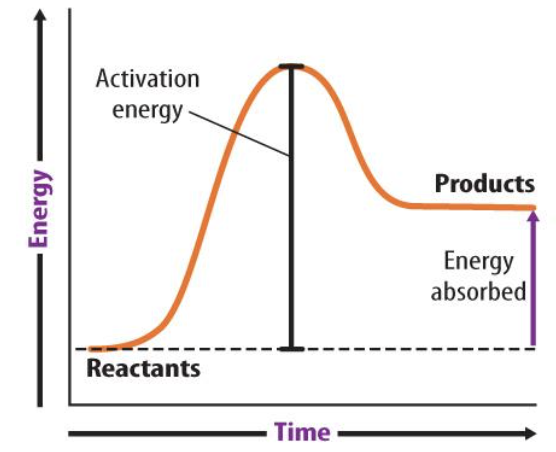
From looking at the figure below it is an Exothermic reaction.
True
False
Question 17
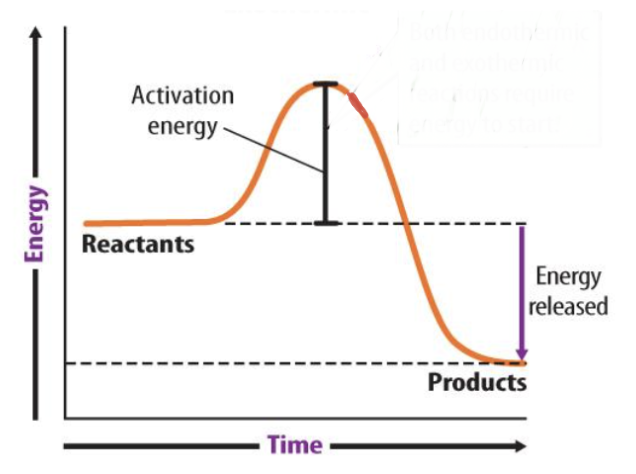
From looking at the figure below it is an Exothermic reaction.
True
False
Question 18
An enzyme is an excellent example of an inhibitor.
True
False
Question 19
Food preservatives are an excellent example of an inhibitor.
True
False
Question 20
Fire is an excellent example of an endothermic reaction.
True
False