DNA Replication
Semi-conservative model

Question 1
Which of the following statements best explains the mechanism for DNA replication?
DNA replication is reductive, because half the total DNA present is copied.
DNA replication is semi-conservative, because each DNA strand serves as a template during replication.
DNA replication is dispersive, because the two resulting DNA molecules are mixtures of parent and daughter DNA.
DNA replication is conservative, because one resulting molecule is identical to the original and the other consists of two new strands.
Question 2
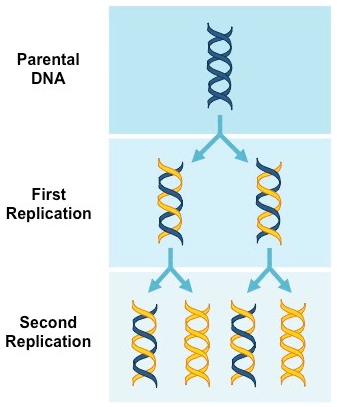
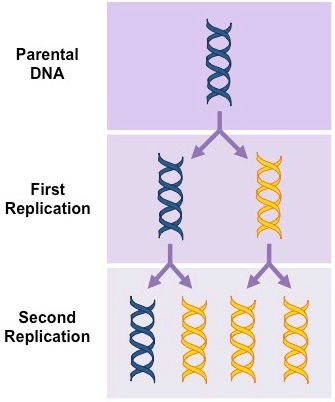
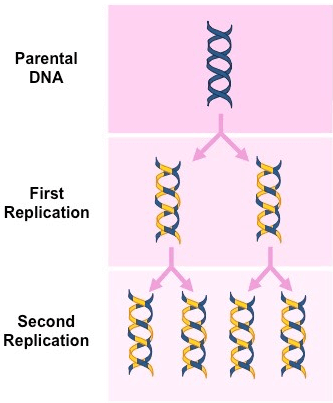
Which diagram illustrates the semi-conservative model of DNA replication?
Question 3
What is the starting point in replication called?
Question 4
In DNA replication, DNA "unwinds" to form two template strands: the leading strand and the lagging strand. Which of the following statements about these strands is true?
Question 5
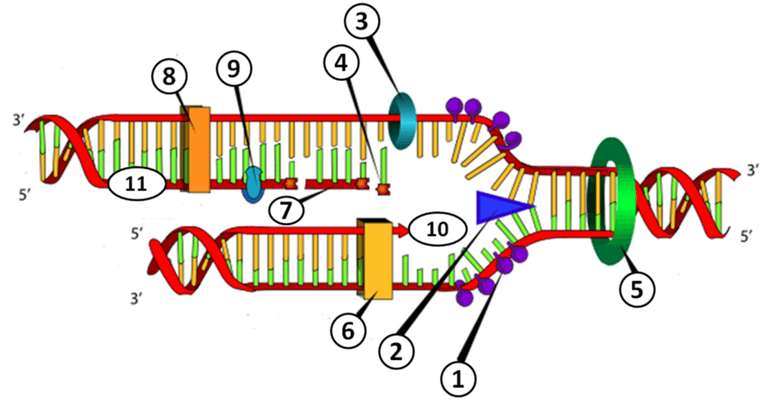
What type of bond does helicase break?
Question 6
The G-C base pairs would be harder to split.
Question 7
Which structure is single-strand binding (SSB) protein?
Question 8
Which of the following enzymes remove supercoiling in replicating DNA ahead of the replication fork?
Question 9
[[1]] catalyze the addition of [[2]] nucleotides that complementary to the [[3]] template to form RNA [[4]].
Question 10
What is the function of the enzyme DNA polymerase III?
Question 11
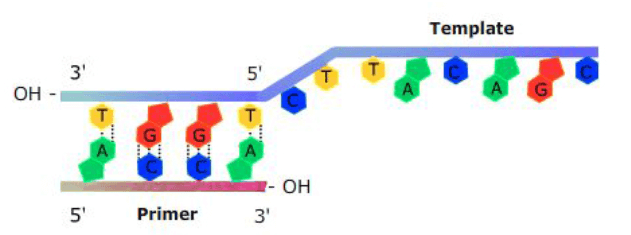
Based on the diagram, the first DNA nucleotide will be added by DNA polymerase III is
Question 12
What will be the complementary strand of the following: 5'-ATGCGTACG-3'
Question 13
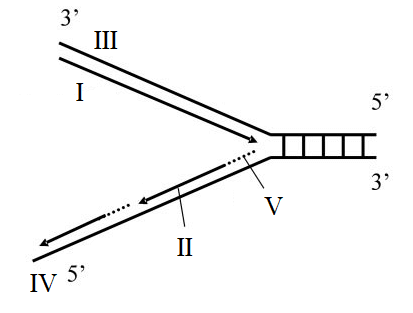
The mechanism of DNA replication is studied in a replication fork. Which is a characteristic of this replication fork?
Question 14
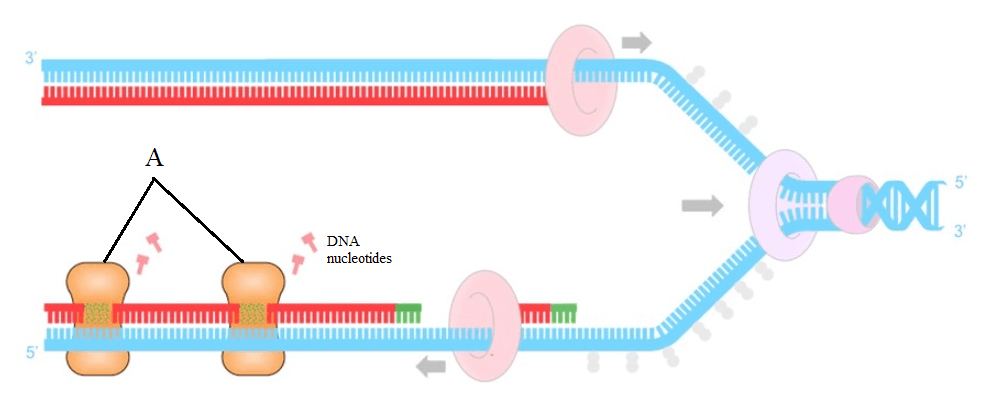
_________ removes the RNA primer and replace it with DNA nucleotides.
Question 15
Which protein can catalyze the formation of phosphodiester bonds?
Question 16
Which of the following is true about DNA polymerase?