WAVES 6P1
Waves 6P1
[Deleted Account]
•over 6 years agoQuestion 1
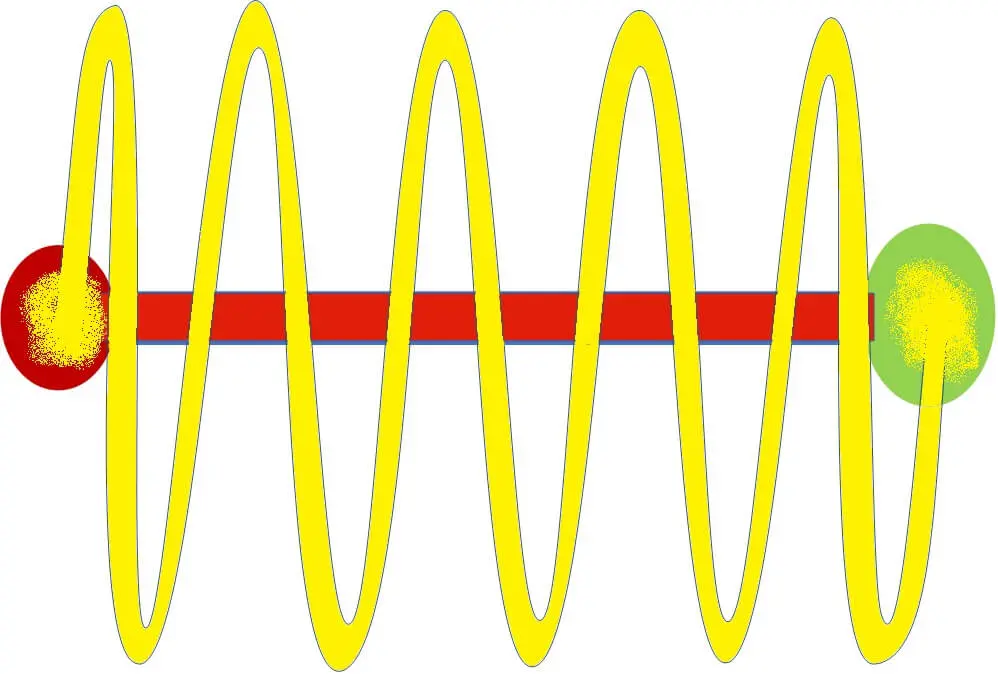
Waves are made of
Question 2
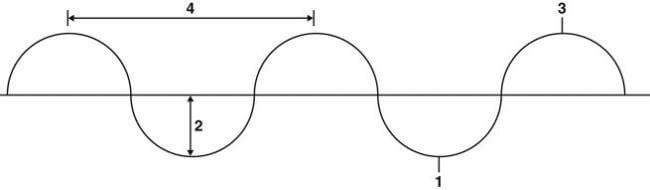
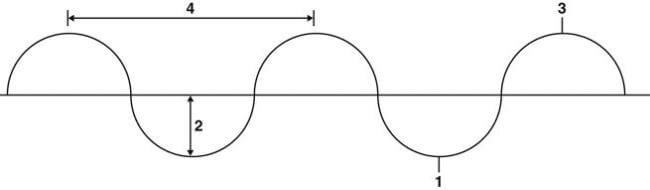
Identify part number 3 of the wave pictured.
Question 3
Zachary studies sound waves traveling through different substances. In what way does a sound wave change when it travels out of water and through wood?
Question 4
When pressure is released along a fault line, the energy produced spreads as mechanical waves in the form of an earthquake. The mechanical waves transferred to the air become...
Question 5
An apple appears red when struck by white light. This appearance is because the red light is reflected and the other colors are absorbed. What color will this apple appear to be when struck by blue light?
Question 6
Wave length can be measured from...
Question 7
Identify part number 2 of the wave pictured.
Question 8
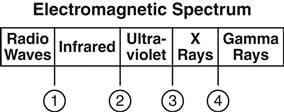
Which list below shows waves organized from most amount of energy to the least amount on the electromagnetic spectrum?
Question 9
On the electromagnetic spectrum shown, which numbered position represents where the visible light spectrum is found?
Question 10
Jacaden often disturbs the class by tapping on the desk once every second. He increases the tapping to twice every second but the intensity stays the same. What part of a sound wave has he changed by increasing the number of taps per second?
Question 11
A musician bought new strings for a guitar. The thickness of each string influences its rate of vibration. How does the rate of vibration affect the sound of the guitar?
Question 12
Why does tapping a fork against a water glass produce a sound?
Question 13
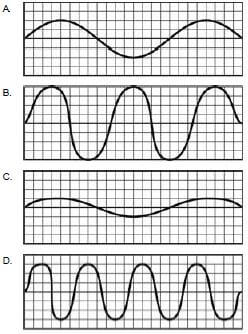
The volume of a sound depends on the amplitude of the sound waves. Which of the following sound waves illustrates the loudest sound?
Question 14
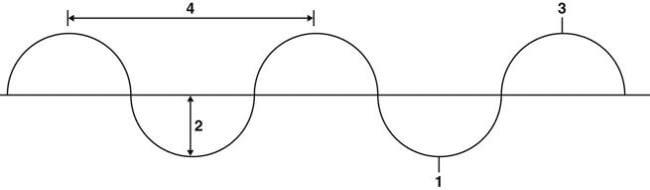
Identify part number 1 of the wave pictured.
Question 15
Which of the following makes up the smallest region in the electromagnetic spectrum?
Question 16
Vibrations in the air caused by knocking on a door form what kind of energy?
Question 17
An ocean wave has a wave length of 50 cm and a frequency of 3 hz. What is the wave speed?
Question 18
Which statement correctly describes how a sound wave travels through air?
Question 19
Which of the following statements best describes visible light?
Question 20
Scientist are able to map the interior of the earth by studying...
Question 21
Wave energy always moves in which direction?
Question 22
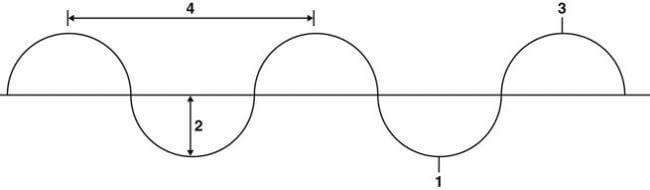
Identify part number 4 of the wave pictured.
Question 23
An ocean wave with a wavelength of 3 meters and a frequency of 2 hertz. The speed of the wave is:
Question 24
Through which material do sound waves travel fastest?
Question 25
Prolonged exposure to excessively loud noise, such as listening to loud music, can create the perception of noise or ringing in the ears. This condition is a form hearing loss known as
Question 26
Color blindness is most likely a result from
Question 27
The three tiny bones of the middle ear are the
Question 28
The formula for wave speed is wave length x frequency. If a radio wave has a wave speed of 144 meters per second and frequency of 24 hz, what is wave length?
Question 29
How do we see images?
Question 30
Why is the sky blue?
Question 31
Increase frequency in sound will result in
Question 32
Which waves move through the earth faster?