What algebraic rule represents a translation.
A.(x, y) --> (1/3x, 1/3y)
B.(x, y) --> ( x, -y)
C.(x, y) --> ( x +4, y - 2)
D.(x, y) --> ( 2 - x, 4 - y)
What algebraic rule represents a dilation.
A.(x, y) --> ( 2 + x, 2 - y)
B.(x, y) --> ( 2x, 2y)
C.(x, y) --> ( -x, -y)
D.(x, y) --> ( -y, x)
What algebraic rule represents a reflection over the x-axis .
A.(x, y) --> ( -x, y)
B.(x, y) --> ( -x, -y)
C.(x, y) --> ( y, -x)
D.(x, y) --> ( x, -y)
What algebraic rule represents a reflection over the y-axis .
A.(x, y) --> ( -x, y)
B.(x, y) --> ( x, -y)
C.(x, y) --> ( -x, -y)
D.(x, y) --> ( -y, x)
What algebraic rule represents a Rotation 270 degrees Counterclockwise .
A.(x, y) --> ( -x, y)
B.(x, y) --> ( y, -x)
C.(x, y) --> ( -x, -y)
D.(x, y) --> ( -y, x)
What algebraic rule represents a Rotation 90 degrees Counterclockwise .
A.(x, y) --> ( -y, x)
B.(x, y) --> ( y, -x)
C.(x, y) --> ( -x, -y)
D.(x, y) --> ( x, -y)
What algebraic rule represents a Rotation 90 degrees clockwise .
A.(x, y) --> ( -y, x)
B.(x, y) --> ( -x, -y)
C.(x, y) --> ( y, -x)
D.(x, y) --> ( -x, y)
What algebraic rule represents a Rotation 270 degrees clockwise .
A.(x, y) --> ( -x, y)
B.(x, y) --> ( -x, -y)
C.(x, y) --> ( y, -x)
D.(x, y) --> ( -y, x)
What algebraic rule represents a Rotation 180 degrees clockwise and counterclockwise .
A.(x, y) --> ( -y, x)
B.(x, y) --> ( -x, y)
C.(x, y) --> ( -x, -y)
D.(x, y) --> ( x, -y)
Which Transformation does NOT maintain congruence.
A.Translation
B.Rotation
C.Dilation
D.Reflection
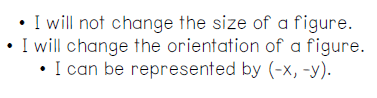
Which Transformation is described
A.Reflection
B.Rotation
C.Translation
D.Dilation
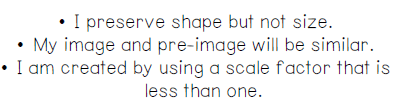
Which Transformation is described
A.Reflection
B.Translation
C.Dilation
D.Rotation
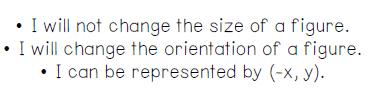
Which Transformation is described
A.Reflection
B.Rotation
C.Transformation
D.Dilation
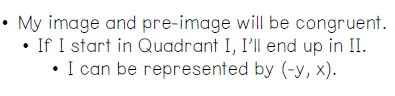
Which Transformation is described
A.Reflection
B.Dilation
C.Rotation
D.Transformation
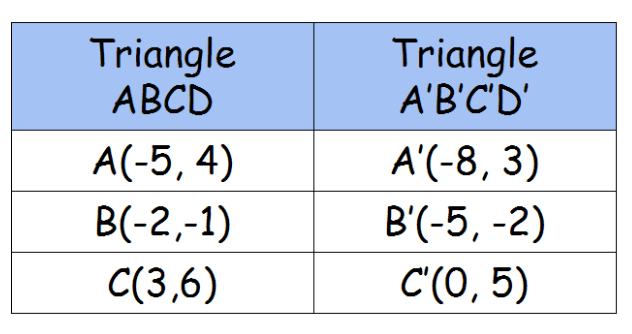
The table shows the coordinates of Triangle ABC and Triangle A'B'C' after a transformation. Which algebraic rule represents the transformation.
A.(x, y) --> ( x - 3, y - 1)
B.(x, y) --> ( 3 - x, 1 - y)
C.(x, y) --> ( x + 3, y + 1)
D.(x, y) --> ( 3 + x, 1 + y)
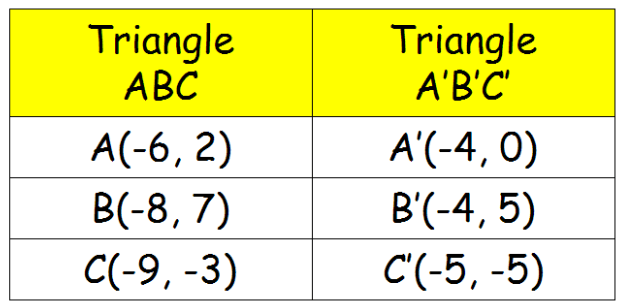
The table shows the coordinates of Triangle ABC and Triangle A'B'C' after a transformation. Which algebraic rule represents the transformation.
A.(x, y) --> (x - 4, y - 2 )
B.(x, y) --> ( x - 4, y + 2)
C.(x, y) --> ( 4 + x, 2 + y)
D.(x, y) --> ( x + 4, y - 2)
What rotation is equal to a 90 degree clockwise rotation?
A.270 degrees counterclockwise
B.180 degrees
C.90 degrees counterclockwise
D.270 degrees clockwise
Describe the rule (x-5, y+2)
A.A translation 5 units right and 2 units up
B.A translation 5 units left and 2 units down
C.A translation 5 units left and 2 units up
D.A translation 2 units left and 5 units up
What transformation is represented by this rule (x, y) --> (-y, x)
A.Rotation of 90 Clockwise
B.Reflection over x axis
C.Rotation 180 degrees clockwise
D.Rotation 270 degree Clockwise
The algebraic rule represents a transformation of Triangle ABC to Triangle A'B'C'. Which statement is true about this rule. (x, y) --> ( x + 7, y - 2)
A.Triangle ABC is translated to create Triangle A′B′C′. The triangles are congruent.
B.Triangle ABC is rotated to create Triangle A′B′C′. The triangles are congruent.
C.Triangle ABC is translated to create Triangle A′B′C′. The triangles are NOT congruent.
D.Triangle ABC is rotated to create Triangle A′B′C′. The triangles are NOT congruent.