Endocrine & the Eye
[Deleted Account]
•about 7 years agoQuestion 1
A gland (as a sweat gland, a salivary gland, or a kidney) that releases a secretion external to or at the surface of an organ by means of a canal or duct.
Question 2
A gland (as the thyroid or the pituitary) that produces an endocrine secretion -- called also ductless gland, gland of internal secretion.
Question 3
Any one of the many circulating chemical signals found in all multicellular organisms that are formed in specialized cells, travel in body fluids, and coordinate the various parts of the organism by interacting with target cells.
Question 4
This regulates the anterior pituitary by releasing TRH
Question 5
An endocrine gland at the base of the hypothalamus; that releases TSH to act on the thyroid
Question 6
The automatic adjustment of the eye for seeing at different distances affected chiefly by changes in the convexity of the crystalline lens.
Question 7
A defect of an optical system (as a lens) causing rays from a point to fail to meet in a focal point resulting in a blurred and imperfect image.
Question 8
The small circular area in the retina where the optic nerve enters the eye that is devoid of rods and cones and is insensitive to light.
Question 9
Any of the conical photosensitive receptor cells of the vertebrate retina that function in color vision.
Question 10
The transparent part of the coat of the eyeball that covers the iris and pupil and admits light to the interior.
Question 11
The ability to judge the distance of objects and the spatial relationship of objects at different distances.
Question 12
A condition in which visual images come to a focus behind the retina of the eye and vision is better for distant than for near objects -- called also�farsightedness.
Question 13
Colored part of the eye
Question 14
A curved piece of glass or plastic used singly or combined in eyeglasses or an optical instrument (as a microscope) for forming an image by focusing rays of light.
Question 15
The sensory membrane that lines most of the large posterior chamber of the vertebrate eye, signals which reach the brain by way of the optic nerve.
Question 16
Any of the long rod-shaped photosensitive receptors in the retina responsive to faint light.
Question 17
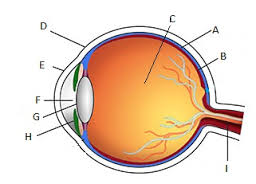
What is C?
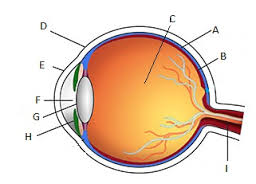
Question 18
This membrane allows animals to see at night.
Question 19
What is G?
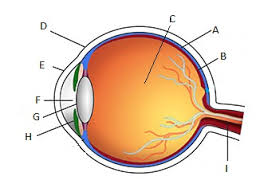
Question 20
What is H?