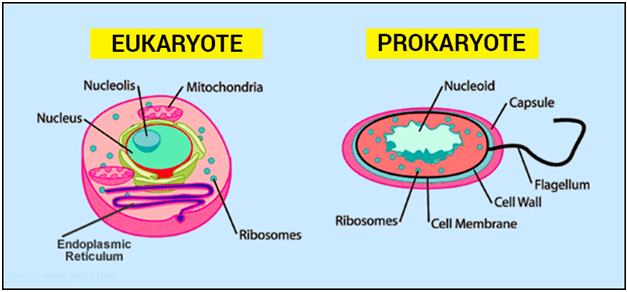
Which statement best compares a eukaryote and a prokaryote?
A.Eukaryotes have a cell wall, while prokaryotes have a cell membrane.
B.Eukaryotes have membrane-bound organelles, while prokaryotes have fewer organelles.
C.Eukaryotes have circular DNA and prokaryotes have linear DNA.
D.Eukaryotes use flagella to move themselves through substances, while prokaryotes are not able to move
Microscopic examination of a plant cell reveals the presence of a chloroplast. Which structure(s) would NOT be present within this cell?
A.ribosomes
B.cell membrane
C.capsule
D.cytoplasm
There are some similarities between prokaryotic and eukaryotic cells. Which of the following structures is found in both prokaryotic and eukaryotic cells?
A.lysosome
B.mitochondrion
C.nucleus
D.ribosome
Which cell structure is correctly paired with its primary function?
A.ribosome - protein translation and transport
B.capsule - allows things to enter/leave the cell
C.flagellum - helps the cell stick to other surfaces
D.nucleoid - structure and support
According to cell theory, which of the following best describes the role of cells in living organisms?
A.Cells join together to form multicellular organisms.
B.Cells are the basic building blocks of living organisms.
C.Cells make up the soft portions of tissues in living organisms.
D.Cells are more complex in eukaryotic organisms.
When scientists set out to test a hypothesis, it is often most practical to try to prove the hypothesis false rather than to prove it is true in all cases. Scientists place great confidence in cell theory, yet it has not been tested in every living thing on the planet.
What piece of evidence would cause scientists to decide that cell theory would need to be revised?
A.An organism was found with tissues made of something other than cells.
B.A cell was found that could continue to divide and reproduce indefinitely.
C.An animal cell was found that could harness solar energy as plant cells do.
D.Cells in an animal and bacteria cell were found to be similar.
According to modern cell theory, how do new cells develop?
A.Cells come from preexisting cells through mitosis and meiosis.
B.The original cell dies and leaves a new one in its place.
C.Cells form by free-cell formation, similar to how crystals are formed.
D.A membrane forms around DNA that is released from a parent cell, and the DNA contains the information needed to produce organelles.
Which of the following statements best describes the nucleus of a cell?
A.The nucleus is free-floating DNA inside of the cell.
B.The nucleus is the power-house of the cell.
C.The nucleus is responsible for supplying the cell with chemical energy in the form of ATP.
D.The nucleus contains the genetic information surrounded by a nuclear membrane.
In the mid-nineteenth century, the discoveries of many scientists were combined to develop the modern cell theory. Which of the following statements is NOT part of the cell theory?
A.All living things are made of one or many cells.
B.Cells are produced from existing cells.
C.All cells have the same organelles.
D.Cells are the basic units of structure in living things.
In the past, some scientists accepted the theory of spontaneous generation. This theory states that organisms can arise from nonliving matter. Now scientists generally accept cell theory to explain the origin and growth of new organisms. Which of these statements is a key idea of cell theory that disproves the theory of spontaneous generation?
A.The cell is the basic unit of life.
B.All living things are made of matter.
C.All cells arise from pre-existing cells by mitosis or meiosis.
D.All cells are formed from the combination of two other cells.
All of the following are non-living except...
A.Viruses
B.Trees
C.Paper
D.Sun
A cat falls the back of a chair when a dark barks at it. What is the stimulus?
A.The cat falling off the chair.
B.The dog barking at the cat.
C.The cat falling as the dog barks.
D.The cat loosing it's footing.
Which is not a characteristic of living things?
A.Are made up of one or more cells.
B.Grow and mature over time.
C.Adapt to changes in the environment.
D.Cells have the same chemical composition.
The characteristics of life include maintaining homeostasis. Which of the following is an example of a living organism maintaining homeostasis?
A.A person sweats on a hot sunny day.
B.A dog barks at a cat across the road.
C.A teacher writes detention for misbehavior.
D.A student falls asleep during class.
Name the organelle: The outside barrier to a prokaryotic cell.
A.cell wall
B.cell membrane
C.capsule
D.pili
Name the organelle: a tail-like structure that helps a cell move.
A.flagellum
B.pili
C.nucleoid
D.plasmids
Which of the following are not found in ALL cells?
A.cell membrane
B.cytoplasm
C.ribosomes
D.nucleus
________ are hair-like structures that allow a bacterial cell to attach to other surfaces.
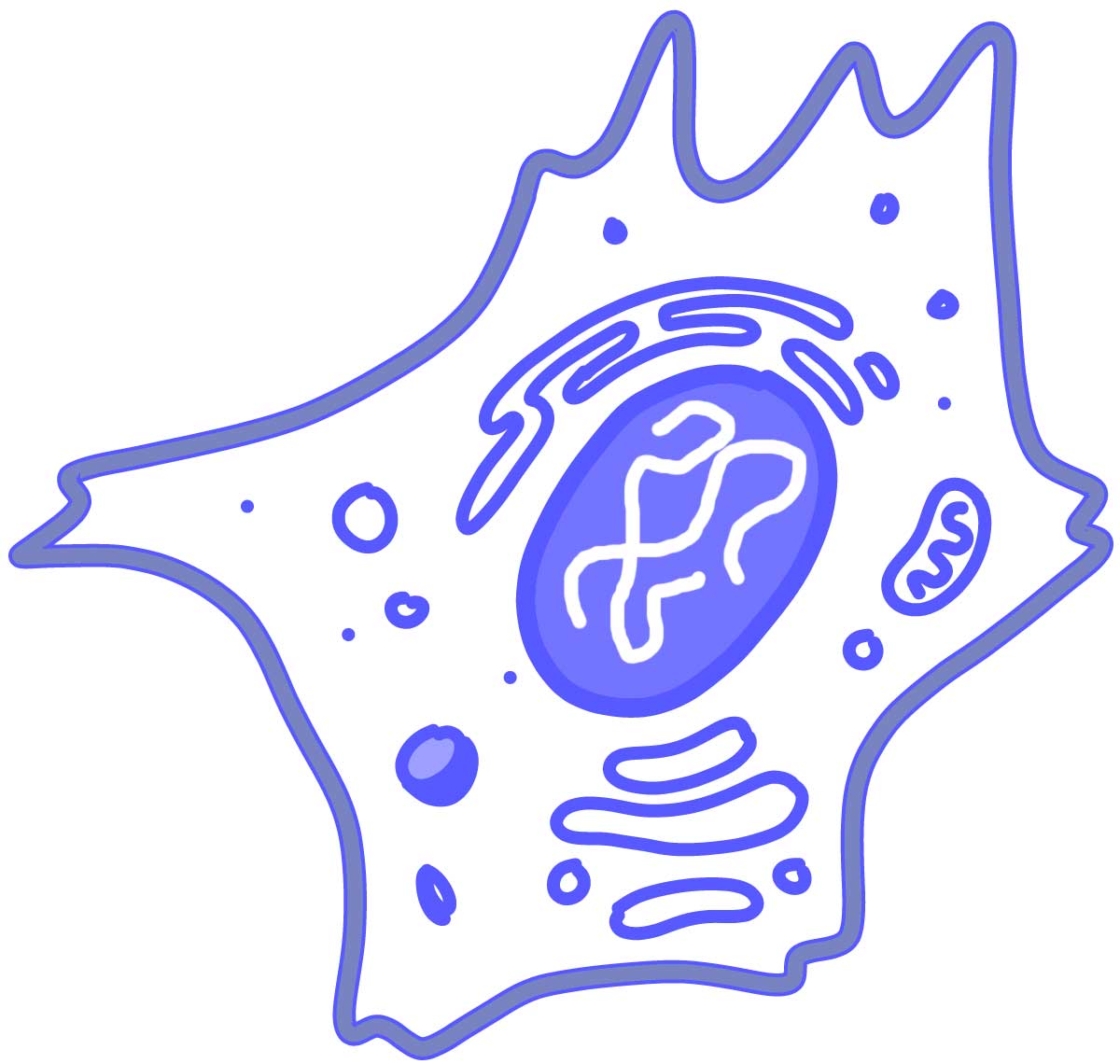
Which TYPE OF CELL does not have membrane-bound organelles?
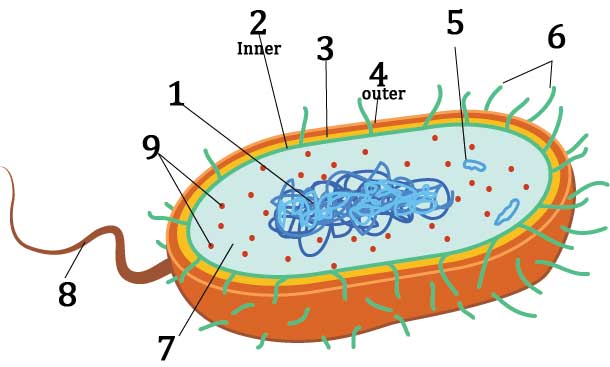
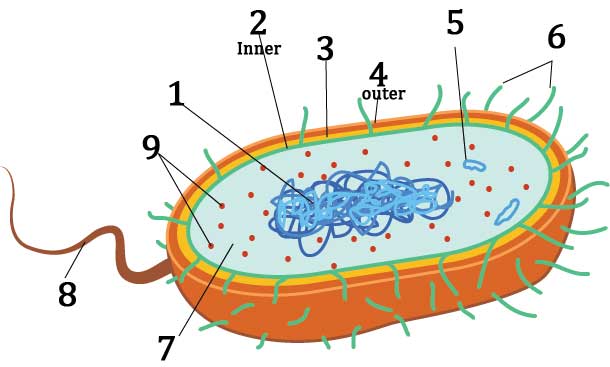
What type of cell is pictured below?
A.Bacteria
B.Prokaryotic
C.Eukaryotic
D.Virus
Tissues are composed of _________.
The largest overall organ of the human body is _______.
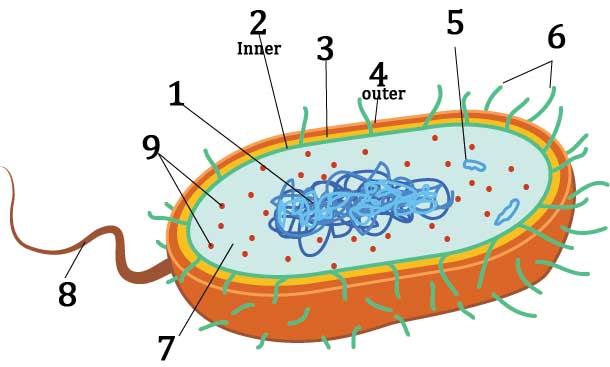
Identify the number that matches the following cell part: plasmid
Identify the number that matches the following cell part: cell membrane
Identify the number that matches the following cell part: flagellum
The smallest building blocks of living organisms.
A.Cells
B.Organs
C.Macromolecules
D.Atoms
Which of the following are NOT properly paired?
A.Ribosome - Organelle
B.Sucrose - Macromolecule
C.Eukaryotic - Cell
D.Bone - Organ
What is a difference between plant and bacteria?
A.Bacteria have cell walls.
B.Bacteria have a plasma membrane.
C.Bacteria are made up of cells.
D.Bacteria have circular DNA.
Which of the following is true about cells?
A.In general, eukaryotic cells do not have a true nucleus or membrane-bound organelles, whereas prokaryotic cells contain both a nucleus and organelles enclosed by membranes.
B.Both eukaryotic cells and prokaryotic cells always contain both a true nucleus that is well-defined and organelles that are separated from the cytoplasm by membranes.
C.In general, prokaryotic cells do not have a true nucleus or membrane-bound organelles, whereas eukaryotic cells contain both a nucleus and organelles enclosed by membranes.
D.Neither prokaryotic cells nor eukaryotic cells ever contain both a true nucleus that is well-defined and organelles that are separated from the cytoplasm by membranes.
These diagrams demonstrate how cells can be differentiated by their
A.cell structures.
B.means of replication.
C.modes of moving.
D.shapes.
Within eukaryotic cells, there is an intricate network of _______ with unique functions.
A.organelles
B.macromolecules
C.molecules
D.tissues
Cells contain specialized parts, known as organelles, to perform specific tasks, such as waste disposal, protein building, and movement. Even though these basic cellular functions occur in all cells...
A.all cells do not perform the same exact functions in unicellular organisms
B.all cells do not perform the same exact functions in multicellular organisms.
C.the cellular components are not at all related to the overall function of the cell
D.the cells in unicellular organisms and all the cells in multicellular organisms must perform the same functions.
All living organisms use energy. They also grow and reproduce. What is another characteristic of all living organisms?
A.All living organisms consist of many cells with specialized organelles.
B.All living organisms can produce glucose through photosynthesis.
C.All living organisms are composed of one or more cells.
D.All living organisms must consume food in order to acquire nutrition.
What is a difference between eukaryotic and prokaryotic cells?
A.Prokaryotic cells contain a plasma membrane.
B.Prokaryotic cells contain DNA that includes instructions for the cell.
C.Prokaryotic cells contain the necessary parts for life and do not depend on other cells.
D.Prokaryotic cells have ribosomes that read genes to make proteins.
Which type of cell lacks a cell wall?
A.Bacteria
B.Animal
C.Plant