Cells
[Deleted Account]
•about 7 years agoQuestion 1
Specialized proteins control cell division in the amoeba. Which cell part is responsible for making these proteins?
Question 2
Which serves as the outer boundary of a cell?
Question 3
Which is present only in plant cells?
Question 4
A protein called p53 can keep cells from dividing. To prevent cell division, this protein most likely stops
Question 5
Which cell structure releases energy for use in cell processes?
Question 6
A cell has many hair-like structures that it uses for movement. What are these structures called?
Question 7
Reproductive cells are produced during
Question 8
Which parts of the single-celled algae are responsible for capturing energy?
Question 9
A scientist removed the cell membranes from bacteria cells in a culture. She analyzed the cell membranes for specific molecules. Which of these was probably the most common type of molecule present in the bacteria cell membranes?
Question 10
A student observes a unicellular organism under a microscope. After a while, the organism begins to split into two cells.Which of these best describes the process shown in the diagram?
Question 11
Horses have 64 chromosomes in each body cell. If a horse cell undergoes meiosis, how many chromosomes should be in each gamete?
Question 12
Which cell structure contains molecules that direct cell activities?
Question 13
Some cells have many short, hairlike structures on their surfaces. These structures are used mainly for
Question 14
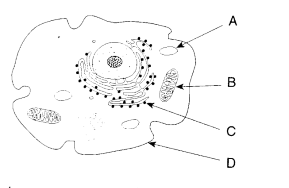
Which organelle in the diagram represents the organelle most closely related with excretion?
Question 15
Many bacteria live in fresh water. Which of these statements best describes what will happen when freshwater bacterial cells are placed in salt water?
Question 16
Animal cells contain an organelle that helps release energy. What is the organelle described?
Question 17
A cell is observed through a microscope. The cell is found to have a cell wall, a cell membrane, and numerous ribosomes. The cell does not have a nucleus. This cell is most likely from a
Question 18
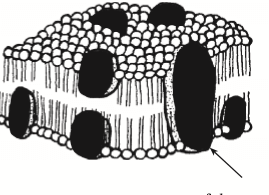
The diagram below represents the fluid-mosaic model of a cell membrane. The arrow points to a component of the membrane that is best described as a
Question 19
Which structure is primarily responsible for directing all processes of a plant cell?
Question 20
The following cell structures are located within cells that make proteins. Which description best explains the relationship among these cell structures in making a protein? • nucleus • ribosome • endoplasmic reticulum (ER)
Question 21
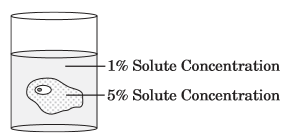
What will happen if an animal cell that has a solute concentration of 1% is placed in a 5% saltwater solution?
Question 22
Which of the following is found only in eukaryotic cells?
Question 23
A plant has been removed from its natural environment and placed into a body of water that contains more salt than the inside of each plant cell. This situation is most similar to which of the following events?
Question 24
While cleaning a saltwater aquarium, students placed the aquarium plants in a container of distilled water. What effect will this have on the plants?
Question 25
In the lungs, the movement of carbon dioxide out of cells and oxygen into cells can best be explained by which of the following processes?
Question 26
Which of the following statements concerning diffusion and active transport is correct?
Question 27
While cleaning a saltwater aquarium, students placed the aquarium plants in a container of distilled water. What effect will this have on the plants?
Question 28
What regulates the flow of water through a cell membrane?
Question 29
What would happen to a marine protozoan if removed from its normal habitat and placed into a freshwater pool?
Question 30
What is the function of a cell’s selectively permeable membrane?
Question 31
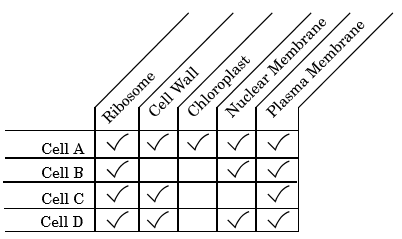
Which of the cells characterized in the chart below is a prokaryotic cell?